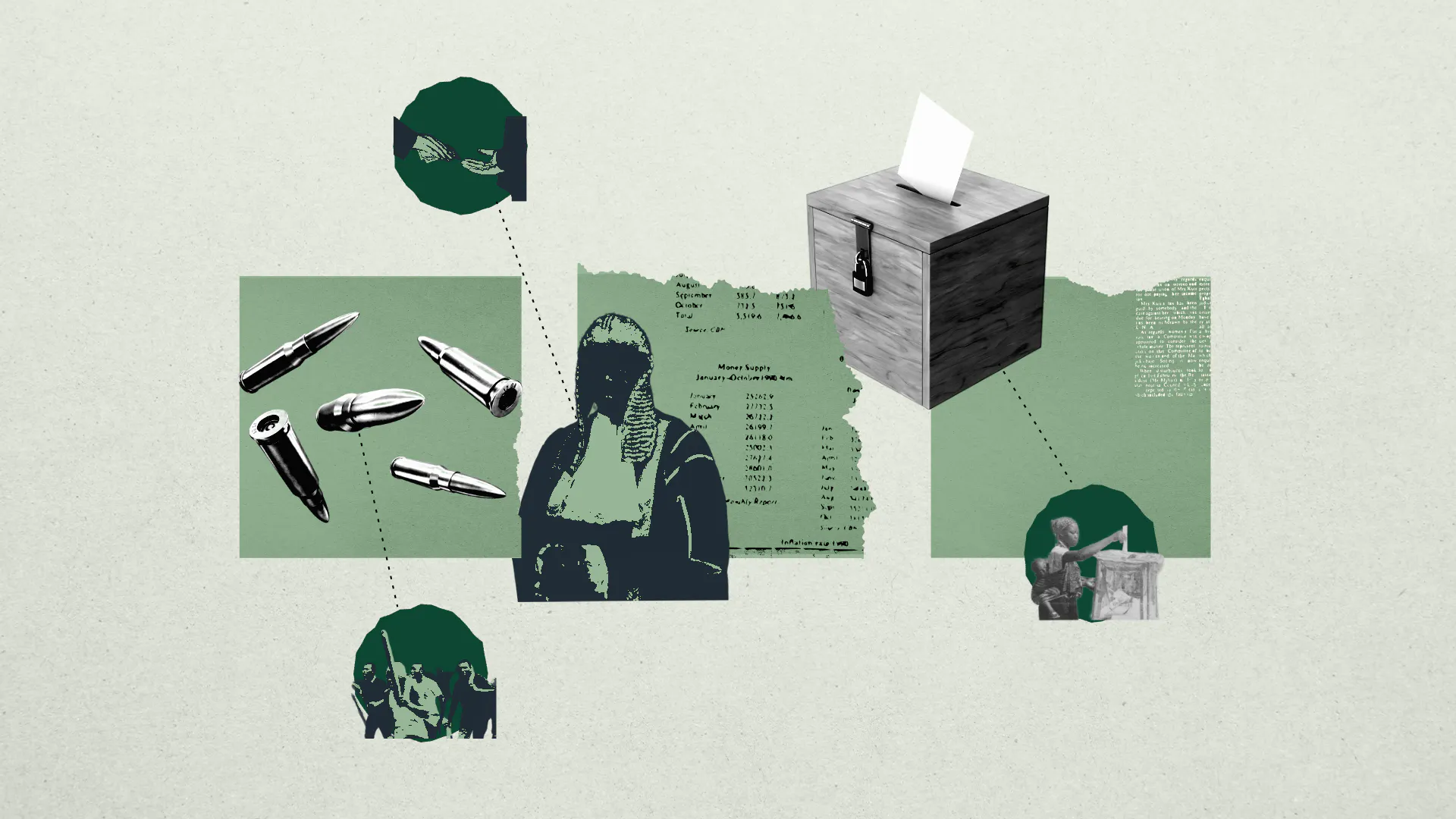
Bullets, Bribes and Ballots: Nigeria's Election Petition Paradox
Nigerian elections have an accountability problem.
The National Bureau of Statistics reports that 22 per cent of Nigerians were offered money in exchange for their votes during the 2023 presidential elections. As for the gubernatorial elections, domestic observers from Yiaga Africa recorded voter intimidation, harassment or assault in eight to 10 per cent of polling units in hotly contested states such as Delta, Kano and Adamawa.
In Oshodi/Isolo, Lagos, observers documented armed thugs firing sporadically to disrupt voting. In Ahoada West, Rivers, an observer was trapped in a collation centre with the electoral officer while thugs shot at the building. In Ethiope West, Delta, observers reported political thugs attacking polling units and brutalising INEC officials with cutlasses. This malpractice did not go unchallenged.
Against 1,491 elective offices contested nationwide, the Policy and Legal Advocacy Centre (PLAC) documents that 1,209 election petitions were filed.
What did all this litigation achieve? In terms of court-ordered results, almost nothing. PLAC reports that 88.9 per cent of petitions failed at the tribunal level.
Criminal consequences are harder to track, because INEC keeps no public record of them. The most recent prosecution data from the commission covers the 2015 cycle: in 2018, INEC's former chairman Professor Mahmood Yakubu testified to the Senate that of 1,080 electoral offences recorded, only 60 convictions were secured. In response to records requests, INEC produced a document tracking only 90 cases.
For 2023, one permanent INEC official was charged — Hudu Yunusa-Ari, the Adamawa Resident Electoral Commissioner who announced a winner before collation had finished. Three years later, he is still not in jail. His initial prosecution was halted by a court order obtained by Aishatu Dahiru, popularly known as Binani, the APC gubernatorial candidate he unlawfully declared victorious. Binani’s argument was that, until the tribunal ruled on her petition, his declaration remained valid under section 149 of the Electoral Act, so there was no crime to prosecute yet.
The order lapsed within days, and her suit was struck out in October. But Yunusa-Ari never appeared in criminal court. So, a warrant was finally issued for his arrest in May 2024, ten months after his trial was due to begin. Police officers told the court that he had gone into hiding; a lawyer said he had fled to Niger Republic.
That is Nigeria's petition paradox: there is widespread malpractice, massive legal mobilisation to challenge it, but few consequences.
What we did
Bullets, Bribes & Ballots, an Archivi.ng Fellowship project, is an attempt to understand that paradox: why malpractice is so frequently challenged and so rarely punished.
To investigate, I assembled a dataset of more than 3,300 judgments from the Election Petition Tribunals, the specialised courts that review election challenges every cycle. These judgments were sorted and digitised into an archive. Then, along with a team of Abuja-based legal research assistants, we read and coded 259 decisions at the governorship level.
Governorships are arguably the most interesting layer of Nigerian election litigation. As executive officials, they wield extraordinary individual power, more than any individual legislator. While the presidential contest may carry higher stakes, courts play less of a role. Every presidential election other than 2015 has been challenged in court, but none has ever produced a nullification, a rerun, or a replacement.
The governorship level is where the courts exert the most influence. They have nullified elections and ordered reruns in Bayelsa and Kogi; replaced declared winners with their challengers in Anambra, Edo, Ondo, Osun and Ekiti; and elevated a fourth-place finisher, Hope Uzodinma, to the Government House in Imo.
The most drastic interventions did not come through election petitions at all. Pre-election suits have imposed a candidate who never appeared on the ballot—Rotimi Amaechi—on the grounds that he had validly won the PDP’s primary and was entitled to the party’s general election votes. They also disqualified Bayelsa's governor-elect the day before his inauguration, not because of his own deficiency but because of the forged educational certificates of his running mate.
These are the exceptions. Across the 259 governorship decisions we coded, 96 per cent were dismissed, one per cent withdrawn, and only three per cent granted. In 2023, the pattern was starker. Every contested governorship result in the country ended exactly where INEC had declared it. At different stages, courts overturned the declared results in Kano, Plateau, Nasarawa, and Zamfara. But by the final court verdict, all four had returned to INEC's original declaration.
Why petitions fail
Nigerians often say that the courts are the last hope of the common man. It is not difficult to understand why. Litigation is an extraordinary engine for factual discovery. By compelling disclosure and letting lawyers test claims in open court, a trial can produce a credible account of what happened, determine who is responsible, and enforce consequences.
In the electoral domain, even a petition that is ultimately dismissed could enhance electoral integrity by exposing failures by the electoral commission, putting powerful politicians in the hot seat, and showing reformers where processes are broken. These benefits depend on the court being a forum that investigates. Nigeria's tribunals are not.
Under section 285 of the Constitution, an election challenger has just 21 days to file a petition and must front-load all the evidence they intend to rely on alongside it. To “frontload” evidence in law is to file all the documents that a challenger expects to use at the trial upfront. In just three weeks, challengers are expected to investigate irregularities and assemble proof to the standard a court will accept. Where the case rests on records, this can mean tendering thousands of exhibits, such as the 3,624 filed by the petitioners in Adamawa.
Where corrupt practices are involved, it can create Kafkaesque results. To challenge the elections in Lagos or Delta, the petitioner would have to identify and name the thugs who fired the guns as well as prove that they did so at the behest of the declared winner.
Where non-compliance is the problem, the requirement is maintained even though INEC, a respondent in all petition cases, holds all the critical evidence. The burden is the petitioner's throughout, while INEC's declared results are treated with the presumption of regularity.
Election litigation is not working as it should
First, cases are increasingly determined by technicalities rather than merits. INEC acts as a respondent in all petition cases and litigates with a technical strategy. Of 177 governorship decisions analysed in further depth, INEC raised threshold objections — on standing, time limits, or failure to follow procedural rules — in 70 per cent of cases. When they raised technicalities, they succeeded 59 per cent of the time, and ultimately 41 per cent of all petitions died on grounds unrelated to the merits.
Adamawa, the same election that produced Yunusa-Ari's failed prosecution, shows what this looks like. In challenging the election, Binani’s legal team applied for a pre-hearing notice on June 15, 2023, four days before pleadings closed. The tribunal held that the application was premature and therefore "a worthless piece of paper," deemed the petition abandoned, and struck it out. It then analysed the evidence anyway, in case it had been wrong to strike the petition out. The merits were reached only as a contingency.
Second, INEC's dual role as custodian of the evidence and committed litigant creates a conflict of interest with no remedy. In that same Adamawa petition, the voters' registers the case turned on were never produced; INEC's letter of July 7, 2023 stated that they could not be traced. The tribunal accepted the explanation and held against the petitioners regardless. Non-disclosure cost the commission nothing, because the consequence is borne by the person trying to prove that the election was flawed.
Third, the Evidence Act badly needs updating. Evidence law should prize credibility and corroboration, not erect unnecessary barriers to pertinent facts. Instead, the courts have adopted several doctrines that are difficult to tie to these twin goals. Consider one example: the subpoena trap.
Courts are increasingly ruling that hostile witnesses compelled by subpoena must have a witness statement on oath filed with the petition. In other words, before the petitioner has any legal power to compel the witness to participate, they must somehow develop a detailed preview of what the witness intends to say.
In a 2023 Rivers petition, brought by Chief Dumo Lulu Briggs, this very rule resulted in the courts throwing out video of a collation centre allegedly overrun by thugs and captured by a Channels Television journalist.
As another example, consider how the courts have treated the BVAS machines, the devices that accredit voters with their biometrics. Courts have repeatedly required petitioners to produce the physical BVAS machines in overvoting cases, when all the petitioner seeks to show is that the accreditation figures are inconsistent with the declared results. It is like a court in a contract dispute insisting you cannot win without producing the laptop the contract was drafted on. The machine is a receptacle that stores the contract, but it has little to add in understanding its terms.
What we produced
The website
We have captured our findings on a website: nigerianelectionpetitions.org.
This is an attempt to provide a comprehensive overview of Nigeria's electoral litigation, reconstructed from the record.
Most useful for anyone tracking the 2027 cycle will be the case tracker and the Electoral Act tracker. The first summarises and analyses key judgments from the previous cycle and makes the full decisions available for download.
It will be updated throughout the 2027 cycle as certified true copies become available, including for pre-election litigation. The second follows changes to the Electoral Act over time and sets out the major departures introduced by the 2026 Act.
The site also carries an interactive dashboard showing petition volume, outcomes, the grounds asserted and the length of judgments, and a Judicial Register with broad demographic information on the judges who have served on election tribunals, including gender where determinable and state of service.
The video explainers
Three short video explainers take up live issues that will shape the next election.
Party primaries and the consensus loophole examines the 2026 Electoral Act's changes to how parties choose their candidates. Abolishing indirect, delegate-based primaries was meant to reduce vote buying and insider control. It has relocated the same problem into a new venue: the consensus route.
Qualification and section 138 argues that the same Act has created a dangerous gap in accountability, removing candidate qualification as a ground for post-election litigation and penalising anyone who raises it anyway.
IReV, the "glitch," and why technology keeps losing in court explains why the courts continue to struggle to absorb evidence from new technologies. It covers the IReV failure of 2023 and the 2026 Act's attempt to fix it, closing one loophole while opening another.
Each video essay shows the same thing from a different angle. Reforms that preserve the powerbrokers do not change the system.
Closing
The 2027 elections are rapidly approaching. The results will be declared, and then disputed. In the end, it will fall to the courts.
I conducted this research because I believe that democracy, at its best, is a commitment to radical political equality. Whatever our differences in wealth, background, or status, the democratic ideal is that we stand on equal footing at the polls: free to express our values, to shape our conditions, and to experience the dignity of holding powerful people to account. This last task is what election litigation should deliver. When malpractice goes unanswered, it does not.
None of this means abandoning the courts. It means being clear about what they are for. It will always be better to prevent malpractice before an election than to punish it afterwards, and that is an administrative task, not a judicial one.
But the courts could simplify their doctrines to produce fewer technical deaths. They could interpret the rules of evidence to determine what actually happened. And they could hold INEC to account, so that the commission cannot benefit from its own failures.
This project is offered as a guide to the litigation ahead, and as an argument that it could go differently.
Onwards.