The Green Eagles Who Won Nigeria's First AFCON in 1980
The noise came first, then the disbelief. People climbed poles, waved flags, handkerchiefs, and their shirts wildly above their heads. In minutes, a sea of bodies filled the streets of Lagos and other cities across Nigeria, screaming until their voices cracked. It was March 22, 1980.
The Green Eagles had just won the African Cup of Nations (AFCON) for the first time, in front of more than eighty-five thousand people at the National Stadium in the capital city.
The host country opened the tournament with a 3-1 win over Tanzania. The Punch newspaper described the performance as a "shaky start," but the result calmed early nerves. A goalless draw with the Ivory Coast in the next game stirred panic in the local press as the team prepared to face an Egyptian side already top of the table with two wins.
But Okey Isima's goal in that final group game sent the Eagles to the top of the table, setting up a daunting semi-final against a Moroccan team that beat Nigeria twice at the 1976 AFCON.
Wahab Adigun attended every Eagles match while juggling his tight 9 am to 4 pm schedule as a Union Bank staff. He'd abandon his desk before the official closing time and dash across the city to secure his seat at the National Stadium.
"It was the first time we were going to host that sort of competition in Nigeria, so the enthusiasm was very high," he recalls.
The Eagles struck early against Morocco. Felix Owolabi scored just eight minutes into the game, and the team held on through a tense ninety minutes to secure a historic place in the final.
Forty-five years later, Adigun doesn't remember everything that happened at AFCON 1980, but he can never forget the team that made magic happen.
Goalkeepers
The Green Eagles squad was primarily composed of players from domestic clubs, and they trained together regularly. Under Otto Glória, the Brazilian coach who led Portugal to a third-place finish at the 1966 World Cup, Nigeria had assembled a team that stirred the hopes of millions of citizens.
Before the tournament, he had implemented what Segun Odegbami, the team's star forward, would describe forty-five years later as "a grand plan" that included a three-month camping period in Brazil. "It changed the philosophy and style of Nigerian football, providing new skills and engendering confidence that boosted the team's morale and chances," Odegbami explains.
Defenders
The crush of fans at the stadium rendered it unsafe for children, so Kayode Oyesile watched the tournament on a black-and-white television at home. The secondary school student was 14, part of a generation that revered the national team.
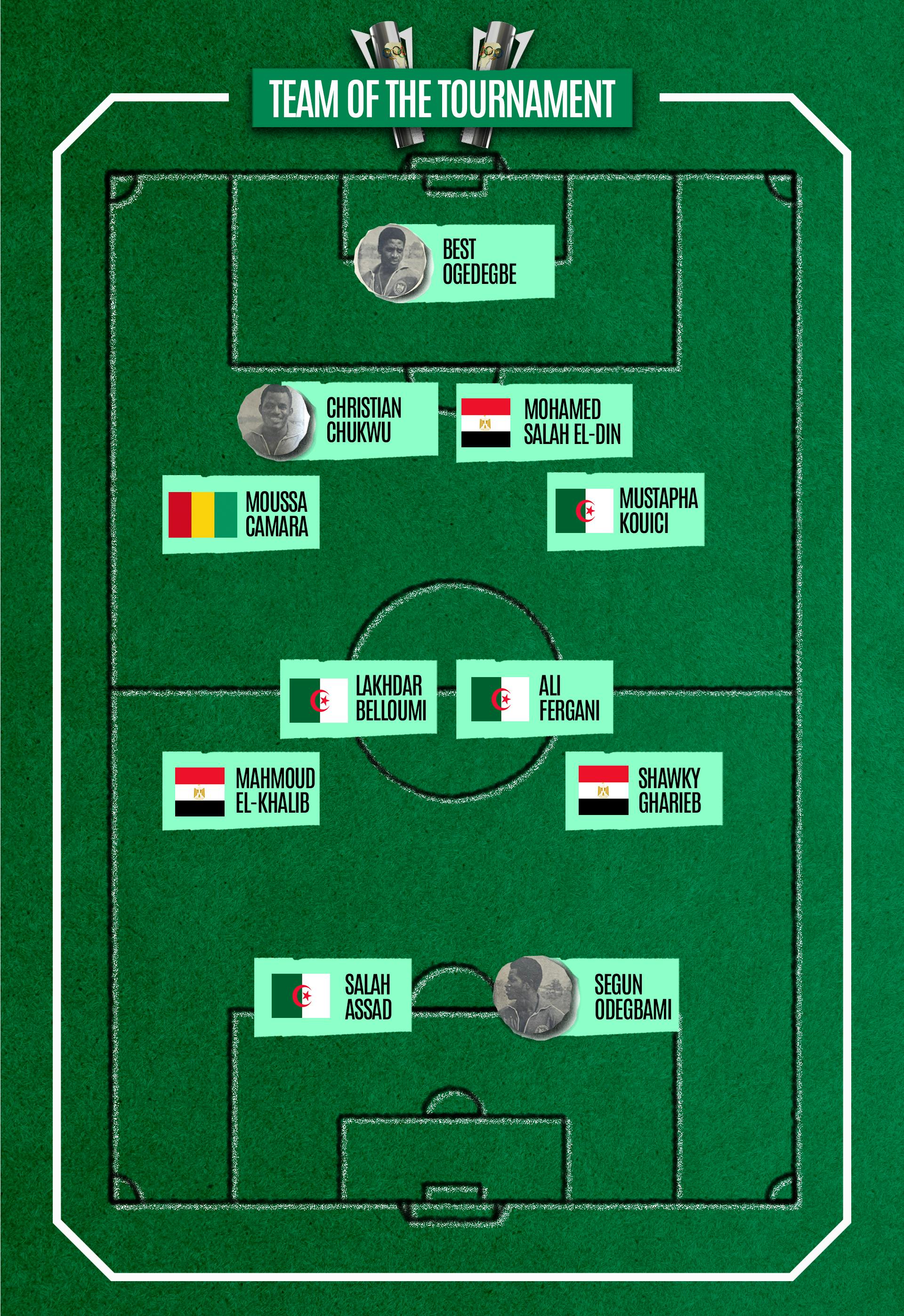
"We had people we were so concerned about, like our goalkeeper, Best Ogedegbe, and players like Christian Chukwu, Muda Lawal, Tunde Bamidele, and Tunji Banjo."
On the day of the final, a Saturday, Adigun arrived at the stadium two hours early in a special ₦20 shirt that made him feel on top of the world. But he wasn't early enough. Tickets were sold out, and the gates had closed. When he couldn't convince anyone to let him through, the banker made a decision that captures his desperation and determination to cheer for his country.
"I had to climb through the ticket gate because so many people didn't have tickets, but we made sure we got into the stadium," he reflects. His shirt tore in the scramble, but he made it in. The roar of the 85,000-capacity stadium washed over him.
Midfielders
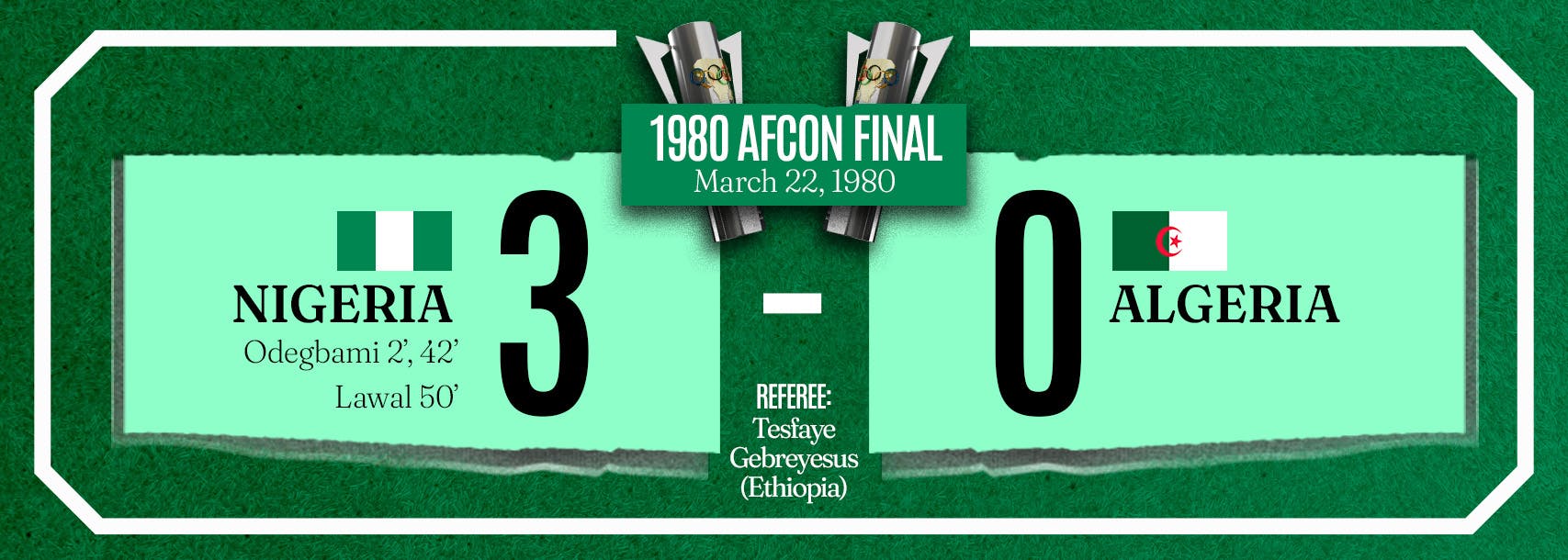
Despite his expectations, what happened in the final was beyond Adigun's wildest dreams. Nigeria dismantled Algeria 3-0. Odegbami, who everyone called Mathematical for the geometric precision of his dribbling, scored twice.
The first goal, scored within two minutes, came from what seemed like nothing, a routine throw-in when both teams had barely settled into the match. "It was like Manna from heaven. That goal changed the entire match. It came early and totally unexpectedly," Odegbami recalls. Before halftime, he had scored again, sealing his name in Nigerian history forever.
The memory still gives Adigun goosebumps. He remembers thinking, in that moment, that his torn shirt was the smallest price to pay for witnessing history unfold.
When Muda Lawal added the third goal early in the second half, the game was over. "It was just like I won a jackpot," Oyesile remarks, a feeling shared across a country that, for a moment, set aside its lingering divisions from the civil war that ended a decade earlier.
In neighbourhoods across Nigeria, people brought out food and drinks. They set up speakers. Some brought out traditional instruments. They danced in the streets to celebrate what they had just witnessed.
"Winning the championship was a new experience for Nigerians," Odegbami recollects. "The joy was indescribable, and the feat was a dream come true for us all. The experience can never be forgotten."
Forwards
Shola Durowade watched the final game from an electronics repair shop where people gathered when they couldn't afford television sets of their own. "You see Segun Odegbami, Muda Lawal, Henry Nwosu, those guys, I can't compare them to any present footballer now. They were just so committed," he notes.
Glória built a winning team with players from Nigerian clubs, but that homegrown model gradually unravelled as the market for footballers expanded and international leagues began to offer opportunities to talented players.
"The world has become a different place since our time. We were semi-professionals and all home-based. We stayed together for longer periods in various camps and played against each other regularly in the domestic league," Odegbami points out.
As more players moved abroad and achieved success internationally, the local leagues suffered. Stadiums that had once been consistently packed began to see declining attendance. The investment in club football, in training facilities, in player development, in the ecosystem that produced players like Odegbami and Lawal, began to wane.
The 1980 victory had depended not just on the talent of individual players, but on the system that had produced them, on the relationship between domestic football and national representation, on a shared understanding that national duty came before individual glory. That system disintegrated.
As more than eighty-five thousand people filed out of the National Stadium on that March evening in 1980, what no one could have predicted was how long the country would wait to feel that way again. In the 45 years since that first history-making victory, Nigeria has won the AFCON title only two more times, in 1994 and 2013.
The 1980 victory was a moment when a nation's football reflected its best self—organised, committed, and home-grown. What followed was a slow erosion of that model, replaced by something more fragmented, more individual, more dependent on a shifting external core.
Yet that victorious moment remains. Etched in the memories of Wahab Adigun tearing his expensive shirt while climbing into the stadium, of Kayode Oyesile watching on a black-and-white television as a teenager, of Shola Durowade pressed against others inside a repair shop, the 1980 African Cup of Nations victory stands as a measure of what Nigerian football could be.
"The championship itself was lifted by the unprecedented support of fans throughout all the matches. Without the fans, we would not have made it. They made us play beyond our capacity," Odegbami admits.
As the Super Eagles of Nigeria start their 2025 AFCON campaign, will a new generation of players make new memories of victory for a new generation of fans?
Credits
Editor: Samson Toromade
Art Illustrator/Director: Owolawi Kehinde
Researcher: Olalekan Ojumu