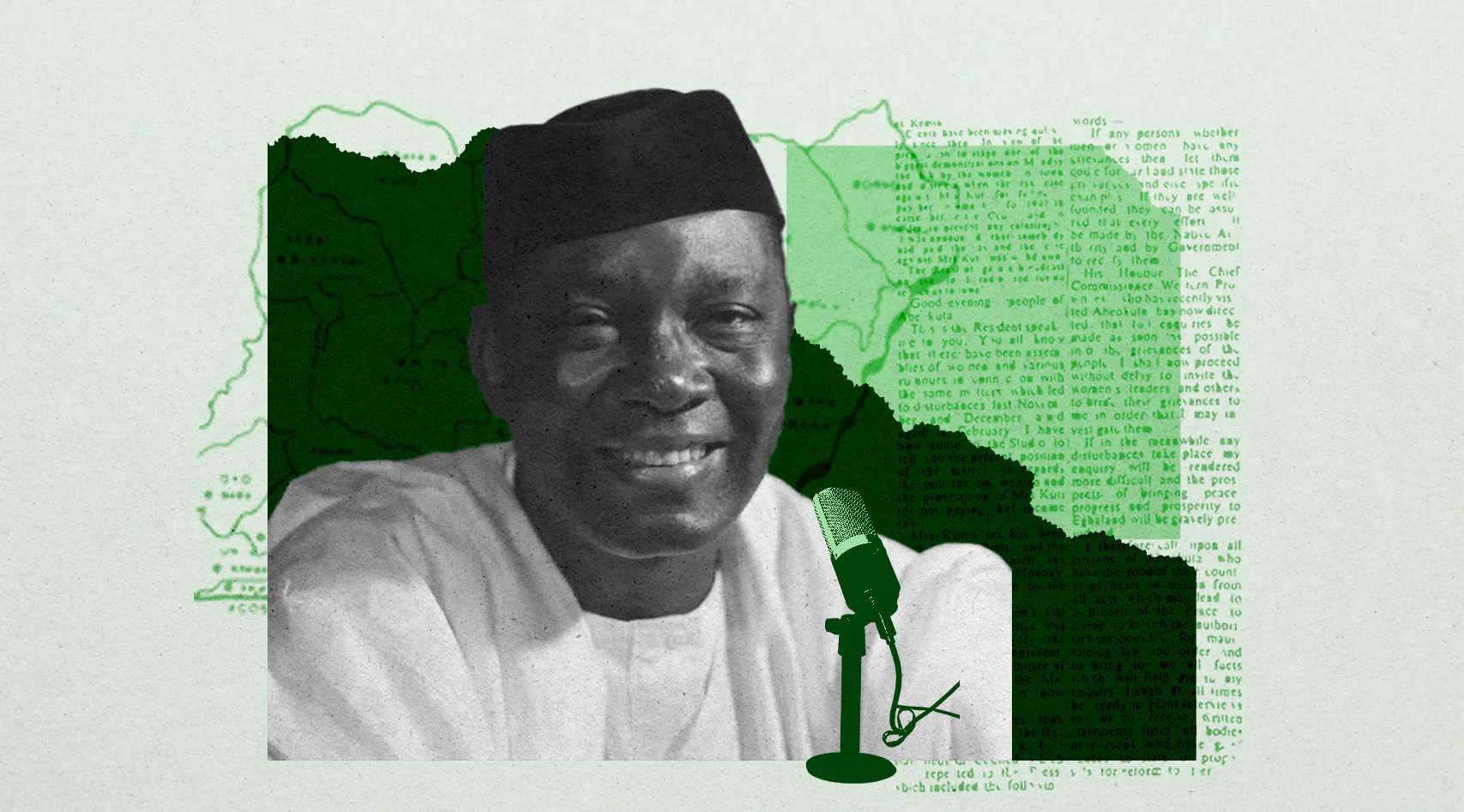
October 1, 1962 Independence Day Speech by Nnamdi Azikiwe
It is a year today since I had the privilege of broadcasting to the nation on the occasion of the first independence anniversary of our federation.
Today, I implore all who listen to me to lend me their ears as I make a brief survey of the past year and renew our faith in liberal democracy.
Our first duty, as a God-fearing nation, is to recognise this occasion as one of dedication and thanksgiving to God, that we have succeeded in administering our affairs, as an independent State, without any major breakdown of law and order, either to endanger our corporate existence or to embarrass our relations with other countries.
In the circumstances, we have cause to be elated that during the past year, the course we charted was fairly smooth and calm, so that our young nation was able to grow in stature in the family of nations.
Barely four months ago, the relative calmness which had characterised our political activities was ruffled by billows of internal strife of a magnitude that called for alertness on the part of the Federal Government.
It would be an oversimplification for me to leave the impression that all is well in our domestic affairs: at the same time, it would be imprudent to exaggerate the current unrest.
Our troubles
The disorder prevailing in the internal affairs of our country is evidence of teething troubles expected in any new sovereign and independent nation such as ours. But they are also a challenge to test the ability of our Federal Government to restore possible breakdown of law and order expeditiously with the speed, firmness, thoroughness and fair play demanded for the stability of orderly government and the security of a state peopled by law-abiding Inhabitants.
May I make reference to specific instances to illustrate my point. In December, 1961, the African Conference on World Peace through the Rule of Law took place in the Federal Capital of Lagos. The conference deliberated on what is now known as the Law of Lagos. This stamped Nigeria as a country which is inflexibly committed to guaranteeing its citizens the enjoyment of fundamental rights under the rule of law.
Calm, cool
In January, 1962, the epoch-making Conference of Heads of African and Malagasy States was held also in Lagos, and resulted in the adoption, in principle, of a Charter of Inter-African and Malagasy Organisation.
In spite of uncharitable and uninformed criticism, at home and abroad, we were calm, cool and collected and history has vindicated our role as a good neighbour in encouraging closer unity and understanding among African states.
Apart from the fact that Nigeria was honoured as a venue for this international conference, the concentration in one country of sixteen heads of state and governments, together with their ministers and advisers is historic in the annals of international relations anywhere in the world.
This unique occasion also offered our people a rare privilege to see in person the Emperor of Ethiopia, whose country, apart from China, is the oldest independent state in the world, going back to 1,000 BC.
Links forged
The linking of Nigeria with the Republics of Dahomey and Togo by telephone is an important step towards social integration with our neighbours.
The signing of a Customs Convention with Dahomey brings economic integration between the two countries much nearer.
Whilst the recent tete-a-tete between our law officers and those of the Republic of Niger, at Niamey, is a positive move towards pan-African unity.
The abrogation of the Anglo-Nigerian Defence Pact, out of deference to Nigerian public opinion, stamped indelibly on the minds of our people the democratic nature and tendency of our Federal Government.
It also showed its determination to be well-informed of what the Nigerian public wants and to reflect and respect it through the usual democratic processes.
Truly proud
The annual conference of Commonwealth Prime Ministers, which has just ended in London, and the performance of our prime minister, in stating without equivocation our stand on the European Economic Community, has reflected credit on our government and lent stature to Nigeria as a non-aligned state.
Like our stand on the matter which led to the expulsion of South Africa from the Commonwealth, last year, when the issue of the dignity of man came to the fore, this has given meaning to our sovereignty and made every Nigerian truly proud of his country.
Coming nearer home, this past year has disclosed a panorama of successes by talented Nigerians in various walks of life, so far as Nigerianisation is concerned.
Whilst much remains to be done, we are bound to take cognisance of the great strides we are making to ensure that our public services are manned by competent Nigerians according to the highest standards of efficiency and probity.
Our success
The departure of Sir Gawain Bell, Governor of Northern Nigeria, and Lady Bell, in June 1962, was a landmark in our history. In Sir Gawain, Nigeria lost a faithful administrator and friend.
Whilst the country regrets the loss of his services, it was a blessing in disguise because his office was filled, for the first time in our national history, by an able son of Northern Nigeria, in the person of Sir Kashim Ibrahim, an experienced statesman and patriot of the first order.
Against this vivid picture of achievement which I have just painted, we must bring into focus the unfortunate circumstances which culminated in the declaration of a state of public emergency in Western Nigeria, last June, necessitating the appointment of an administrator to assume responsibility for the government of that region, on behalf of the Federal Government.
The situation has been further complicated by recent news of the discovery by the police of a fairly large quantity of arms and ammunition, illegally imported into this country by certain members of the community. Our security officers are still investigating this illegal traffic and some Nigerians have been apprehended in that connection.
However, there is no cause for alarm, since the due process of law will run its course if the liberty of the persons concerned should be in jeopardy.
Another chance
This picture will not be complete without mention of what I consider to be one of the most outstanding events during the second year of our independence.
It is the visit of the Prime Minister of the Republic of India, Shri Jawaharlal Nehru. The warm reception Mr Nehru received is indicative of the reservoir of goodwill the people of Nigeria have for him and our desire to strengthen friendly relations and mutual understanding between the peoples of Nigeria and India.
On this second anniversary of our national independence, we have another chance to pledge anew our inflexible faith in liberal democracy as the system of government best suited to our present situation.
Believe
We believe that it is the birthright of our people to elect their rulers.
We believe that our elected rulers should govern us in accordance with our written constitution.
We believe in a government that is based on the consent of the majority of the governed.
We believe that such consent can only be obtained effectively after a general discussion in a deliberative and legislative assembly in which an opposition, whether organised or not, has been given every opportunity to have its say, in accordance with the rule of parliamentary dialectics.
We believe that the existence of political parties is an essential ingredient of liberal democracy because it enables different opinions to be expressed on any public issue before the popular will is crystallised and collectively expressed.
We believe in individual freedom — in the freedom of thought, freedom of conscience, freedom of opinion, freedom of expression, freedom of association, freedom of movement and the exercise of the fundamental rights of man under the rule of law.
African model
These freedoms are enshrined in our constitution not only as a bulwark against tyranny but also as a bastion against licentiousness.
They characterise Nigeria as a model state in Africa and portray our country as an island of reason and tolerance in a sea of bigotry and intolerance.
As a democratic country, we have encouraged consultation, discussion and free exchange of ideas as a safety valve that should prevent disagreement of opinion from degenerating into active hostility.
As a government, we have a duty to guarantee that our people enjoy fundamental rights but, in doing so, we must ensure that they do not attempt to deprive others of the exercise of these rights or impede the efforts of others to enjoy them.
Love of Nigeria
As we enter our third year of independence, let all our patriots loudly profess their love for Nigeria and renew their faith in the democratic way of life, not as an end in itself, but as a means of serving our fellow man in the crusade against poverty, disease, hunger, ignorance, superstition, corruption and injustice in our beloved country.
In our contemporary history, our leaders have adopted constitutional means to bring about changes in our government structure.
This is a healthy and desirable method of demonstrating to the world our political maturity. To that extent, ours has been a democratic tradition.
Let us continue to cling to this exemplary legacy and make the task of those who govern less irksome for, as William Gladstone counselled, "The proper function of government is to make it easy for people to do good, and difficult for them to do evil."
Source: Morning Post