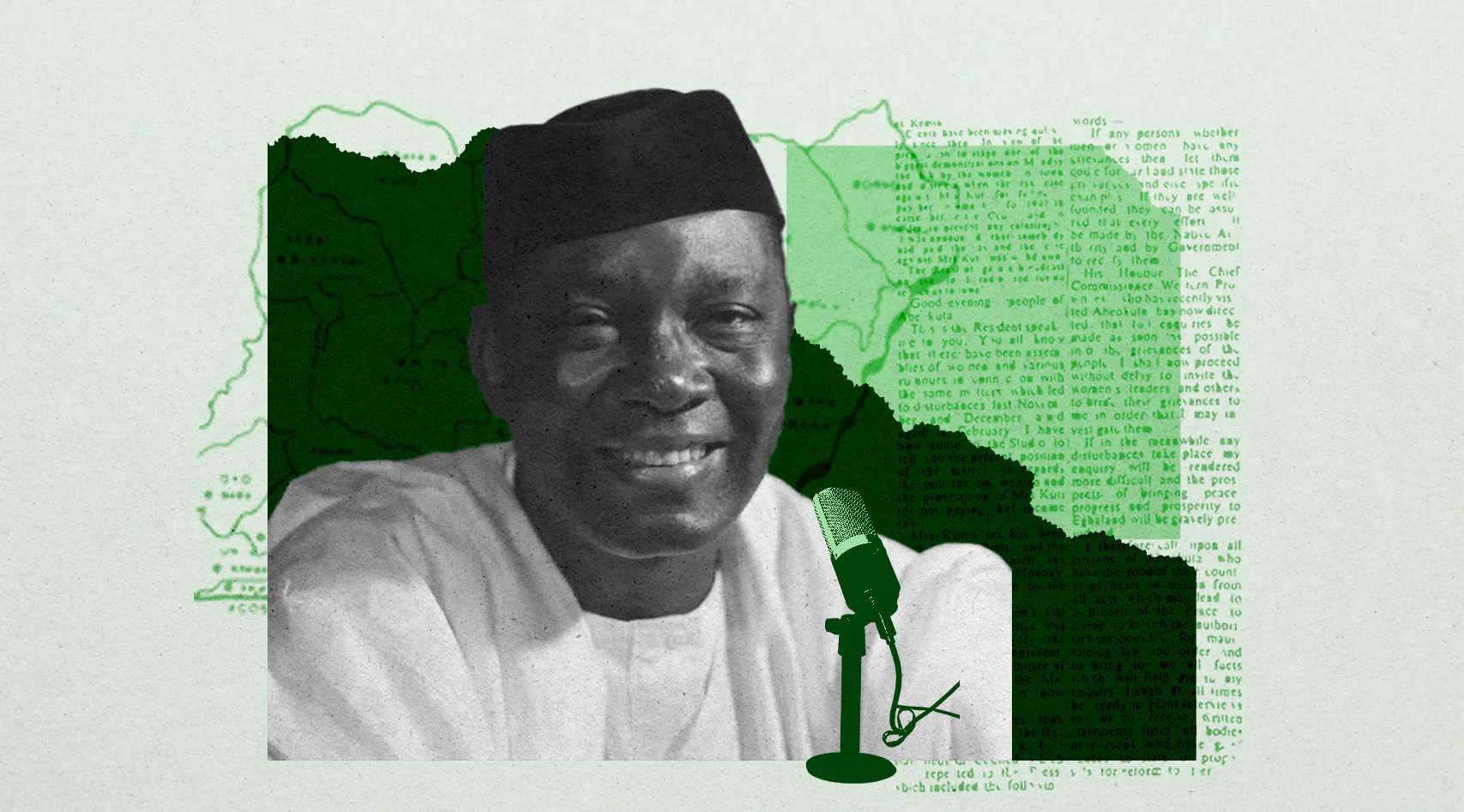
October 1, 1964 Independence Day Speech by Nnamdi Azikiwe
Fellow Nigerians, one year ago, we firmly resolved to establish the Federal Republic of Nigeria, with a view to ensuring the unity of our people and faith in our fatherland, so as to further the ends of liberty, equality and justice both in our country and in the world at large. Today, this preamble to our constitution poses a challenge to us as we stand at a fork in the crossroad of history, with one path leading to squabbling and a disunited group of tribes, and the other to a tolerant and united nation.
On that historic occasion, you honoured me, through your accredited representatives, to become Head of State, and I took the opportunity then to express my gratitude to a beloved nation, which crowned one of its sons with an aura of eminence and dignity.
We happily sang our national anthem and solemnly affirmed our patriotism by pledging ourselves to remain united in one brotherhood — “though tribe and tongue may differ.”
Now, instead of the harmonious voice of unity instilling in the minds of our people and their children just principles on the basis of what is right for our nation, there are discordant sounds of disunity polluting the fountain of human relations and profaning the tenets of our constitution by insisting on who is right and who is wrong. Throughout the vast expanse of our country, a new crop of evangelists has arisen, steeped in bigotry, sowing seeds of disunity, emphasising our differences, and pitting brother against brother. Someone defined a bigot as a person who, for the most part, clings to opinions adopted without investigation and defended without argument, while he is intolerant of the opinion of others.
In my humble view, I should not allow the celebration of our first anniversary as a republic to pass without reminding my compatriots of the basic principles upon which we agreed to live together as citizens of one nation. Irrespective of our religious persuasion, we have been taught that love and not hatred should influence our attitude to our fellow citizens.
In the Holy Bible, according to St. Paul's first letter to the Corinthians 13:2-13, it is written according to the new English translation, “I may speak in tongues of men or of angels, but if I am without love, I am a sounding gong or a clanging cymbal. I may have the gift of prophecy, and know every hidden truth; I may have faith strong enough to move mountains; but if I have no love, I am nothing. I may dole out all I possess, or even give my body to be burnt, but if I have no love, I am none the better.
“Love is patient; love is kind; love envies no one. Love is never boastful, nor conceited, nor rude; never selfish, not quick to take offence. Love keeps no score of wrongs, does not gloat over other men’s sins, but delights in the truth. There is nothing love cannot face; there is no limit to its faith, its hope, and its endurance.
“Love will never come to an end. Are there prophets? their work will be over. Are there tongues of ecstasy? they will cease. Is there knowledge? it will vanish away. For our knowledge and our prophecy alike are partial, and the partial vanishes when wholeness comes. When I was a child, my speech, my outlook, and my thoughts were all childish. When I grew up, I was finished with childish things. Now we see only puzzling reflections in a mirror; but then we shall see face to face. My knowledge now is partial; then it will be whole, like God’s knowledge of me. There are three things that last for ever: faith, hope, and love; and the greatest of them all is love.”
Islam is a religion which teaches brotherhood and an internationalism that knows no differences of colour or nationality or tribe or caste. The Holy Koran places great emphasis on man's kindness toward mankind and towards one's neighbours. In sura 4, verse 37, it is written: "Show kindness unto parents, and relations, and orphans, and the poor, and your neighbour who is of kin to you, and also your neighbour who is a stranger."
In paraphrasing the precepts of Islam regarding friendly living and cooperation among human beings, Sir Muhammad Zafrulla Khan, in his latest book entitled ISLAM: ITS MEANING FOR MODERN MAN, referred to the Holy Prophet's definition of Muslim to mean "one from whose hands, and tongue his fellows apprehend no harm."
Fellow Nigerians, if Christians are taught to love their fellow human beings, and Muslims are taught to show kindness to their fellow human beings, and we know that in our traditions we emphasise charitableness and hospitality to strangers, why should we, in this first year of our existence as a republic, take delight in beating the tom-tom of tribal hatred and fouling the air of God with vituperations against ourselves, all in the name of politics?
Some of our leaders have carried their propaganda of hate to such an extremity that private armies are said to be organised in order to liquidate political opponents, contrary to the sacred teachings of Christianity and contrary to the holy teachings of Islam.
In singing their hymns of hate, some of our leaders are advocating secession, and some have urged that the country should embrace revolutionary ideologies in order to contain the great issues confronting us today. Secession means the splitting of our beloved nation into smaller units, with each unit going it alone and pursuing its own way of life in accordance with its mores and ethos. Revolutionary ideologies are not necessarily bad, but some of them can lead to violence. Is that what we fought for? Is that the type of freedom we wish to bequeath to our posterity?
This day is appropriate to remind ourselves of our pledge to our own dear native land, that we shall live in brotherhood, no matter whether we speak different languages, or practise different cultures, or reside in different climes. Therefore, I urge on the leaders and people of Nigeria to take seriously the admonition of the great poet Longfellow: "All your strength is in your union, and all your danger is in your discord."
Our beloved nation is gripped with election fever. Prospective candidates are busy striving to win the sympathy of their parties so as to be nominated candidates. The parties themselves are sparing no effort to woo the electorate to support their chosen candidates.
All the actors in this great national drama are playing their roles with gusto: orators demonstrating their skill, organisers displaying their effectiveness, party officials drafting their manifestoes, and party leaders counting their chickens in the hope that they will soon be hatched.
This is very welcome. As a democratic country, we should be proud to watch these activities because they demonstrate to the world our political maturity. A quinquennial exercise of this sort is both an assurance that democracy shall continue to influence the course of our nation, and an insurance that autocracy shall find no haven in our country. In the words of Reinhold Niebuhr, "Man's capacity for justice makes democracy possible, but man's inclination to injustice makes democracy necessary."
It is, therefore, our self-appointed task, as worthy citizens of this republic, to ensure that the elections are so conducted as to reflect correctly the collective will. This can be done provided three assignments are faithfully discharged—by the political parties contesting the general elections, by the electorate who shall decide the party to be entrusted with the government of this republic for the next five years, and by the electoral authority which shall supervise the voting activities in the 312 constituencies of our nation.
The political parties should publish manifestoes containing their policies in respect of our domestic issues and foreign relations. They should explain how they intend to implement their policies, should their standard bearers be elected to form a majority in the House of Representatives.
They should appeal to the electorate to support them, either on the basis of their past performance or on their potential ability. Then they should conduct their electioneering campaigns in a lawful manner so as to justify the faith of the citizens in their capacity to rule justly.
The electorate, on the other hand, should concede to all political parties a right of audience, but reserve to themselves the privilege to determine which person or party to support. They should listen carefully to what the vote hunters have to say about their policies and achievements, in contrast to the opposing parties.
They should assess the validity of such claims in the light of their knowledge and experience. Then they should decide to vote according to conscience, realising that their vote is a sceptre of authority to enable the successful party to form the next Federal Government machinery.
The electoral authority should ensure a free and fair election. Our electoral law is comprehensive, but it is also comprehensible. It contains provisions showing what should be done by electoral officers, by candidates for election and their polling agents. It safeguards the integrity of the election by stipulating against illegal and corrupt practices, such as intimidation, impersonation, and other conceivable techniques that may be used in rigging elections.
The electoral authority and the Police must be on guard to check those who may seek to cause confusion by directly or indirectly violating our electoral law. No matter how important a person may be, if he is caught attempting to interfere with the electoral process, then he must be apprehended.
After five years of orderly government, we have proved conclusively that we are a law-abiding country, where the rule of law prevails and where the ballot, and not the bullet, determines who shall govern.
That being the case, the voters of Nigeria are entitled to a free and fair election in order to express their preference without fear or favour. According to Thomas Jefferson: "The will of the people is the only legitimate foundation of any government; and to protect its free expression should be our first object."
In the circumstances, I appeal to the leaders and members of the various political parties contesting the forthcoming elections to demonstrate their good sense and probity by ensuring a free and fair election. Their campaigns should be featured by a spirit of give and take and not necessarily by rancour, bitterness and violence.
Discipline
I appeal also to the electoral officials, who are charged with the enforcement of our electoral law, to perform their duty with stern discipline and strict impartiality. Let there be no interference with the electoral machinery, either by the interested parties or by the sympathisers. Let the voice of the nation be heard.
The supreme task confronting our republic today is to insulate our citizens from fear and from want. Freedom from fear and freedom from want are two basic freedoms which the citizenry anticipates from those who are privileged to rule. Fear, in this sense, implies insecurity to life or person or property. Since our government derives its power from a written constitution and functions under the rule of law, it is obvious that our people are guaranteed personal and civil liberties. That should be a sufficient safeguard to strengthen the belief that Nigerians can be trusted to resist lawfully any attempt to deny or deprive them of the fundamental freedoms enshrined in our constitution.
Want implies poverty of some sort. It might mean paltry wages or lack of balanced diet, lack of comfortable shelter, lack of sufficient clothing, lack of employment, lack of care when sick or when injured or when handicapped or when old. Our federal and regional governments are devoted to improving living standards, and sincere efforts are being made to grapple with this aspect of the economic problems confronting our nation. Its magnitude is sufficient to stagger the imagination of our most devoted servants because of the anomalous situation which finds some of us to be extremely wealthy and most of us to be extremely poor.
This paradox of living in want in the midst of plenty is a challenge to all of us to be our brother’s keeper and bear one another’s burden. The solution does not lie in the have-nots seeking to displace the haves, or the latter seeking to hold what they have at the expense of the former. In the modern world, capital and labour are interdependent. In the words of Pope Leo XIII: "Each needs the other—capital cannot do without labour, nor labour without capital." Thus we must make sacrifices so as to redress this inexcusable imbalance. Statesmanship of the highest order is required of us to ensure a stable society where social justice will prevail.
In other words, we should aim to build in Nigeria "a nation where everyone cares enough, and everyone shares enough, so that everyone has enough." This should enable us to create "a new social and economic order for this and all future generations." I have quoted the immortal words of Frank Buchman.
After one year of our republican constitution, we must be astonished at the increasing tempo of distrust and suspicion which characterise the relations and activities of our political leaders. Friends of yesterday now doubt each other's sincerity, with the result that some citizens of our country live in an atmosphere of mutual suspicion.
Even fellow servants of the state publicly attack each other, in spite of the fact that they are collectively responsible for their acts to their masters, who are the voters of this country. Thus, the atmosphere of our nation reeks with mutual antagonisms, bitter recriminations and tribal discrimination.
The causes of this evidence of social maladjustment are due to the insidious activities of the common enemies of Nigeria. And who are these enemies? They are tribalism, nepotism, perfidy, bribery, and corruption. Tribalism is an undue attachment of affection for one's tribe or clan. Nepotism is an undue attachment of affection for one's family or ancestry. Perfidy is an undue attachment of affection for one's untrustworthiness. Bribery is an undue attachment of affection for one's acquisitive instinct. Corruption is an undue attachment of affection for one's perversion. My use of the above words is to bring out clearly the extreme selfishness and utter depravity of their natures.
With tribalism on the ascendance, the personality of our nation becomes decomposed and stinks. With nepotism influencing our judgement, the will of the nation becomes stifled and immolated. With perfidy as the vogue among some of our nation, values vanish to zero as no faith can be placed on the words of a crooked, double-faced, double-tongued scourge of the human race.
With bribery and corruption permeating our way of life, the prestige of our nation dwindles to the vanishing point, defacing our national image, and bringing shame and contumely to those who wear the "AGBADA" of Nigerian citizenship.
We must declare war on these common enemies of Nigeria. We must purge our nation of all traces of tribalism and cleanse our public life of all vestiges of nepotism. Perfidy is one heinous crime which should attract the attention of our lawmakers, and we should be so drastic with perfidious persons that they and their kind should be obliterated from the public life of this country. Bribery and corruption are twin evils which have lingered too long in this country.
They should be completely eradicated. I suggest "OMBUDSMANISM" as the effective weapon we should use in annihilating these common enemies of Nigeria. It has worked wonders in certain European countries and is worth experimenting in Nigeria. We should dare to "ombudsmanise" so as to expunge from the Nigerian body politic parochialists whose souls are dead and whose hands are stained with the blood of the innocent, in their mad ambition to encourage fratricide and genocide in our beloved nation.
What we need today is a government of peace and love, free from tribal discrimination, free from treachery and perfidy, free from bribery and corruption, and free from all vices which sap the energy of our nation and strengthen the evil forces that encourage friend to betray friend, and brother to betray brother.
To accomplish this desirable end, we must be humble and seek divine guidance by praying after Ignatius Loyola, "Teach us, good Lord, to serve Thee as Thou deservest; to give and not to count the cost; to fight and not to heed the wounds; to toil and not to seek for rest; to labour and not to ask for any reward, save that of knowing that we do Thy will."
Let it not be said of us that we had an opportunity to build a united country, where no man can be oppressed, but we fell far short of the hopes and aspirations of our people because we preferred to follow the devices and desires of our finite and fallible hearts. Let it not be said of us that we struggled all these years to win independence for our people, and when we had the chance to build a heaven on earth for them, we made a colossal mess of our country because, in our selfish materialism, we allowed our private prejudices and partial affections to distort our interest in our motherland. Let it not be said of us that when we obtained power, we regarded it as an end in itself, and not as a means to bring peace, happiness and contentment to our people.
These, then, are the main domestic problems facing our country as we celebrate our first anniversary as a republic. We manufactured them, it is true; but we can also contain them and save our nation from shame. Our parliament is being prorogued and dissolved.
Lawmakers
In the last five years, our lawmakers have served this nation to the best of their ability. It is not opportune to pass permanent judgement on them. But we can help them to finish the business of consolidating the unity of an embryonic nation.
Let us place more emphasis on those things which unite us at the expense of those which divide us. Let us not make political capital of the obvious differences which exist among us on account of our language or culture. What we need now is a reaffirmation of faith in the land of our birth. We should pray that God should continue to give us leaders whose mission would be to carry on the torch of love and peace handed down to us by our forebears.
In this spirit, let me end this broadcast by asking all who listen to me now to join me reverently in reciting the consecrated prayer of Josiah Gilbert Holland:
"God give us men. A time like this demands strong minds, great hearts, true faith and ready hands. Men whom the lust of office does not kill. Men whom the spoils of office cannot buy. Men who possess opinion and a will. Men who have honour. Men who will not lie. Men who dare to face the demagogue, and condemn his treacherous flatteries without wincing. Tall men, sun-crowned, who stand above the fog in public duty and private thinking. For while the rabble, with their thumbworn creeds, their large professions, and their little deeds wrangle in strife, lo, freedom weeps. Wrong rules the land and waiting justice sleeps. God give us men!"
Two sentences in the Lawmakers section, preceding “What we need now is a reaffirmation of faith in the land of our birth,” were omitted because the available newspaper from which the speech was transcribed had decayed in that portion.
Source: Nigerian Daily Sketch