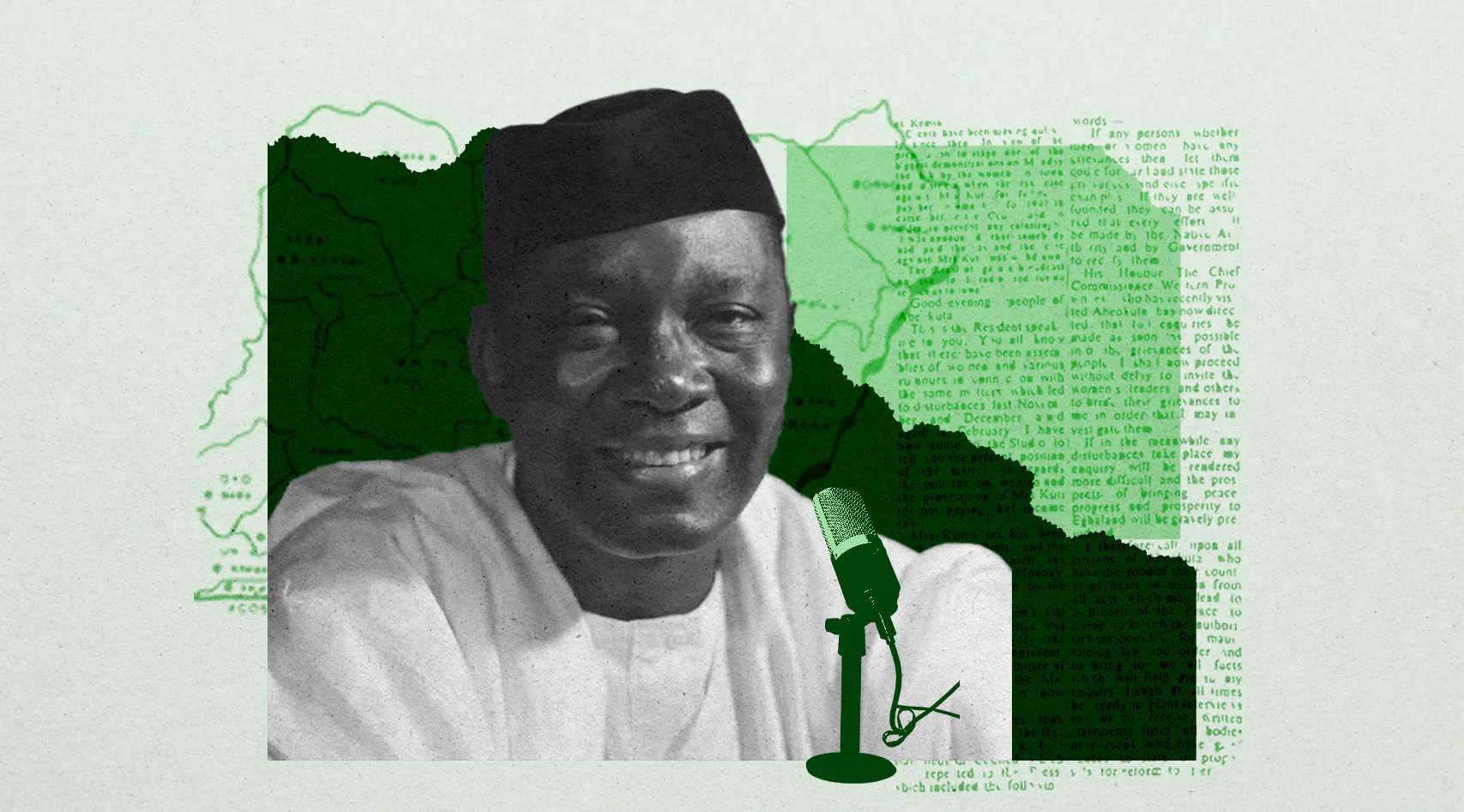
October 1, 1965 Independence Day Speech by Nnamdi Azikiwe
Fellow Nigerians,
In the recent past, I was not certain that I would be physically fit to broadcast a message to you on this occasion of the second anniversary of our republic. As is well known, I have not enjoyed very good health lately. On medical advice, I had been away to Nsukka, to take a complete rest.
Nevertheless, I was kept fully informed of the affairs of state by the prime minister; and throughout my absence from the Federal Territory, I have had to attend to the duties of the state forwarded to me regularly.
I am able to say today that, with the help of God and the skill of my physicians, I am gradually being nursed back to good health. According to my medical advisers, it will be necessary for me to go abroad for specialist consultation and treatment in the near future.
I would, however, like to take this opportunity to express my gratitude to my physicians and to the many well-wishers who have through personal letters, telegrams and other media, sent me prayerful messages of warm greetings for a speedy recovery.
A year ago, our great and beloved country was engulfed in political commotion which would have spelt disaster to the nation. In which case, all the contributions we made to become a sovereign state would have come to nought.
I have often pondered why we moved so perilously near disintegration? Perhaps the reason for this kind of confrontation was because many of us still regard ourselves as aliens in our own country and strangers among our own peoples.
This way of thinking should no longer be fostered or tolerated in an independent Nigeria for which all of us sacrificed so much. It is true that in the past we concentrated our efforts against foreign rule. This was justifiable, because under such a regime we suffered racial, social, political and economic disabilities.
But we should now realise that within forty years — from the founding of the national congress of British West Africa to the date of our independence in 1960 — we have been able to cast away the yoke of colonialism and we are now a free people with a manifest destiny.
Ambition
That manifest destiny is the building of a united, prosperous and democratic nation, which we can conscientiously bequeath as an imperishable legacy to our posterity. Such a nation should be a worthy example of true democracy and the efficacy of the rule of law, in Africa. Such a nation should give inspiration and hope to all the black races and oppressed peoples of the earth.
Unfortunately, the road to this manifest destiny has not been smooth. It has been made rough by the pot holes of misguided ambition, enthronement of privilege, abuse of power, naked greed, rank intolerance and barefaced parochialism. These are the familiar problems of nation-building of which we cannot be an exception. But we must not be dismayed, because these political problems are symptoms of our growth to nationhood.
However, we must admit that we are making progress, in spite of desirable self-criticism. It is to our credit that after five years of self-rule, we are now in the process of setting up a machinery for the review, and not the revision, of our constitution.
With goodwill and the spirit of compromise on all sides, the next five years should bring us an era of increased prosperity, greater adherence to the spirit of our constitution, strict compliance with the principles of individual freedom under the law, and a stronger sense of common nationality.
And now, let us take stock of our achievements during the past year so that we may better appreciate the efforts of our government and our people to forge a united and strong Nigeria, capable of taking its rightful place among the prosperous and peaceful nations of the earth.
The assignment of creating and maintaining a united nation, in the modern world and in its African context, implies imaginative development of the economy and effective expansion of the social services of such political entity. To reinforce its unity In concrete terms. It devolves on those who exercise power to refurbish the social services and ensure that commendable progress is being made at a reasonably understandable pace.
For such a united country to keep together, it must be strong. Hence, it becomes necessary that our defence and security forces should be such as not to make us vulnerable either to internal subversion or to external aggression.
Development
On a comparative basis with the experiences of other countries similarly situated, we have reason to hold high our heads in appreciation of the honest efforts being made to lift our country from the slough of poverty, degradation of ignorance and disease to a better standard of life.
During the year under review, my government set as its objective, the continued development of our agriculture, industry, trade, shipping, transport and communications, including desirable innovations and modifications in our education, health and labour policies. These activities are a healthy sign of growth of which we should not be apologetic.
I will now briefly examine the efforts of my government to build a united and strong country. In doing so, I shall demonstrate the actual achievements and potential plans in certain facets of our national economy, social services, defence forces, and international relation. In appreciation of the work done and effort made by the various governments of the federation to improve agricultural development in the country, the Rockefeller and Ford Foundations have jointly agreed to establish, in collaboration with Nigeria, an international institute for tropical agriculture, to undertake research in finding ways of increasing the output and improving the quality of tropical food crops.
The programme of work to be undertaken will be supplementary to that being done by all our Ministries of Agriculture. It will be concerned also with high-level professional training for selected persons to be engaged in research since, at present, there is a shortage of experienced research personnel in the country.
Industry
An agricultural credit bank will soon be established. Its purpose is to provide the much-needed financial assistance, both long and short term, to farmers as it is now possible for people engaged in the industrial sector of our economy. This should satisfy a real need since agriculture is the mainstay of our economy.
As far as our industries are concerned, it is with pleasure that I announce that during the past year, 30 new manufacturing plants, with a total capitalisation of £25 million, were established in Nigeria.
Several new oil fields have been discovered and brought into production. The petroleum industry remains an important factor in our economy; in fact, we are now the second largest producer of crude oil in the Commonwealth.
In addition, Nigeria will soon become an important gas producing country: the £17.5 million liquified natural gas project at Bonny is being actively considered by a reliable consortium.
Minting
The Nigerian Iron and Steel Complex, which is the second largest project under our Six-Year Development Plan, has been tailored to make the most significant and basic contribution to our designs for economic independence. Arrangements are being made to implement the recommendations contained in the feasibility studies of this complex and thereby make Nigeria a producer of steel.
One of our most outstanding achievements in industrialisation is the establishment of a security printing and minting factory, said to be the first of its kind in Africa. Its uniqueness lies in the fact that it combines two operations in one: printing currency notes, and minting coins. In other countries, these are usually done by separate organisations.
In respect of trade, practical steps had been taken to find answers to some problems of our internal trade. A conference of our trade ministers held recently reached agreement on various measures to harmonise inter-regional trade, increase indigenous participation in wholesale and retail trades, set up a national re-insurance company, regulate hire-purchase transactions, and patronise "Made in Nigeria" goods.
We hope that through the forum of the United Nations Conference on Trade and Development and its various agencies, developing countries will be able to participate more actively in the formulation of international economic policies. It is anticipated that through this conference, measures would be taken to increase the export earnings of developing countries to enable them to finance their development programmes.
On shipping, I report that the Nigerian National Shipping Line presently operates 14 vessels. Nine of these are owned by it and the other five are on charter. Its present areas of operations include the United Kingdom, the continental ports of the North Sea, the Atlantic coast of France, and the Mediterranean: a service to the USA and Canada will soon be introduced. Since we are fast becoming a major oil-producing country, our Shipping Line is actively investigating means of entry into the tanker trade.
Aviation
We have not lagged behind in civil aviation either. Following the introduction of VC 10 jet aircraft, on the international route between Nigeria and Europe, Nigeria Airways now competes equally with other airlines and is in the forefront of African airlines flying direct to the USA.
At home, the introduction of F27 aircraft on our internal services has made air travel to be more comfortable. Fares have been reduced in some parts of the country to bring the benefits of aviation to the reach of many. Nigerians have been trained as pilots and they are flying our aircraft as first and second officers.
Our Civil Aviation Training Centre, which is under construction, is a great step forward in my government's policy to Nigerianise all branches of civil aviation in this country.
The most significant development in our internal communications system has been the completion of the Bornu Railway Extension. This has added 400 miles to our railway complex and has opened vast fertile lands to modern transport and commerce.
Railway
The international importance of this railway line, which is less than 100 miles from the Chad border, cannot be over-stressed. With the planned development of the Chad Basin, the Bornu line will become a great link to draw together peoples of our continent.
With an eye to the future, the Railway Corporation has already completed traffic surveys of possible new routes from Western to Eastern Nigeria, across the Mid-West, and from Gusau to Sokoto, in the North.
Development of telecommunications services has achieved steady progress. The most spectacular of these is the execution of work on the provision of a microwave radio relay route linking Lagos with Port Harcourt, through the principal towns of Ibadan, Ijebu Ode, Benin, Onitsha, Enugu and Aba.
This project is the first phase of our national telecommunications development five-year plan and it will begin operation by the end of the year. Very soon, another phase of our telecommunications services will cover the expansion and modernisation of telephone services in 30 urban centres throughout the federation and provide subscriber trunk dialling systems to all the main centres. The towns to be served include Kaduna, Zaria, Kano, Jos, Maiduguri, Bauchi, Sokoto, Yola and Minna.
The Nigerian External Telecommunications Limited is making progress on its plans to establish telecommunication links between member countries of the Organisation of African Unity.
Between January and August, we opened telecommunication links with Niger, Senegal, Sudan and the United Arab Republic. Its development programme, begun in 1963 for the improvement and expansion of external telecommunications services, will be completed early next year. By then, more circuits will be established with other African countries which, hitherto, have no telecommunication links with us.
Bridges
As far as roads and bridges are concerned, the Federal Ministry of Works are equally cheerful. A contract with a German engineering firm for the construction of the second mainland bridge between the island of Lagos and the mainland was signed on August 24. Construction work is expected to begin by the end of the year. When completed, in 30 months' time, that bridge will help to alleviate traffic problems in Lagos.
Work on the Niger Bridge, at Onitsha, has progressed satisfactorily. It is expected to be completed by the end of this year. This bridge is an important link between Eastern Nigeria, Western Nigeria, and Mid-Western Nigeria.
Satisfactory progress is being made in the construction of the Otta-Idiroko road, the main route from Nigeria to Dahomey enroute to Togo and Ghana. Work on this road will be completed in March 1966; it is estimated to cost my government £1,435.830. The construction of this international road Is a practical demonstration of the spirit of pan-Africanism which is the chief anchor of our foreign policy.
A substantial portion of the Tegina-Daura road, which is an important federal trunk road in Northern Nigeria, has been completed. This road, too, is a link between Nigeria and the Niger Republic.
We have made giant strides in the implementation of our policy in higher education. The total number of students in our five universities, at the end of the 1964-65 academic year, was 6,707 — the highest ever attained in our crusade for the mental emancipation of our people.
During the last financial year, the National Universities Commission allocated £7 million as federal grants to our universities for their capital and recurrent expenditures.
In consultation with the Committee of Vice-Chancellors, the commission has been working to achieve a coordinated and balanced development of our universities in relation to our national high-level manpower needs and priorities.
As far as health services are concerned, my government has continued to modernise and extend its activities to cater for the convenience of our expanding population. Particular progress was made during the year in the training of medical personnel, the control of drugs, the diversification of treatment centres, epidemiology and the registration, control and discipline of medical and para-medical cadres.
The training of health personnel has been pursued with enthusiasm*.* Both the medical schools at Ibadan and in Lagos have been acclaimed to equate the best anywhere in the world, and there is now every hope of achieving our target of producing 200 medical practitioners annually, in the near future.
In addition, a post-basic school of nursing has been established at Ibadan and arrangements have been completed for a school of radiotherapy in Lagos. Three health centres have been opened to supplement existing medical facilities in Lagos. It is expected to open more of these centres during the year.
The new Pharmacy Board of Nigeria has been inaugurated, transferring the control of pharmaceutical practice and discipline to the pharmacists themselves. Expansion of the pharmaceutical inspectorate has improved the control of the importation and handling of poisonous drugs.
Seminar
The Pharmaceutical Manufacturing Laboratory has been expanded and is now producing a significant quantity of the drugs used in hospitals and dispensaries. Planning is in progress for its further expansion so that most of the common drugs consumed in the country can be produced locally.
Nigeria was host to the United Nations Seminar on the Control of Narcotic Drugs, held recently in Lagos. The recommendations adopted by the seminar will contribute much to the further strengthening of the machinery for the control of dangerous drugs in Nigeria.
Our labour problems are being tackled with realism. The inauguration, last July, of the National Labour Advisory Council, comprising representatives of the governments, employers and workers in the federation, is a unique achievement of which we should be elated.
Only a few countries In the family of nations have so far adopted this most democratic consultative machinery to advise government on labour and social security policies and the application of international labour conventions and recommendations.
Rent control
A bill with provision for setting up rent control tribunals in Lagos will be introduced at the next meeting of Parliament. As soon as it is enacted, steps will be taken immediately to set up these tribunals to the mutual advantage of tenants and landlords.
The Ministry of Housing and Surveys is examining the different methods adopted by various tropical countries to solve their urban housing problems. This is considered to be a preliminary step for executing low-cost housing scheme for workers to which the Federal Government is committed.
It is necessary to evolve a housing project which will not be out-of-date within a comparatively short time. As soon as arrangements are completed, the work of constructing the low-cost houses will begin without delay. It is planned to build with considerable speed a reasonable number of houses.
My government has also agreed to provide over £1.3 million as grants to the Lagos Executive Development Board to build low-cost apartment blocks in Surulere. This should provide accommodation for 14,000 initially. Efforts are being made to acquire more land for much larger building projects.
The important additions to the amenities of the Federal Government during the year include the modern Ebute Ero market, completed at a cost of £250,000. A new swimming pool of Olympic standard is being constructed at Rowe Park, Yaba, at a cost of £56,000. Twenty more buses have already been put to use on the roads, a greatly needed increase in the strength of the fleet in Lagos, thereby providing quicker means of transport for the inhabitants of Lagos.
The Municipal Library is under construction, at a cost of £100,000 and a branch Library at Yaba has been built at a cost of £13,000. Several parks and open spaces have been improved during the year. The Lagos City Council plans to build, very shortly, a city hall befitting the capital city of this republic.
Having given the people of this great country a gist of my government's blueprint for making our unity worthwhile, I shall now disclose what efforts are being made to guarantee the corporate existence of such a united nation whose citizens are to be protected in the enjoyment of their constitutional rights and privileges.
The Army
The progressive development and modernisation plans of our defence services, initiated mainly since the attainment of independence five years ago, have begun to bear fruits. The Nigerianisation of all ranks in the Army has been achieved. Nigerians now bear our Army, Navy and Police.
Our Air Force is developing steadily towards the same goal and it has been progressively stepping up the training of personnel and acquisition of aircraft — thanks to the technical assistance rendered us by the government of the Federal Republic of Germany.
Already, a number of pilots and technicians have qualified and they now form the nucleus of the Nigerian Air Force Training and Tactical Wing.
The construction of Nigeria's premier frigate, the NNS. Nigeria has been completed and the vessel was commissioned for service last month.
Defence
The building of the Ordinance Factory is completed and the installation of machinery in it is proceeding most satisfactorily. The woodworking and ammunition sections have already started production in accordance with the planned programme to be followed next year by the manufacture of weapons.
The Nigerian Defence Academy is two years old; its first intake is expected to graduate by the end of next year.
The Nigeria Police Force has continued to discharge its duty of maintaining law and order throughout the federation with a sense of responsibility, in an efficient manner. The nation mourns the death of those police officers who paid the supreme penalty in the execution of their duties.
On the international scene, Nigeria showed great initiative in avoiding a crisis among some members of the Organisation of African Unity, when it summoned a meeting of the Council of Ministers in Lagos to resolve the differences between Ghana and certain Francophone African states.
Nigeria also played an important role at this year's Conference of Commonwealth Prime Ministers which took vital decisions on several matters, including Rhodesia, Vietnam, and independence for non-self-governing countries.
At the United Nations, Nigeria continued to participate in the search for a peaceful solution of its financial crisis, not only by urgently fulfilling all our financial obligations to that body, but also by active participation in the deliberations of the National Committee on Peacekeeping Operations.
Achievements
The foregoing are but few of our many activities and achievements during the past twelve months. Some of them are very significant in the social and economic history of nations.
In five years of independence, we have demonstrated capacity to make friends not only with our near neighbours but with distant neighbours as well. Indeed, we have shown capacity to develop and expand our economy as far as our resources would permit.
Our main problem now is to hold one unity intact by safeguarding individual freedom under the law. Our liberties would be meaningless if we paid lip service to the spirit of our constitution and merely worship its letters. Ours is a man-made constitution. Therefore, it is an organic law which can succeed provided the men and women who inspired and promulgated it are prepared to let it guide their political behaviour and utterances.
Appeal
Let me conclude this broadcast by appealing to Nigerians to be just to one another. Our peoples belong to different tribes; they speak difference languages and they have acquired different cultures. Yet, after one century of British connection, we have been obliged to live together as natives of one country. In other words, the cement which now holds us together is common nationality.
The logical thing to do, in the circumstance, is to tolerate each other through the common citizenship in a united country. The leaders of our various communities are servants of the peoples of Nigeria. They were selected to strengthen the bonds of national unity. Their main task is to promote understanding among the various tribes of Nigeria. So long as they discharge their sacred responsibility, loyally and faithfully, so long shall they have proved themselves capable of enduring the complicated problems of leadership in Nigeria.
From what I have stated earlier on, it is patent that our leaders have embarked upon the challenging task of building a united and strong nation for which they deserve the gratitude of the nation. But more barriers remain to be hurdled and we must direct our attention to them in all earnestness.
After five years of independence, we have made much material progress; but we are still encompassed by problems whose solution must be found through a spiritual lubrication of the machinery of human relations. The way and manner we implement the provisions of our constitution should reflect the degree of the faith of our people in our political integrity.
Therefore, let all our citizens, who believe in the unity of our nation, be humbled and cultivate the habit of listening quietly to the silent voice of God, admonishing them to love their neighbours and do good to them as they would wish their neighbours to love them and do good to them.
It is the moral duty of all Nigerian citizens to foster the spirit of good neighbourliness not only among our neighbours but also among ourselves.
Interest
We should not be tempted to commit the common error of polluting the atmosphere of our social contacts by hatred and antagonism born of bigotry, due to enlightened self-interest. More than a century ago, an English clergyman said, "We hate some persons because we do not know them; and we will not know them, because we hate them."
The application of the golden rule to the daily lives of our people is consistent with the sum-total of all the true religions of the earth.
Let our religiously-inclined compatriots be humble and allow themselves to be used by God to create bridgeheads of goodwill and fellowship between the various peoples of Nigeria.
Faith
In sura 49, verse 13 of the Holy Koran, it is written, "O ye men, verily. We created you of a male and a female and made you tribes and families that you may know each other." In sura 5, verse 11, faithful Muslims were enjoined to love their neighbours in these wise words, "And let not hatred towards any community induce you not to act unuprightly." Even the Holy Prophet taught humanity a lesson of love when, in his TRADITIONS, he warned, "He shall not enter paradise whose neighbours are not secure from the calamities inflicted by him."
In the same vein, let our Christian adherents reinforce their faith in the ultimate goodness of humanity by drawing inspiration from the Holy Scriptures to enable them to love their neighbours and do good to them.
In the Epistle of Paul the Apostle to the Galatians, chapter 5, verses 14 to 26 PASSIM, it is written (and I quote from the new English translation), "For the whole law can be summed up In a single commandment, 'Love your neighbour as yourself.' But If you go on fighting one another, tooth and nail, all you can expect is mutual destruction. I mean this: if you are guided by the Spirit, you will not fulfil the desires of your lower nature. That nature sets its desires against the Spirit, while the Spirit fights against It. They are in conflict with one another so that what you will to do, you cannot do.
"But the harvest of the Spirit is love. joy, peace, patience, kindness, goodness, fidelity, gentleness, and self-control. We must not be conceited, challenging one another to rivalry, jealous of one another. My brothers, if, on a sudden impulse, a man should do something wrong, you who are endowed with the Spirit must set him right again very gently. Look to yourself, each one of you; you may be tempted too. Bear each other's burden, and in this way, you will fulfil the law of Christ."
After two years of our republic, the challenge which history flings at our leaders and our peoples is that we should be just and fair in all our dealings with one another, and practise these eternal truths and values in our every day lives.
In spite of our vaunted material progress, if we do not complement it with spiritual progress, then we are building our nation on shifting sands.
Blessing
According to Daniel Webster, "If we work marble, it will perish; if we work upon brass, time will efface it; if we rear temples, they will crumble into dust; but if we work upon immortal minds and instil into them just principles, we are then engraving that upon tablets which no time can efface, but will brighten and brighten to all eternity."
Fellow Nigerians, let us enter the third anniversary of our republic by installing JUST PRINCIPLES in the minds of our leaders and our peoples so that we may march forward confidently as a united team of devoted and dedicated servants of our country, inspired by the sole desire of building a peaceful, prosperous, progressive and powerful nation where, in the words of our national anthem, "No man is oppressed," so that, "With peace and plenty, Nigeria may be blessed."
Source: Daily Times