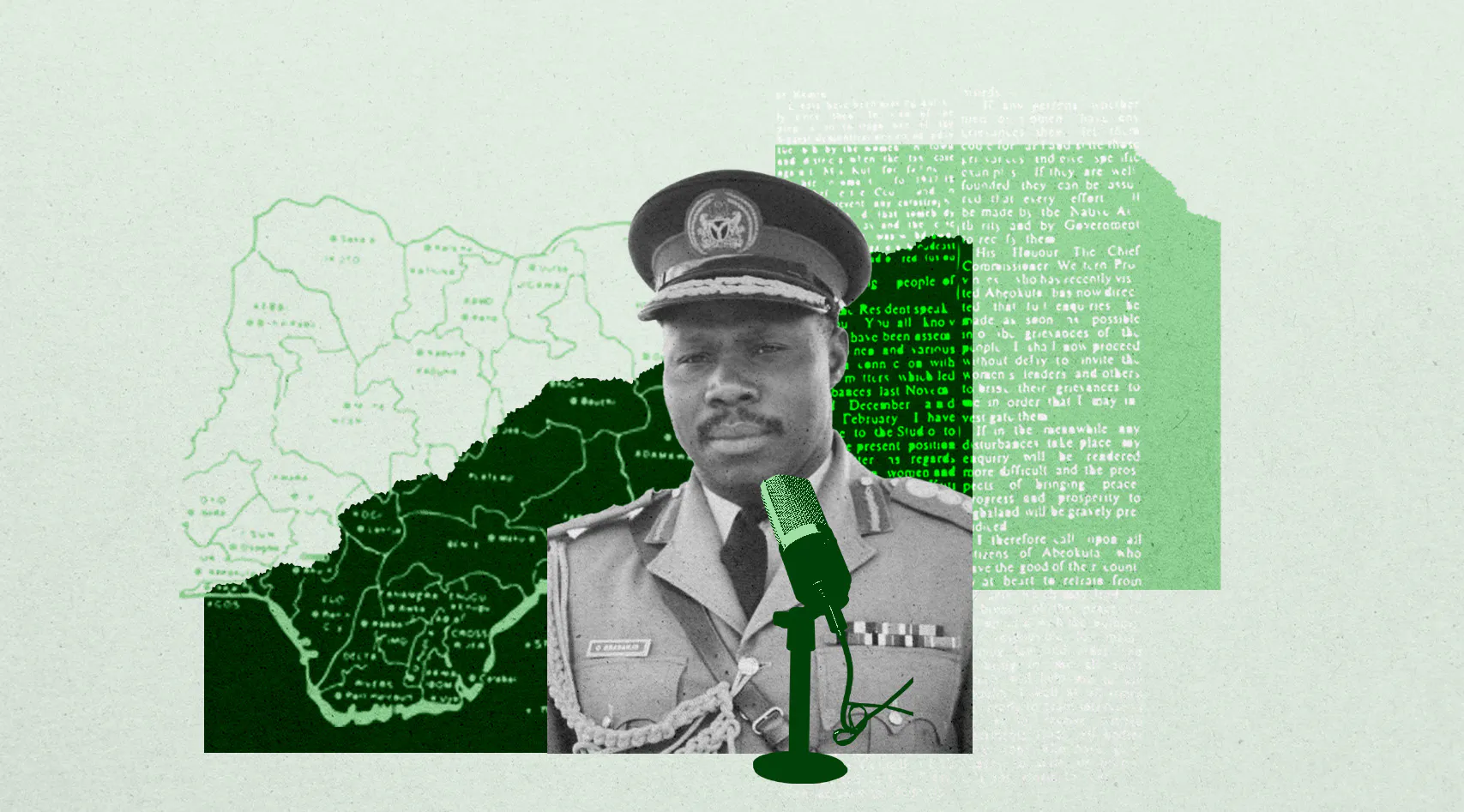
October 1, 1976 Independence Day Speech by Olusegun Obasanjo
Fellow countrymen,
Today we celebrate the sixteenth anniversary of our independence. This day has seen us through yet another eventful year, a year which was marred by the tragic assassination of the late Head of State, General Murtala Muhammed.
The sentiments of condemnation and deep sense of loss expressed by Nigerians across the country over the events of February 13th were remarkable for their spontaneity.
In that tragedy, we witnessed for once as a people the emergence of a truly Nigerian consciousness.
In spite of our pains, we emerged from that tragedy a more united nation. This augurs well for the future and for our major national objectives, including a smooth return to civil rule in 1979.
One of the most important steps of the planned transition to civil rule is the drafting of a new constitution. Work on this vital document has now been completed by the Constitution Drafting Committee well within the scheduled time.
It is necessary to remind ourselves of the significance of the exercise and what we expect to achieve by the new constitution.
The Constitution is clearly the starting point for what we believe will be a fresh, progressive, and unifying political process. The Constitution by itself will not solve all our problems.
Solutions to our problems will be found only through sacrifice, understanding, and in mature consideration at all times of what is ultimately the best for the nation as we work the Constitution.
Constitution
It has been made quite clear by my predecessor, late General Murtala Muhammed, in his National Day speech last year that the new Constitution, while taking our best experience into account, should be a living document capable of influencing the evolution of the nation and the orderly development of the political life of our people.
It is our earnest hope that the new Constitution will indeed influence free and better political interactions for the future. The draft document has been received by me and noted by the National Council of States and the Supreme Military Council, and it will be launched on Thursday, October 7, 1976. I urge that it will be discussed in the spirit of a genuine desire to forge a viable and stable political future for Nigeria.
The draft Constitution with comments from the Nigerian public will be submitted to a Constituent Assembly to consider and adopt.
Although, according to the political programme already announced, the Constituent Assembly will not formally come into being until October 1977, certain fundamental issues have to be resolved well before that date.
The Federal Military Government has carefully deliberated on such issues and has taken a number of decisions. On the issue of the size of the Assembly, the Federal Government has decided that the Assembly should consist of about 200 elected members.
It is felt that to have an Assembly much larger than this would prove unwieldy, and its work might be unduly prolonged beyond the time limit within which it has to complete its assignment.
Members of the Constituent Assembly are to be elected from their states on the basis of one half of equality and the other half on 1963 population census figures.
In addition, the Supreme Military Council will nominate not more than 10 per cent of the total elected membership of the Assembly.
This nomination is considered desirable in order to bring into the Assembly a number of Nigerians who, by their various circumstances, cannot or do not necessarily need to express the interests of a particular group or constituency. Such an arrangement will, it is thought, also provide a useful bridge between various contending interests.
The Federal Government has also decided to appoint to the Constituent Assembly the Chairman of the Constitutional Drafting Committee and the Chairmen of its seven subcommittees. This will ensure a useful link and continuity between the Constitutional Drafting Committee and the Constituent Assembly.
These members will help in clarifying issues and the thinking behind the Constitutional Drafting Committee recommendations. All the three categories of membership, that is, the elected, nominated, and Constitutional Drafting Committee elements, will be voting members of the Assembly.
The issue of the appointment of the Chairman and Deputy Chairman of the Assembly has also been specially considered. Any attempt to elect a Chairman of the Constituent Assembly from the members of the Assembly in our present circumstances is likely to start the Assembly off on a note of unnecessary conflict. He is likely to be viewed as the future president and leader and will therefore generate prematurely such stress and tensions as might adversely affect the outcome of the Assembly's deliberations.
The Federal Military Government has, therefore, decided that the best course of action is to appoint a non-voting chairman and deputy chairman. They should be seen to be clearly non-partisan and without future political ambitions.
The Supreme Military Council has appointed an Electoral Commission of twenty-four members under the Chairmanship of Mr. M.O. Ani. The Commission will be concerned with the organisation of the first elections into states and federal legislatures and other elective offices as prescribed by the Constitution.
In addition, the Electoral Commission will be responsible for registering political parties as well as delimiting constituency boundaries. There is clearly a need for the Electoral Commission to get down to work now if our determination for the country to have a democratically elected civil government by October 1979 are to be achieved.
The process of collating and preparing a register of voters for the federal and state elections takes time, and the earlier this process is started, the better. An equally urgent task is the delimitation of the country into constituencies.
Given the time available, it was felt that there was no need to set up a separate delimitation committee.
The Electoral Committee was therefore charged with additional functions of delimiting constituencies. After the elections for the first post-military government, the commission will be dissolved so as to allow the incoming government to appoint a new one under the new Constitution.
All these plans for federal and state elections will be preceded by the elections to local government councils towards the end of the year.
The local government areas will be regrouped where necessary to provide the constituencies for the Constituent Assembly. Members from within or outside the elected councils will be eligible for election into the assembly. The details and modalities of the elections into the assembly will be announced later.
The Federal Government has considered the appropriateness of our national anthem to our national circumstances, mood, and aspirations for now and for the future. It came to the conclusion that Nigeria needs a new national anthem with words and music composed by Nigerians.
Accordingly, a competition for the words of a new national anthem is to be launched. This will be followed by a competition for its music. The new anthem is to be ready by the time the new constitution is adopted for the country. Only Nigerians will be eligible to take part in the two competitions.
On the economic front, I am happy to say that the available data show clearly that the policies which the Federal Military Government has pursued yielded positive results.
Petroleum
The relatively poor performance of the economy last year was caused by a number of factors, the dominant one being the drastic fall in the contribution of the oil sector. Oil production, which had reached a daily average of 2.3 million barrels in October 1974, fell to 1.5 million barrels per day in May 1975. The decline in production was worsened by a slight fall in the price of oil.
Today, however, the rate of production has increased to about 2 million barrels, and there has been an upward revision of the price of oil. This recovery is mainly due to the adoption of a more rational policy on petroleum production.
The government is determined to ensure and maintain a healthy and mutually beneficial relationship between it and the oil-producing companies. Adequate incentives to encourage greater exploration and production are being worked out.
Work on the two liquefied natural gas plants, one on each side of the Bonny Estuary, in partnership with some oil companies, is progressing satisfactorily. So also are the plans for the construction of 100,000 barrels per day refinery at Kaduna. The contract for an ambitious network of petroleum products and crude oil pipelines have been awarded to three foreign companies.
Work on the Ajaokuta Steel Mill is still being processed with greater vigour than hitherto and the contracts for the design and construction of the two direct reduction process steel plants have been awarded.
Work on the first phase of the double track standard gauge railway line from Port Harcourt to service the Ajaokuta Steel Mill is progressing satisfactorily.
On the agricultural front, the enthusiasm which has attended the “Operation Feed The Nation” programme has been encouraging. However, our effort has to be continuing and sustained and not just sporadic burst of energy and exertion.
Decisions have been taken to ensure that the prices of certain agricultural products do not fall below a certain level. This is to make the price of these products such as would justify their cultivation by the farmer.
The ports situation has considerably improved. In October 1975, there were some 400 ships that had been waiting for months for berthing at our ports. Today, the turn about time at the ports has been drastically reduced, and well less than 100 ships are now waiting to berth at the ports.
A number of administrative and physical measures have had to be adopted to increase the port facilities and further reduce the waiting time. The implementation of the Apapa Third Wharf extension has been accelerated. In addition, contract has been awarded for a ten berth harbour at Tincan Island, which will be completed next year. Work is also progressing on Calabar Harbour development.
Regarding inflation, a number of monetary, fiscal, and administrative measures have been adopted to arrest rising prices. It is too early to fully appraise the long-term impact of these measures, but it is gratifying to note that the data for the first half of 1976 indicates a declining trend in the rate of inflation.
What is clear is that had drastic measures such as the decongestion of the ports not been taken, inflation would by now have wrecked our economy and made it impossible to achieve the economic and social goals of the Federal Military Government. As promised in my budget speech in April, some of the measures adopted then to relieve port congestion have been reviewed and part of the restrictions on imports have been lifted.
The past year has witnessed some eventful development in Nigeria's objectives in the field of foreign policy. In my address to the nation last June, I had informed you of the decisions we are taking on the report on Nigeria's foreign policy. These decisions are being pursued with vigour.
We are following closely the rapid developments in Zimbabwe. Here, as in the liberation struggle in Namibia, Nigeria's posture will be in consonance with the wishes of the nationalist movements concerned.
Naturally, we believe that independent Africa has the duty to be concerned with and assist in every way possible the total liberation of the continent.
We believe that there can be no externally imposed solutions to the problems of Southern Africa, which do not enjoy the support of the genuine nationalists who represent the majority of the people of those countries still under minority domination.
We are gratified that the cause of the liberation struggle, which has been gathering momentum for years, has been significantly advanced during the past year.
Turning nearer home to the West African sub-region, I am glad to say that arrangements have been completed for the final acts to formally establish the Economic Community of West African States (ECOWAS) firmly on the ground.
The Council of Ministers are due to meet soon, preparatory to the final summit meeting of Heads of State. Nigeria is fully committed to the objectives of the ECOWAS. For, we believe that only through such regional co-operative endeavours aimed at economic independence can we consolidate our political freedom.
In retrospect, the past year has had bitter moments, moments of national tragedy. We are determined, in spite of our loss, to evolve a stronger and more united nation as the best tribute we can ever pay the memory of our revered dead leader.
The year has seen significant advances in the steps towards the return of the administration to democratically elected civilian leadership.
While we had been subjected to the worldwide pressures in our national economy, we had performed better than some had expected, and the prospects for the next year already look bright.
We have pursued our international interests with vigour and independence of action. And Africa remains the centrepiece of our foreign policy.
The Federal Military Government greatly appreciates the support and encouragement from all of you. We shall continue to value your support as we march forward towards the consolidation of peace, justice and prosperity in Nigeria. We must not fail. Thank you.
Source: The Comet