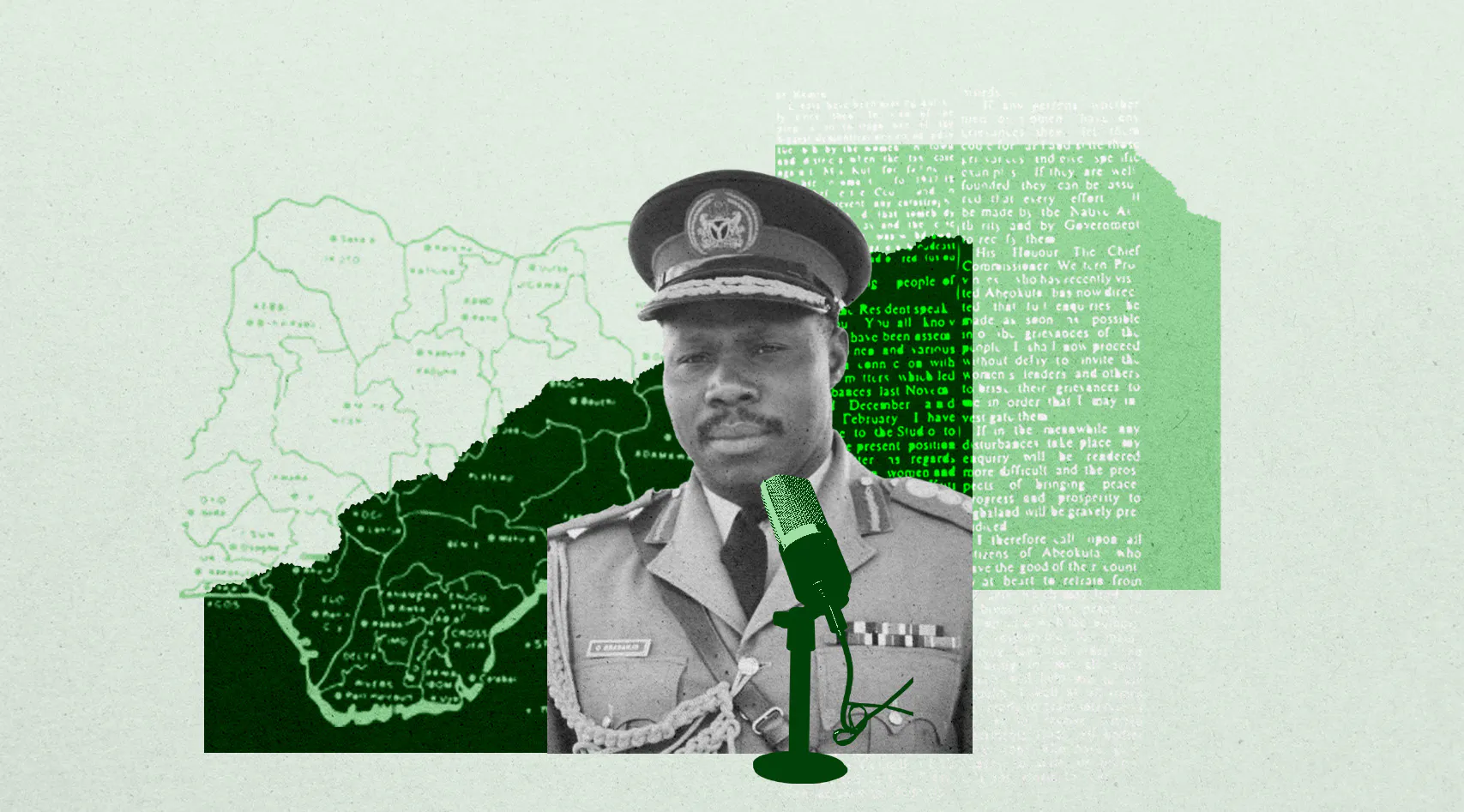
October 1, 1978 Independence Day Speech by Olusegun Obasanjo
Fellow countrymen and women,
At its inception, this administration defined certain objectives within given time limits for our society and economy and set a course for the nation In domestic and external relations. It will be for history to determine what impact these objectives and this direction have had on the nation. It is, however, proper that those of us charged with the responsibility for achieving these objectives and for guiding this direction should on occasion like this take stock for ourselves and for the nation.
In this regard, the present administration has striven in the past twelve months to maintain the pace of development, set a high standard for individual, corporate and communal behaviour and create the basis for building a nation in which a high quality of life, shelter, education and health will be guaranteed to the majority of our citizens.
We note with a degree of satisfaction the decline in unnecessary flaunting of material wealth, the disfavour rendered to ostentation and a new readiness to pour scorn on ill-gotten wealth. We have cause to feel that tardiness and indolence in the course of public services are now acknowledged vices deserving of summary punishment. It is now established that indiscipline and disregard for properly constituted authority will not go unpunished. In general, a tone has been set for discouraging anti-social behaviour and encouraging an ethnic of justice, duty and orderliness in our society.
It is our belief that unless the moral fibre of society is firm, material success would be meaningless and vulgarity will debase achievement. I am still to meet a Nigerian who prefers injustice to justice. I do not know any who rates indolence higher than industry. I am not aware that any of us would choose chaos over stability. We are committed to fashioning a new Nigerian — a man of dignity, a person respected for honesty and industry.
To continue to reward service and merit other than by means of material consideration, sixty-four Nigerians from all walks of our national life have honoured with national awards. To further enshrine selflessness, commitment and dedication to duty and national service, as worthy of every Nigerian's pursuit, the Supreme Military Council has decided to create a Register of National Heroes for Nigerians who most exemplify the best of our societal values and virtues. The register, which will be kept in the National Hall, will contain the names of Nigerians who have made outstanding contributions to the social, economic, political, cultural and scientific advancement in the country. The modalities for according this great honour have been designed to discourage politicisation and commercialisation of the recognition and encourage the spirit of sacrifice and selflessness in the service of the nation. Accordingly, the late Herbert Macaulay, Alhaji Tafawa Balewa, Alvan Ikoku, General Murtala Muhammed have been made the first National Heroes of the Federal Republic of Nigeria.
None of these men can be said to have won this honour because of any materialistic considerations. The lesson is clear. While not denigrating hard work which can lead to honest material success, it must be clearly established that there are other values superior to the pursuit of the base material wealth. This nation's greatness and future depend more on how readily Nigerians are to make sacrifices and give honest, dedicated and selfless service. All these men have made the supreme sacrifice so that this nation can be strengthened and prosper and they are being honoured accordingly. As the highest and greatest that the nation can bestow on any individual, dead or alive, it will neither be cheapened nor debased.
Consideration in time started when Nigeria became a political entity in 1914. As we embark on yet another year of nation-building, it is my hope and prayer that those values which make a nation great will be further inculcated and ingrained visibly in our interactions with one another. For our part, and in the time available to us, we shall continue to consolidate the gains of this period in the hope that our successors can and will uphold that which is in the best interest of this society and this nation.
On the same note, the structure, quality and pace of development in the economy have and continue to be of central importance to this administration. Decisiveness has been brought to bear on economic management and we have not shied away from sacrifices where we believe that denial today will make for abundance tomorrow. We have opted for economic self-reliance and self-sufficiency because only thus can we regain control over our destiny and be capable of giving meaning to the black man's dignity and making our potential credible.
To this end, we have identified a number of structural weaknesses within our economy. The Nigerian economy remains basically monocultural and is characterised by heavy dependence on imported manufactures of processed and semi-processed goods, neglected agricultural sector, limited contribution and therefore gains from invisible trade, fragile and overloaded infrastructures and a temperamentally volatile general level of prices. Until these weaknesses are corrected, economic management must remain primitive and meaningful economic development a pipe dream.
Realising this, we have set the course for improving the productive capacity in the agricultural and manufacturing sectors to reduce the rigidities in our international trade pattern and balance of payments position. We have also embarked on improvement of basic infrastructure. In so far as we remain not importers of food and other basic needs of our society, we must live in fear of being cut off from those supplies either through not being able to finance their purchase or through other acts beyond our control.
The second major problem of economic management has been the scourge of inflation. For sometime, we attributed this to external factors but time came when we had to take measures to restrain prices. To combat the twin evils of external dependence and price inflation we have Imposed a number of physical controls and taken firm fiscal and monetary measures.
The decision to tighten our belts and control our appetite for that which we do not produce has been spread fairly evenly across all sections of our society. These measures were aimed at encouraging Nigerians to produce more of our needs at home, take over the essential spheres of economic activity and to enhance the purchasing power of the naira. To a large extent, these measures have bitten hard and are having the desired effect on the economy. Yet factors like speculative stockpiling, administrative and legal loopholes, socio-economic indiscipline continue to bar the way to faster progress in the direction we have mapped out.
We owe a duty to this nation and to posterity to carry through this economic struggle. We shall, therefore, continue to lay the foundations of structural change in the hope that Nigerian goods will hold sway at home and can compete in external markets to reduce revenue fluctuations which result from reliance on the extractive sector as foreign exchange earner. For now and in view of the slow response of the value of imports and recovery of our external reserves, additional measures will be announced to remove from our import bills those items which can easily be substituted by local production. Measures will further be taken to reduce public sector spending, tighten the loopholes exploited by the private sector and further increase public revenues and the value of what the naira can buy in the market.
Over the past three weeks, I have repeatedly entreated you all, in a series of addresses which I gave to selected groups of leaders at various levels of our society, and in my address to the nation announcing the decision of the Supreme Military Council on the new Constitution, to bear in mind at all times the lessons of our recent past in whatever you do during the political activities that will lead to elections next year.
All Nigerians, and particularly we in this administration, have cause to be grateful to God that the course we have charted up to this moment has been free of serious turmoil. With the return to active party politics, it is my hope that all those who have responsibilities for running, managing and leading political parties will exercise the greatest restraint in their utterances and general conduct and maintain a firm control over the activities and behaviour of their party functionaries, followers and supporters.
Politics may entail hard work, toil and anxious moments, but it needs not be accompanied with tears, bitterness, hostility and destruction. We can disagree among ourselves on policies, principles and methods and maintain an air of civility and a courteous attitude to one another. Let us not at this final phase of our evolution away from military rule commit any act for which posterity will hold us to blame. Let us resolve to make the rest of the journey smoothly uneventful and dignified.
At this juncture, I wish to congratulate all those involved in the administration and management of the labour movement in Nigeria. Their commitment to making the new organisational arrangements a success can only facilitate the attainment of industrial peace and economic progress. To this, we must add the admirable enthusiasm and sure-footedness with which Nigerians all over the country are seizing opportunities in entrepreneurship which the measures introduced by government have made possible to ensure that the economic destiny of this country is in the hands of Nigerians.
We are committed to this course because unless our economy is buoyant, substantially-owned and controlled by us, the political and social aspirations of our people will be frustrated and our External influence diminished.
In the past year, Nigeria continued to play a progressive role in Continental African and international relations. We have used our influence to advocate moderation and mutual respect among African countries. We have appealed to negative external influences to leave Africa alone and encouraged our brothers to free themselves from the domination of foreign dogma.
In spite of threats to the security of the continent, giant strides have been taken towards reconciling warring neighbouring African states. Presently, a battalion of the Nigerian Army is serving with the United Nations Peace Keeping Operations in Lebanon. This is an honour to our arms and acknowledgement of our commitment to world peace.
Our support for the liberation movements in Southern Africa is also beginning to yield fruit. We had expected all parties concerned to cooperate in making the United Nations transitional arrangements in Namibia a success. The government in Pretoria is, however, reported as proceeding with arrangements to hold elections outside the United Nations approved process. The SWAPO has, therefore, rightly decided to further intensify the armed struggle. In this, they have our fullest support.
Zimbabwe continues to be delicate and fractious, but even here the end cannot be far. We continue to appeal to the Patriotic Front to move forward and present Africa with the leadership that Zimbabwe needs. We hope it will not be long now before we welcome a free and Independent Zimbabwe to the Organisation of African Unity.
Further south, the domain of apartheid must take stock of events and open the door to favourable change. As we have always indicated, Africa must be saved the holocaust of a racial war. To the regime in South Africa, therefore, we recommend the course of peaceful change.
As we celebrate another independence anniversary, I commend to the young order; to our elders, maturity; to leaders, responsibility; and to all, dedication to a greater Nigeria.
Finally, wherever we go throughout these holidays, let us all spare a thought for others and reduce the death toll on our roads. In this regard, I am cheered that motorists continue to show road discipline on the expressway. While this is commendable, there is increasing concern that we are not keeping to the prescribed speed limits. Speed kills and we cannot continue to lose human life through recklessness on our roads.
I wish every Nigerian and this great nation happy anniversary and commend all of us to God's care.
Source: Daily Express