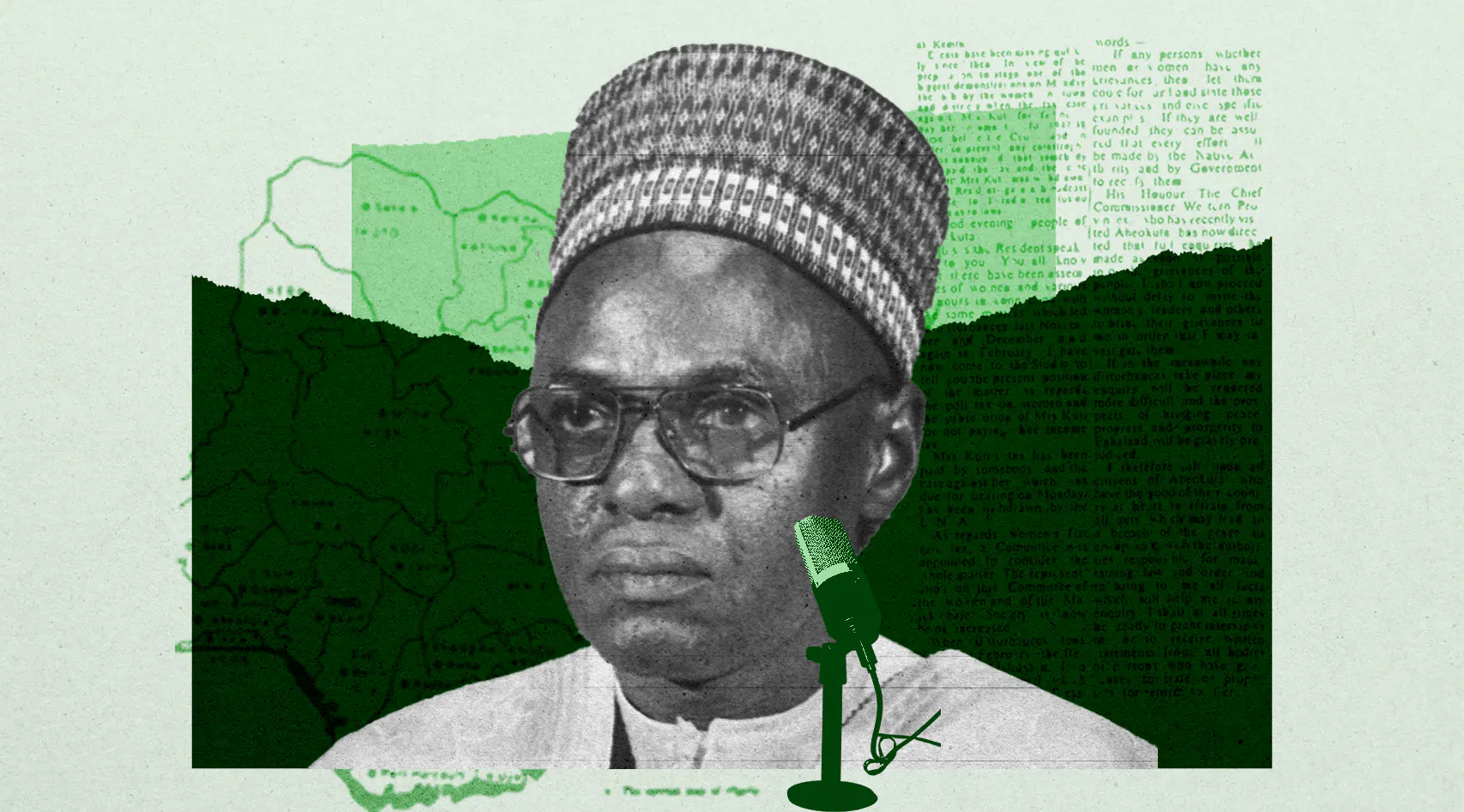
October 1, 1981 Independence Day Speech by Shehu Shagari
Fellow Nigerians,
Today, 1st October 1981, we celebrate our National Day. It is customary on such occasions to review the past year's events, and to take stock of achievements as well as map out future aspirations.
For us, this year has an added significance. It marks the end of the twenty-first year of our independence from colonial rule. As you all very well know, twenty-one years marks the coming of age in many societies. For this reason, if for no other, I should like to devote a large portion of this National Day speech to examining some of the significant features of our national experience over the past twenty-one years.
Such a recapitulation does help in avoiding future mistakes. It is my ardent belief that we can learn from history and avoid repeating it.
During the last twenty one years of our history, we experimented with parliamentary democracy of six years. We were then ruled by a succession of military regimes for thirteen years. Today, we celebrate two years of a presidential democratic system of government, freely adopted and elected by us all.
The first six years of post-independence rule, and even more so, the last six years of pre-independence rule, were characterised by ignorance and unfamiliarity, and therefore, fear and mistrust amongst the various tribes, or to be more accurate, the nationalities that inhabit Nigeria.
Situation
I recall as a matter of historical fact, and by way of illustrating the tremendous gulf that then needed to be breached, the motion of the then Emir of Zaria, the late Mallam Ja'afaru, demanding the return to the 1914 colonial situation when the Northern and Southern protectorates of Nigeria were two separate countries under British colonial protection.
Those pre-independence apprehensions and suspicions were carried over to our post-independence parliamentary democratic era. These fears persisted, indeed grew, despite the best efforts of many of the leaders of the government.
The Federal Government, of which I was at the time a member, and the regional governments finally came to grief with varying degrees of bloodshed, basically because of this fear and mistrust, though it can be argued that the then constitutional arrangements did not help matters either. I emphasise the point that there was not much wrong with parliamentary democracy as such. Our failure stemmed from inordinate ambition, ethnic suspicion, and chauvinism.
The succeeding military governments exhibited with varying, though somewhat lesser degrees, this basic tribal or nationality chauvinism. During military rule, we witnessed the attempt at secession, which culminated in a tragic civil war. The civil war and its aftermath has made it crystal clear to all Nigerians, military and civilians, old and young alike, that we not only want to be, but are in fact ONE NATION WITH ONE DESTINY.
Many lives were lost, much blood was shed in that cause. We believe all Nigerians today know and accept that the sacrifice made in the cause of unity was not made in vain.
It is also abundantly evident that Nigerians are agreed that democracy is the most legitimate and therefore most acceptable form of government possible.
This strong yearning for democracy culminated in its re-establishment two years ago. In this particular presidential democratic system, I am convinced that we have a system that satisfies our unique needs and is appropriate to our particular circumstances.
It guarantees for all individuals their civil rights and for different groups their political autonomy. It provides an opportunity to have individual interests represented and different concerns expressed. Finally, it allows for purposeful action in the protection and pursuit of national interest.
Government
In the early days of the democratic presidential system, we moved cautiously, testing and working an unfamiliar system. In two years, we have all developed a clearer understanding of the respective rights, duties and powers of the three arms of government — the executive, the legislature and the judiciary.
I believe that all three are playing their respective roles adequately and it is critical that they continue to do so as these institutions are the bedrock of the freedom and democracy that we so cherish. I am of the view that our system is effective, legitimate and should prove to be durable. It surely ought to stand the test of time here, as it had elsewhere.
The president is president of the whole nation. I have therefore endeavoured to conduct the affairs of the state in a spirit of cooperation with all, respect for all, and with honesty and sincerity in all my dealings. I regard debate, dissent and criticism as the hallmarks of a democratic system. We must however ensure that the level of political conduct does not degenerate from criticism to abuse, from a political contest to political warfare and that adversaries do not become combatants.
Above all, we need to restrain our selfish sectional interests and place the integrity and progress of Nigeria first. Our democratic system must satisfy the natural aspirations of the individual and the public interest of the community as a whole, if it is to develop lasting roots.
Looking back over the past twenty-one years, we as a nation have several achievements to be justly proud of. Let's list a few. Our first development plan, launched soon after independence, postulated a projected spending of ₦2.2 billion. This year, we launched a plan which envisages an ₦82 billion spending. Such has been the explosive growth of our economy over the last two decades.
Twenty-one years ago, we had only four Federal Government secondary schools, today we have over forty. Twenty-one years ago, we had only one university at Ibadan with a total enrolment of 1,113 students, today we have sixteen. The total university enrolment last year was some 70,000. I could go on to list successes and milestones in a wide variety of other fields, from which equally impressive statistics can be quoted but I need not. I am a one-time teacher and have therefore focused on our attainments in the field of education.
I must remark that I am also a firm believer that our human resources are our best assets and improvements in the quality of education will bring the greatest benefits to the nation. In twenty-one years of independence, we have indeed come a long way. We should therefore with deep sense of humility, thank God for his gifts and his blessings.
I now turn to our immediate triumphs and tribulations, to the successes and the tragedies of the past two years. Throughout this period, my administration has sought to create and present a calm and stable political environment for all Nigerians. The violence and chaos exhibited in the Kano disturbances, in inter-state border disputes and in armed robbery we condemn. We will be unrelenting in our efforts to stamp out crime, to protect the lives and property of all who inhabit Nigeria, citizens and foreigners alike.
My administration has also sought to propel this nation along the path of sustained economic development. For this reason, from the first days of my assumption of office, I have warned repeatedly against the oil dependency complex that has gripped our nation. The dangers of excessive reliance on oil has been illustrated in the adverse effects on our economy that untoward developers in the oil market has had.
We will do our best to reduce spending, to maintain healthy level of reserves and retain investor confidence in our economy. Later this month, I shall submit the 1982 budget to the National Assembly. It will outline appropriate measures designed to sustain our national economy in a turbulent international economic environment.
We face oil glut problems but we are not in the midst of a crisis or on the brink of economy disaster despite the alarmist prophesy of a few.
We have launched the Fourth National Development Plan with a target growth rate of *(unclear) per cent. It focuses on agriculture and manufacturing areas in order to reduce this damaging dependency on oil and create a self generating economy.
Let me now touch on some specific details of my administration’s programmes. We set a national target of 200,000 housing units yearly. Of this, the Federal Government was to be directly involved in the construction of 40, 000 units annually — 2,000 units in each state including the Federal Capital Territory.
Construction of the first batch of the housing units is virtually complete and the allocation process is underway. In the execution of our Green Revolution programme, we have invested a good proportion of our national income. Our own target is self-sufficiency in food production.
As regards cash crops, we have established or intensified plantation cultivation of cocoa and palm products. For the first time in fifteen years, the groundnut pyramids have reappeared. We have continued our support for the large integrated agricultural development programmes, encouraged the fishing industry by authorising construction of coastal fishing terminals and acquisition of fishing trawlers.
I must remind my fellow Nigerians that national development ultimately depends on self-discipline, productivity, morale, and welfare of the working force. We have taken steps to improve the welfare and morale of workers by substantially raising the minimum wage, housing and transport allowance, and offering incentives for training. It is of the utmost importance that workers reciprocate with matching increases in productivity and self-discipline.
In the conduct of our foreign affairs, we have placed Africa at the centre of our concerns and pursued a policy based on the principles of peace, security, justice, and freedom. We, therefore, deeply resent the fact that our just concerns for independence and freedom are being seen through a distorting lens of a supposed battle against communism.
Nigeria urges the Western nations to see apartheid South Africa as it really is — a ruthless racial elite which seeks to conjure up the spectre of communist subversion as a cynical, self-interested strategy for securing Western support for the continuous subjugation of black people.
We are, indeed, a non-aligned country, but this does not preclude us from taking a firm stand against injustice. We denounce the campaign of military terrorism perpetrated against the frontline states by South Africa, and we condemn, without reservation, the invasion and occupation of Angola by South African forces.
Peace
All members of the human race must be concerned at the deterioration of East-West relations and the apparent resurgence of a Cold War mentality. The lack of progress to date in the North-South dialogue towards a new international economic order is equally disturbing.
It is my sincere hope that the Mexico summit, which I will be attending later this month, will break the deadlock and pave the way to progress in this field. We appeal for an early restoration of peace between Iraq and Iran. We continue our support for Palestinian self-determination in accordance with the UN resolution on the issue.
My fellow citizens, there is one subject I should like to touch upon on this occasion of our independence anniversary. Since my assumption of office two years ago, I have ceaselessly espoused the cause of promoting peace and stability of our great nation. It is a cause for which I have devoted my entire political life and will continue to do so, in or out of office.
It is my belief that a spirit of magnanimity and restraint ought to be injected into our political life if peace and stability are to reign. In this spirit, I have, in consultation with the National Council of State, given due consideration to giving clemency as part of our 21-year independence anniversary celebration.
I am therefore taking this opportunity to review the cases of those who were convicted or wanted in connection with the sad events of February 1976. They fall into three categories, they are:
i. The guilty who were convicted and sentenced to periods of imprisonment;
ii. The participants who fled after the act, and
iii. One suspected of having been remotely party to the design.
It is to the first and third categories that I consider action timely, appropriate, and defensible.
I have therefore ordered the immediate release from prison of all those who are serving various terms of imprisonment as a result of their conviction for their part in the dastardly event of February 1976. I have given them remission of the residue of their prison sentences.
Yakubu Gowon was declared a wanted person after the sad event of February 1976. I have also ordered that that declaration be rescinded forthwith, and that Yakubu Gowon should be free to visit or return to Nigeria should he so wish.
Two of the participants in the sad event of the said February 1976, and who were declared as wanted criminals at that time remain on the wanted list and must answer for their crimes.
I will conclude my address by reiterating my often-stated belief that since independence, Nigeria has made tremendous strikes in all areas, whether it be material abundance, education, health, or our national self-confidence.
We should take pride in these successes and not inflict upon ourselves an exaggerated degree of self-criticism. We must realise that it took the Western nations several centuries and Japan over one century to reach the level of economic wellbeing that we ourselves seek to attain.
We should, therefore, place our achievements in this context. We have done well. We have taken the first steps and with renewed dedication and commitment, a sense of vision, greater national self-discipline, and God's guidance, we can march forward to an even greater future.
Thank you.
Source: Daily Times