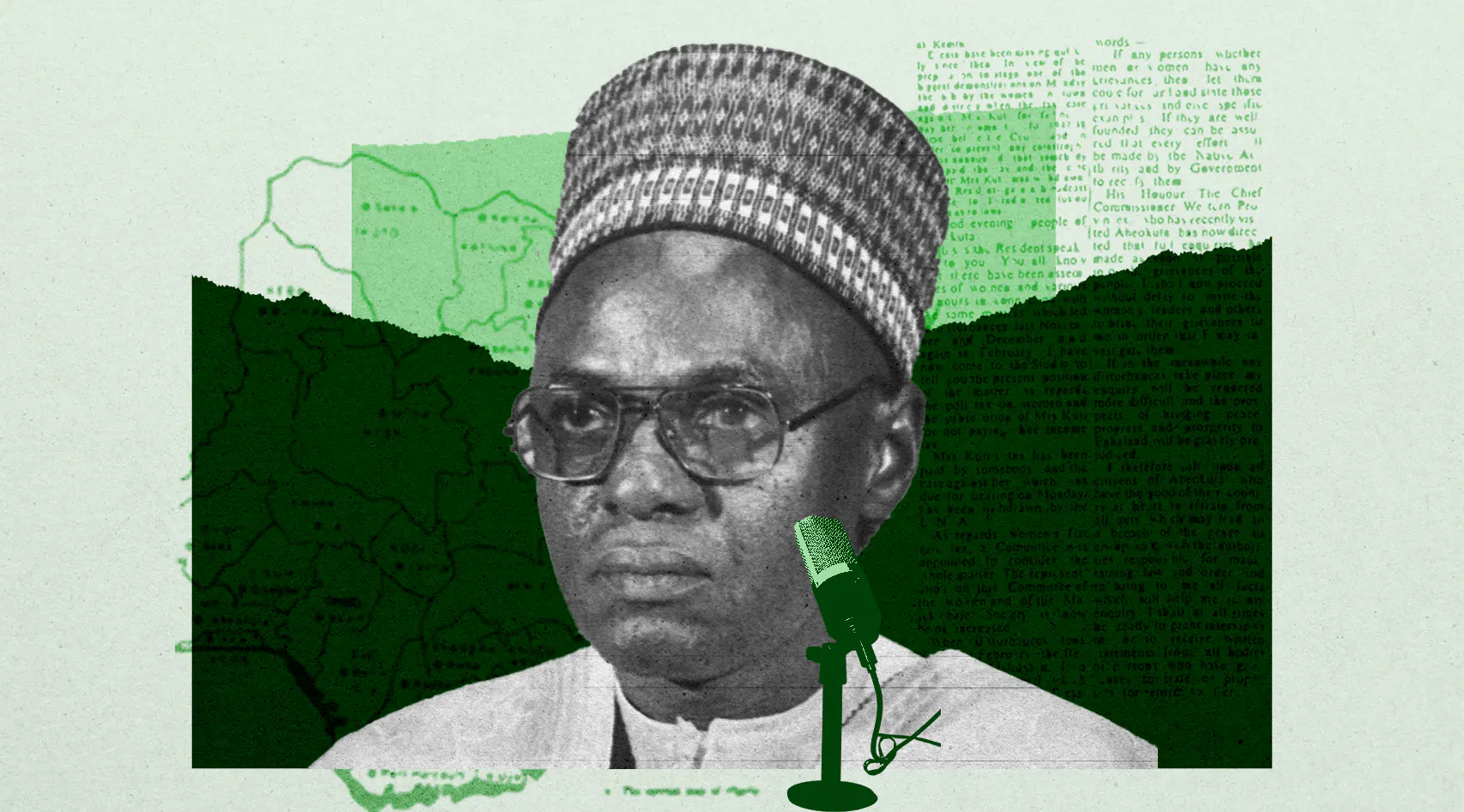
October 1, 1982 Independence Day Speech by Shehu Shagari
Fellow countrymen and women,
Today we celebrate the 22nd anniversary of our independence from colonial rule and for the first time ever in the history of our country, the event is taking place outside Lagos.
I am addressing the nation from the new Federal Capital of Nigeria — Abuja. I know that many who are sitting in their homes either listening or viewing this broadcast would have wished to be present in person among the thousands who have gathered from all over the federation to witness this historical occasion. To you all, I send my warmest compliments and best wishes for a happy celebration.
You will probably recall that at the inception of this administration, I pledged to fulfill our election promise to implement the constitutional provision establishing a new Federal Capital at Abuja.
Today, I am pleased to say that the movement to the new seat of the Federal Government has commenced and will continue as physical development of the city progresses. This, as you are well aware, will suffer some delay owing to our current economic problems.
I am conscious of the fact that millions of Nigerians are, for obvious reasons, anxious to see the nation's new capital built without delay. Let me assure you that, despite financial constraint and at times the orchestrated and unfair criticisms of the project, every effort is being made to execute it as conceived in the approved Fourth National Development Plan, 1981/85.
I wish to assure you all that this administration is executing the new Federal Capital project with a great sense of responsibility and in the best interests of this country.
Fellow citizens, I am sure many of you, especially those who keep abreast of the international economic trend, know that the world is engulfed in an economic recession of almost unprecedented dimensions.
Many countries with highly developed and relatively self-supporting economies have suddenly found themselves face to face with grave financial problems. A few of them have even been declared insolvent by the international financial institutions.
Naturally, Nigeria could not have possibly escaped the adverse effects of this global economic crisis, especially in view of its over-dependence on a single export commodity — petroleum.
It should be recalled that a year ago, our oil production level fell sharply from 1.9 million barrels per day to a mere 600,000 barrels per day. Again from early February 1982, the oil market suffered another serious slump when export fell slightly below 600,000 barrels per day.
Consequently, revenue from oil sales dropped from $14.3 billion to $10.4 billion in 1981. Although the market is gradually picking up, prospects of increased sales and higher revenues remain uncertain while our import propensity had risen to the all-time record of ₦1.2 billion per month. It was against this background that I had to request the National Assembly to give me special powers to introduce appropriate austerity measures to prevent the total collapse of the economy with all attendant consequences. These measures, which are being constantly reviewed for necessary adjustments, have already checked the hitherto unrestrained outflow of foreign exchange through excessive importation and at the same time stepped up domestic production. I call on all Nigerians to see the measures in their correct perspective, designed as they were, to inculcate a sense of financial discipline and prudence in both public and private sectors as well as to promote self-reliance.
I know that it entails sacrifice on the part of all of us but I am confident that we shall overcome the hard times and emerge economically stable.
Whilst we are still very largely dependent on oil revenue for all our financial needs, the necessity for an aggressive crude oil marketing strategy cannot be over-emphasised. Accordingly, I have directed the NNPC to evolve appropriate marketing strategy aimed at ensuring that we maintain our level of production within the OPEC.
In furtherance of our objective to diversify our revenue sources, highest priority rating has now been accorded the liquified natural gas (LNG) and phase II of petrochemical projects. The feasibility reports of the two are being scrutinised. At this juncture, I wish to acknowledge the numerous useful pieces of advice I received from private individuals and organisations on possible solutions to some of the economic problems and to say that this administration will continue to encourage patriotic Nigerians to contribute their quota in this national effort aimed at stabilising the economy.
If we are to succeed in tackling many of the problems that face this nation, we must seriously address ourselves to the task of instilling discipline and high moral standard in our society. As I recently said to a gathering of prominent and respected traditional rulers of this country, "A nation without morals and tradition is like a body without a soul." The need for ethical re-orientation in our society today is no longer a debatable issue. The debate is only on the method, this is how best to achieve the noble goal of putting this great nation back to the path of morality and accountability.
I have observed that previous efforts made by government in isolation to achieve this goal met with no appreciable success. There can be no question that only the combined determination of the people and the governments of the country can achieve the desired result. It is in realisation of this fact that I, after due consultation with the Council of State, decided to set up a panel to study the causes, nature, and extent of apparent breakdown in our national ethics and discipline in all its ramifications and to determine the impact of such ramifications upon the society.
The setting up of this panel provides yet another opportunity for all those good and patriotic citizens of this country who share with me the concern for arresting indiscipline in the society. I, therefore, wish to invite such men and women of goodwill to participate in this great crusade by assisting and fully cooperating with the panel to not only diagnose the ailment but also prescribe appropriate treatment for it.
At this point, it is pertinent to advise those who are more interested in condemning their country rather than help it to cure its ills, and no country is without its share of ills, that law courts and similar institutions established to deal with proven cases of corruption, embezzlement, fraud, etc. are open to them.
Fellow Nigerians, permit me to use this opportunity to formally launch the already well-publicised new policy on education. As you are aware, the new policy was initiated by the previous military administration. Contrary to what Nigerians are made to believe, the policy document was subjected to very wide consultation since the inception of the civilian rule in the country. Even the date of implementation was chosen after a consensus had been reached at the meeting of the National Council on Education. It is envisaged that the products of the UPE scheme adopted throughout Nigeria in 1975 would come under the new secondary education system. It should be explained that the new system will not involve the nation in the construction of entirely new infrastructure as commonly believed.
It will merely add new components of pre-vocational subjects to the existing system. There is, however, no doubt that additional workshops and pre-vocational subject teachers will be required at extra cost. Of course, at the start of the implementation of the policy, the extra cost need not be prohibitive as to frustrate the takeoff of the scheme. I wish to assure all state governments that the Federal Government will cooperate with them to make the scheme an offence.
On the whole, the new system has been commended after very painstaking exercise by our experts in the field of education. The recent call by the Nigerian Union of Teachers in support of the new policy is reassuring.
Here, let me say that I have noted with admiration the efforts of a number of state governments to provide new classrooms and to build workshops for the 1982/83 intake of junior secondary schools and this, being in spite of the present economic difficulties, augurs well for the future and is indicative of our common desire to improve the quality of education for our children which the new system is designed to bring about. I call on the state governments which are still reluctant to implement the new system to endeavour to make a start.
As we approach 1983, the tempo of partisan political activities is rising and yet we must do everything possible to ensure peaceful, free, and fair elections. I, therefore, must appeal to all to eschew bitterness during campaigns as well as during elections. I am not unaware of the complaints from certain quarters against the conduct of the recent exercise of voters register review.
I have been assured by FEDECO that these complaints, where found to be genuine, will be corrected. Furthermore, I understand that there would be an opportunity for those who were inadvertently left out of the exercise to have their names inserted in the register of voters during the period set aside for claims and objections.
In our foreign relations, this administration holds dear the principles enunciated in the charter of the Organisation of African Unity and will continue to subscribe to the United Nations ideal of world peace and stability. Our national interest has always dictated the extent of our contribution to the solution of international problems affecting peace, security, freedom, and development.
In the Middle East, the continuing Israeli aggression in Lebanon and its persecution of the Palestinian people have elicited our deep concern. After careful assessment of the role of the UN Peacekeeping Force in Lebanon, I had decided to recall our two battalion that form part of the force.
However, on appeal by the United Nations Secretary-General who has highly commended their role, I agreed to let them remain to complete the scheduled period of six months. I have since directed the Ministry of Defence not to send any more troops to that country after the return of the two battalions currently serving there.
Aggression
Our relations with Asia, Latin America and Europe have improved significantly in the political and economic spheres as we continue to explore further areas of bilateral cooperation especially with the developing countries. In matters of concern to Nigeria and Africa we have received the support of Asia, Latin America and the Caribbeans.
On the continent of Africa, Nigeria supports self-determination of the people of Western Sahara and all who are allies. South Africa has not relented its oppressive and wicked policies against black people. It has also remained criminally adamant in opposing the independence of Namibia.
Recognition
Now in desperation, South Africa has resorted to all manner of unprovoked military aggression against Angola and other frontline states. On the whole, Nigeria's well-known foreign policy in Southern Africa will justify struggle against imperialism, colonialism and oppression.
Consequently, Nigeria will, as one of the founding members of the OAU, do all it can to ensure the survival of the organisation.
In the Chad and the Horn of Africa, Nigeria supports peaceful settlement to their crises.
In Southern Africa, the racist white minority regime has remained blind to the clear handwriting on the wall. With the subtle support of its partners, Nigeria's well-known policy in Southern Africa will continue to be pursued with vigour. We also urge all well-meaning people of the world, especially those with leverage on South Africa, to exert pressure on that country to return to the path of sanity.
Traditionally, independence anniversary occasions are moments to accord due recognition for services rendered to the nation. I have accordingly, after due consultation with the Council of State, conferred national honours on 142 deserving Nigerians.
The nation can rest assured that the final list of recipients emerged after thorough assessment of the contribution of each awardee. I wish to congratulate all of them for their well-deserved honour and especially Chief Obafemi Awolowo who has been awarded the Grand Commander of the Federal Republic (GCFR), the highest honour that Nigeria can confer on a person. The full list of the 1982 National Honours recipients has been published today in an extraordinary federal gazette.
Impressive
In conclusion, I wish to pay tribute to the members of the Armed Forces, the police, and security agencies for their impressive role in preserving our territorial integrity and internal security. Let me also express my appreciation for the co-operation I have received from the National Assembly and the admirable role played by the Nigerian judiciary in sustaining the rule of law in our democracy. It is noteworthy that in 1982 we have witnessed better and improved relationships among the three arms of government.
Finally, I thank the entire masses of Nigeria for their cooperation, support, and understanding towards the government freely and democratically chosen by them.
May God bless us all.
Source: Daily Times