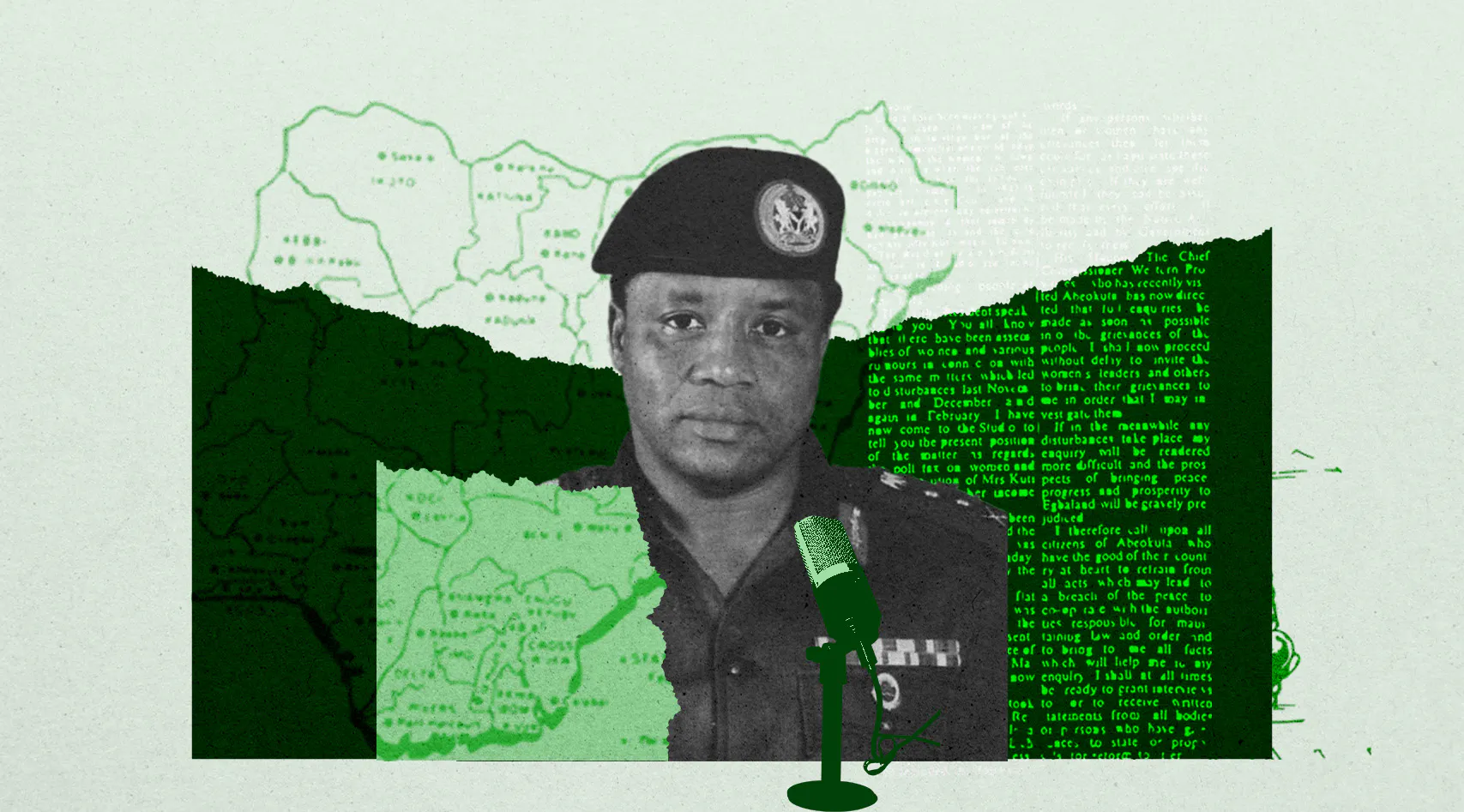
October 1, 1988 Independence Day Speech by Ibrahim Babangida
Fellow countrymen and women,
I salute and congratulate you all on the twenty-eighth anniversary of our country's political independence. Looking back over the years, some people might indeed wonder what cause Nigeria has for celebration. They might point to some ugly feature in our social life; man-made problems like political instability, religious bigotry, crime and violence; or structural economic problems like external debt burden, technological dependency, unemployment and income inequality; or even the incidence of natural disasters like drought, flood, erosion and desertification. For good measure, cynics might even recall our recent unpleasant experience with toxic-wastes dumping and our rather poor performance at the Seoul Olympics.
But really, we have every cause to celebrate. We remain independent, and are fully ready and able to defend that independence. We are a free people in our own land, with the destiny of our nation within our own grips. In spite of all the past turbulence, we remain united and peaceful as a people. Most of our problems are manifestation of a society that is still basically underdeveloped politically, socially and economically. Our pride lies not so much in how many of the myriad problems have been eliminated, but in our resolute determination to ensure that they are all progressively addressed and resolved.
That determination was the very basis of both our political transition programme and our package of economic reforms. The process of achieving our objectives may, indeed, be agonising and sometimes even frustrating. But there is no basis for us as a people to despair. On the political front, we remain a free society committed to pursuit of the democratic spirit. On the social front, there lies beneath our gaiety and cultural pride the essential attributes of hard work and seriousness of purpose. On the economic front, even though progress has been rather slow, we have now started to see positive signals of recovery. What is now needed is an unalloyed faith in the future through a rediscovery of our national self confidence.
Our current efforts should be seen as strides to steady the Nigerian state and to guarantee a bright future for its people in the twenty-first century. We are committed to end oppression, misery and want. Our human rights conviction will continue to find fundamental expression in the democratisation of all institutions that affect our social relations.
At this juncture, I would like to remind you all my fellow compatriots of a salient portion of my National Day address last year. I said then and I say now that the legacy which we owe our future generations is to lay a more enduring foundation for true national development. That is the path of genuine pride and self-esteem for us as a people. But it can only be sustained by patience and determination. It is the central message which should challenge our new leaders in the emerging polity.
In my address to the nation last August 27th, I indicated some of the modest gains that we have made in the three years of this administration. They were made in spite of the enormous obstacles confronting us at every step.
In consolidating and enlarging those gains, it is now important that we change our administrative gear while we remain committed to our basic strategies. This means that as we move closer to another civilian era and foster the democratic spirit, our institutional reforms will be both wider and quicker. The change of gear is soon to begin with the Presidency itself. We need to put in place a more coherent policy-making team and raise the quality and selection process of our top management personnel throughout the public service, including the parastatals and government-owned companies.
To many of our citizens, the economy remains the Achilles' heel of our national efforts. But as I have not failed to always remind us all, genuine national economic reconstruction and sustainable development necessarily involves sweat and pain. Enduring growth is about serious production, not about easy consumption. It is precisely for that reason that we need during this painful adjustment process a deep national understanding and unwavering commitment to that momentum of profound change which we had set in motion these past three years.
We have not always succeeded in making the people fully appreciate the basis of our actions; and this has led occasionally to tendencies to alienate some groups from the national cause. Such alienation, if it persists and grows, can become a hindrance in the body politic through apathy and distrust, no matter how noble the intentions of government. It is in this sense that we shall further intensify our efforts in various forms of dialogue as a primary art of governance. Again, to strengthen public confidence and promote public accountability, all administrative misconducts and corrupt practices must always be promptly investigated and appropriately punished. In pursuit of our policy of open administration and the discouragement of vicious rumours, vital organs of government and financial institutions will be made to regularly update and publish full information on their sources and uses of public funds.
There are nevertheless certain specific programmes and projects which touch on the daily lives of our citizens. Government is not unmindful of the need to alleviate the pains of structural adjustment as they affect the most socially vulnerable groups.
The reality of our national financial resources compels us to put some breaks on our budgetary commitment, impose a firm restraint on domestic credit expansion, reduce pressures on domestic inflation in order to stabilise the exchange rate, and contain the excesses of various financial transactors. But we remain loyal to the spirit of our reflation package as contained in the 1988 Budget. To the limit of our ability, we shall therefore continue to reflect and carefully preserve that spirit even where we are forced to make cuts during the release of budgetary funds. We have managed to avoid simple across-the-board reductions. It is in that light that I wish to touch on a few priority programmes that directly affect the daily lives of our people.
The Mass Transit Programme was a key element of the special reflation package. It was intended to alleviate the transport difficulties of urban commuters, improve the general transport situation, and provide, as an important by-product, employment opportunities for Nigerians. Its emphasis was not to be on the importation of fully-built vehicles, but on the utilisation of chasis in local body construction for private bus operators.
Unfortunately, implementation of the programme has fallen short of our original expectations. Government has therefore decided to revamp the procedure, turn the programme back on its original tracks, and seek a greater involvement by private financial institutions. Interest in the scheme will also extend to suburban railways.
Similarly, this administration continues to be concerned about the availability of basic drugs and dressings in our health clinics, dispensaries and hospitals. To further alleviate the problem, it has decided that the sum of ₦100,000 (one hundred thousand naira) be given directly to each of the three hundred and four local governments for the immediate purchase of such essential hospital drugs and dressings. Each of the twenty-one state governments is also to receive ₦1 million (one million naira) for that same purpose. The teaching hospitals are to share an additional total allocation of ₦6 million (six million naira); and the Federal Ministry of Health is to have the sum of ₦2.6 million (two million and six hundred thousand naira) in further support of its curative health programme.
An area of increasing interest to the government is that of child nutrition, and especially in respect of primary school children. A number of proposals to raise the nutritional status of this group of our future national asset is now being closely considered. From its present tight budgetary resource and in fear of future unmanageable fiscal burdens, we cannot undertake a full welfare programme to sustain a high nutritional standard for all citizens based on government subsidies. But we have decided to make a modest beginning by supporting some pilot schemes based on a systematic sampling of primary school children across all our local governments, aimed at raising their nutritional status and providing much needed knowledge about the content and logistics of a possible full programme in the future.
Government is also anxious to arrest any decline in the quality of our education, considering particularly the pressure of large numbers in our primary schools system. One element of the problem which we must proceed to address immediately is the provision of appropriate and adequate educational materials, text books and teaching aids.
It is a challenge which all those involved in curriculum design, book development, educational publishing and school administration at the primary school level must direct their energies. To this end as well as in pursuit of the earlier pilot project on the nutritional status of children, government has decided to set aside immediately the sum of ₦40 million (forty million naira) under the fiscal control of the Cabinet Office for appropriate disbursements.
During the last several months, government has closely watched the unintended consequences of some of its economic and financial policy measures. In particular, the problem of inflation has been of great concern. We shall continue to address the inherent structural imbalances by a combination of demand management, aggregate supply expansion, and export promotion. While all governments will do everything to keep their fiscal deficits to the absolute possible minimum, the Central Bank will ensure, through the application of appropriate sanctions, that the banking and credit system fully conforms with the laid-down guidelines on domestic credit expansion. It will also take all necessary steps to ensure the smooth, honest and efficient operation of the foreign exchange market through measured guidance.
It has become apparent that our people are becoming increasingly wary of big and complex government. They are becoming apathetic about government activities and are crying out that government is becoming increasingly too distant from them.
This administration is committed to ensuring that our populace at the grassroots participate fully in governance. Already, through the activities of MAMSER and DFRRI, the majority of our people in the rural areas are rapidly becoming enlightened about their rights and are now more alive to their civic responsibilities. We intend to consolidate the achievements made so far by devolving more responsibilities to the local governments and allowing them some autonomy to function effectively as the third-tier of government — which is truly local to the environment.
From our experience, we have realised that local government is closest to the people. It is also the bedrock of our projected democratic order and is admirably well-placed to tackle and resolve most of the issues and problems that confront our people. It is for these reasons that this administration has been trying to ensure that our local governments are managed by responsible, competent and dedicated people, imbued with a sense of service and accountability. We would not, as part of the learning process, tolerate any rabble rousers and political hypocrites. We are equally convinced and determined to make the various local governments the prime centres for social and economic development and the real power base of the new democracy.
In effect, given our commitment to accelerated development of the rural areas, local governments are no longer there to just pay salaries. They are there to ensure collective participation in governance, motivate physical and economic development, create the conditions for employment opportunities, and provide social services which can improve the wellbeing of our people. Thus, in order to fully realise this goal, ensure their integrity as an autonomous level of government, the ministries of local government in all states are hereby abolished with immediate effect.
Furthermore, the state governments are hereby directed to hands off all items of functions which are specified in Section 1 of the Fourth Schedule.
Appropriate laws or regulations required by Sections 1(f) and (g), Section 7(3) and Section 1(a) should be put in place on or before 31st December, 1988. In addition, all states are directed to submit a three-month programme to terminate or otherwise streamline through legislation, joint services being carried out by local governments and supervised by the state governments.
Under this new dispensation which allows for greater autonomy for the local governments, the state governments are to invigorate their local government inspectorate departments in the Office of the Military Governor to specifically offer guidance and ensure the attainment of set targets by the local councils.
We are committed to ensuring that local governments are grafted on a solid foundation. On their part, officials of the local governments should regard this opportunity as a challenge and endeavour to justify the confidence reposed in them. They should see their role as a call to service — a first base for proving their worth and demonstrating their commitment, dedication, hard work, honesty and credibility.
Let me warn that this new political order at the local level is no licence for political and administrative recklessness. The new local government structure and operation must fit into our transition programme. It is a learning process as we try to establish a democratic polity. Therefore, government is determined to closely monitor progress at all levels during the transition.
Let me at this juncture warn overzealous local government officials who may regard the new measure as an opportunity to corrupt the system and thwart our intentions of developing more authority on the local governments, to search their conscience again. They have the option to bow out of service before they are forced out. We are committed to ensuring the success of the new style local government administration which will bring hope and succour to our teeming population.
We have followed with keen interest the continuous demands by various communities for new local governments. The agitations, like those for new states, are rationalised on the need for faster development at the grassroots level, peaceful coexistence and for administrative convenience.
While some of these demands are frivolous, there are many which are sincere and borne out of genuine conviction and desire to bring government closer to the people. We appreciate that not all requests for local governments can be satisfied. However, we are convinced that on the basis of an agreed set of criteria and our commitment to grassroots development, this matter can be adequately reviewed.
As a practical demonstration of the new order, local governments are already receiving their statutory grants directly from the federal government. Such funds are expected to correct much of the imbalance in the spatial distribution of economic and social development. In order to ensure prompt release of funds to local governments by state governments, the proportion of 10 per cent internal revenue of states not remitted to the local governments will now be deducted at source on a quarterly basis. Thus, local governments will continue to be given the necessary freedom and autonomy to operate within the ambits of the constitution, not as mere adjunct to the states but as a truly coordinate and effective level of government.
The Political Transition Programme of this administration is central to the new course that we are charting for this country. The next major item in that programme is the lifting of the ban on political activities, as well as the formation and registration of political parties. In the second quarter of next year, the ban on political activities will be lifted. The process of the formation of political parties as an essential institution of a truly democratic polity would then begin.
Political parties serve the basic purpose of aggregating public opinion and articulating individual and group interests into coherent national policies and programmes for positive action. Given these functions of political parties and the nature of our society, it becomes obvious that we cannot afford excesses such as political intolerance, mudslinging, and recklessness in the process of political party formation. For the avoidance of doubt, religious extremists, ethnic chauvinists and those individuals seeking political alliances on the basis of discredited regional, geographical, religious and ethnic affiliations and historical conveniences will not be tolerated.
What the nation most requires are parties that focus on and articulate the legitimate aspirations of our people for better economic, political, social and cultural opportunities.
From our candid perspective, there are some common ideals to which most Nigerians subscribe. We believe that all Nigerians have a right to life. All Nigerians have a right to basic freedom. All Nigerians have a right to education, to make a decent living and to gainful employment. More importantly, all Nigerians have a right to live anywhere in the country and within a system that operates and promotes social justice. These basic ideals are cherished by Nigerians; and they must be accepted and propagated by the two parties. I am aware, of course, that there may be differences in the approach to these basic ideals, especially given resource priorities and utilisation. The challenge before the parties will therefore be competition of ideas and the strategies for bringing about the greatest good for the greatest number of our people. In effect, the two political parties shall be founded and propagated on fundamental ideas and values of governance.
Political parties formed on the basis of religion will unduly politicise and polarise the nation along religious lines. This can only breed intolerance and sow the seeds of religious conflict. Such persons who propagate this idea are extremists. They will not be allowed to play their debilitating role in the new political order. Similarly, self-seeking regionalists who seek to divide our great country along geographical and regional lines for petty, personal and political advantages are extremists. They too will not be allowed to disrupt the building of our new society.
The new political order must be on the basis of two-party system which we firmly believe will transcend all religious, ethnic, geographical and socio-economic boundaries in the country. The National Electoral Commission is already working on the modalities for the evolution of two national political parties.
Meanwhile, in anticipation of the lifting of the ban on political activities and the formation of the two political parties, government directs that from the local to the federal levels of government, two identical structures be provided for the two parties in each of the local governments and state capitals as well as at Abuja. Our new arrangement must avoid the old situation whereby men of means hijacked political parties from their inception because they provided much-needed resources such as office accommodation, vehicles for mobilisation, and financial assistance.
As we journey to the next year, government wishes to further clarify Decree No. 25 of 1987. There is need to remind ourselves of the distinction between those who are not qualified to succeed the present administration from those who should not be allowed to enter politics now and in the future.
Those who are not qualified to succeed this administration include the military members of the present government and some categories of old political actors (military and civilian) beginning from October 1, 1960 to date.
They are being told to give other Nigerians a chance to try their hands. They are free to come into politics after 1992 if they find that they have a role to play. I still want to appeal to those of you in this category wherever you may be to give the political programme the respectability it deserves.
The second category of Nigerians affected by Decree No. 25 of 1987 consists of those found wanting in their conduct while in public office. Certainly, this administration will be failing in its duty if it does not impose the sanction of total ban on them. This administration believes that it will be failing in its responsibility to the nation if they are allowed to run for public office now or in the future. As a demonstration of government's determination to usher in a new political culture, we have already begun and shall continue to hold regular elections at local government levels, and subsequently at other levels.
As our nation strives progressively to take its rightful place in the comity of nations, we shall maintain our known posture in international affairs. Our foreign policy will continue to have Africa as its main concern and reach out to promote the national interests of this country in all parts of the world. We shall strengthen our commitments to regional cooperation in Africa and the Organisation of African Unity. We shall continue to support the liberation movement in Southern Africa, the non-aligned and the United Nations System.
Our relationship with our immediate neighbours is cordial, and we intend to keep it so. However, recent developments have confirmed that the upsurge in crime and armed robbery which has continued to defy solution despite the combined efforts of the Police, members of the Armed Forces and security agencies is as a result of the unpatriotic citizens in our midst, who have taken advantage of our open-door policy towards our neighbours as a sign of weakness on our part to deal with crime irrespective of its source.
The relaxation of the rules pertaining to international trade and movement of persons across our borders is not intended to provide an avenue for disposing stolen goods or smuggling of banned items, and acts detrimental to our economy. Rather it is intended to strengthen our relationship and provide new opportunities in trade, commerce and other economic ventures for our people. Accordingly, perpetrators of violent crimes who hope to find sanctuary across our borders are hereby warned to desist from their unpatriotic actions which tend to tarnish the country's image abroad and also result in untold hardship to our people. Government has now established a machinery for dealing with this kind of crime, and is determined to stamp it out.
In our efforts to ensure peace and stability in our polity and to create a conducive atmosphere for the implementation of our socioeconomic programmes and the transition to civil rule programme, this administration is now determined to deal ruthlessly with armed robbers and their collaborators wherever they may be. Accordingly, the Armed Forces Ruling Council has decided on a number of measures that will check the increasing wave of crime. As we prepare to launch an assault at home, we are mindful of the fact that to achieve positive results on this matter, we will need the support and cooperation of our neighbours.
I am happy to announce that our neighbours have agreed to join hands with us in combating armed robbery and smuggling which have been a genuine source of concern to our various countries.
I wish to pay tribute to officers and men of the Armed Forces. After resolving our crisis of mission, we have firmly resolved to embark on the journey back to our barracks. Our decision has received national and world acclaim. Our supervisory role is a patriotic act for which future generations will remember us. We must continue to be the protector of our national sovereignty. We should consider ourselves bound by the constitution as the fundamental law of our land.
To my fellow countrymen and women, I wish to salute their courage in deciding to take their destiny in their hands to create a better future for our children as the nation goes through the current economic hardship. The Armed Forces Ruling Council appreciates the sacrifices being made by all Nigerians and the support given to this administration.
Fellow compatriots, I need not emphasise that the transitional provisions envisaged in the proposed constitution should be construed in the context of the military's desire to supervise the transition process. They are not meant to permanently entrench diarchy as a feature of the body-politic in Nigeria. This administration is conscious of its objective of reducing military participation in the political process as the nation moves towards 1992.
The task of creating a greater Nigeria rests on all of us. It rests on our ability to evolve a new and viable institutional framework that will allow for good governance. It also rests on our ability to raise truly committed people to make the system work. In order to realise these expectations, I appeal to all and sundry for a new commitment to and increased patriotic love for Nigeria.
As we celebrate our twenty-eighth year of independence, we must resolve to learn from our past mistakes. We must rededicate ourselves to the noble goals of building a stable, virile and happy nation. Our hopes for the future must be matched with our performances today.
This country has great potentials; and our challenge is basically one of developing the ability to translate these potentials into manifest reality. The Armed Forces Ruling Council believes that, with greater sense of patriotism, hard work, collective determination and purposeful leadership, we can meet this challenge.
I therefore call on all Nigerians to rededicate themselves to the cause of a united self-reliant Nigeria, ready to face the future with hope and confidence.
Long live the Federal Republic of Nigeria. Thank you.
Source: The PUNCH