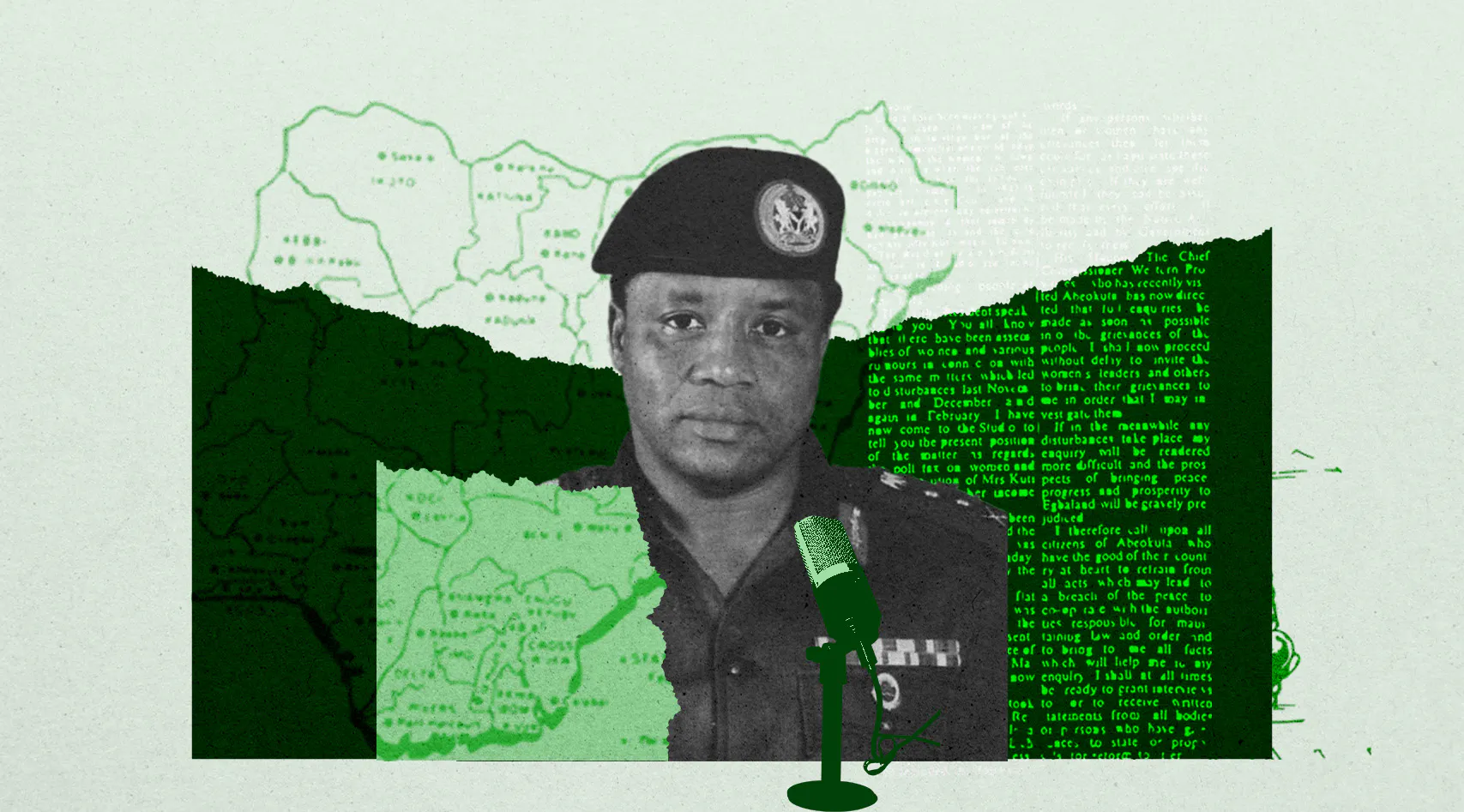
October 1, 1991 Independence Day Speech by Ibrahim Babangida
Fellow countrymen and women,
For over six years now, we have taken on the awesome task of putting in place relevant institutions that define the order and stability of our fatherland. Stage by stage, we have planned and implemented on all fronts in the economic, social, political, cultural and governmental spheres. Our communication with the nation has largely been in the order of reports which seek to explain in detail what our collective problems have been and the policies and programmes for solving them.
In the course of our duties and explanations, we have received applause as well as criticism. Events which are daunting and ameliorating have inter-spaced our march forward. Nonetheless, we have been reinforced in our initial conviction that we should not choose the easy way forward.
On this anniversary, I am not going to speak about the latest episode or phase in our agenda for the nation; rather, I want to share my innermost confidence with Nigerians — our fathers, mothers, brothers, sisters and children who, together, constitute the great family called Nigeria. I wish to remind you all that when this administration took over the government of this nation, we had two options — the first was to merely restore the liberties and privileges that were constrained in the administrations that preceded us and consequently be applauded for being a restorative regime. The other option was to do much more — namely: To take the plunge into the turbulence of our past, and create the basis and foundation of a new future. We decided on the second option.
In the past six years, we have, with the blessed understanding and forbearance of Nigerians, come this far. No one can doubt how profoundly we have touched on every facet of our national life, even though I am aware that many have certainly expressed doubts about how some of these would turn out to be.
Who would not doubt in these times? Who would not hesitate to refashion foundations when the very world in which we live continues to be surprised by events that daunt the will and patience of even the most wilful of men?
When we started on the road to the Third Republic, the global system appeared intact. There were two Germanies; there was the Berlin wall; there was the WARSAW PACT, there was the West and there was the East. Today, all these familiar landmarks are gone. Libraries of received knowledge on this epoch appear now as stories about a ghostly past. The future is doubly problematic — both because it is the future and because its antecedent pasts no longer wear the garment of validity.
What is happening to our world today is enough to make the scientific intellect doubt its own laws. We are part of a world that is daily shifting its base of operation. Those things which were hitherto imponderable phenomena have now become incidents of daily news. In this new and emergent world, Nigeria must find a place.
This administration has decided to reconstruct and rebuild, and to see that Nigeria should hear and recognise its own vital sounds. We do so too, so that the nation can come to a reasoned awareness of the perilous storms through which we are sailing. We are at a juncture in our history in which many people demand of us the proof of truth and certitude. But we cannot give any iron clad guarantee that what we are and where we will be in the years ahead will remain what we want them to be. We have no specific variables with which to measure our advance because there are familiar coast lines to guide our journey forward. We know and acknowledge that our light and lamp are the faith we have in ourselves as Nigerians and it is our faith that we have drawn the strength of vision of a better tomorrow.
Our motto of "Economic Reconstruction, Self-reliance and Social Justice" has proved prophetic. For, when at the very beginning of this administration, we defined our terms of reference in these phrases, we knew, even before signs of it became evident to most people, that there was no other foundation upon which we could build, solidly and effectively. We were aware that we lived in a world of interdependence, but we had come to an early realisation that as everywhere, each nation must come to terms with itself.
We knew then, and much more so now, that our destiny has to be homegrown. We knew also that we must, together as a nation and one people, swim or sink. We decided that as a regime, we would not sink; that rather, we would swim. We would swim, even if it is against tidal currents, because we are held in faith and are convinced in our determination to find the safety of the shores.
We could not direct the governance of this nation if we did not believe in ourselves. We could not have dared what we did if there were no Nigerians from all walks of life who are truly attuned to our vision. We believe and do affirm that what the nation requires is a leadership that recognises the problems at the roots of our national life; a leadership which decides to risk its will and reputation to solving these problems. We hold firmly to the belief that our Nigeria of tomorrow is precious enough for us to sacrifice our today. It is out of that conviction that we took decisions upon which we have built.
You will remember that at every critical turn and bend, we have been pressed to name our government in ideological terms. Some have wanted us to be called by this or that label or tradition of thought and governance. We declared then, and do restate it now, that our problem is not one of "isms," but of creating arrangements that would give every societal tendency a sense of being part of the process of growth and development of our nation.
What we know about the foundation of our society and the experience which we have been through, are enough to convince us about the wisdom of our approach.
We inherited a Nigeria of contending polarisations and dichotomies: North versus South; Liberal Democrats versus Socialists; Sectarianists versus Secularists; Modernists versus Traditionalists. Today, we have put in place the processes of building a new Nigeria to gradually replace a pernicious inheritance. We believe that current reforms and policies will, over time, compel the extirpation or reduction of these issues and transform the social and political landscape of our great country. We have created party structures, rules and processes that induce consensus, political tolerance and accommodation.
We have refashioned the economic environment and capabilities that make control of the executive branches of government less and less attractive. We have consciously created conditions of existence that shift resources away from mere patronage to those of productive work, especially at the mass and grassroots level. We have put in place a set of arrangements, the stable and effective operation of which will obviate the overriding influence of sectarian lines of division. We remain confident that the processes which we have engineered will be deeply rooted to the extent that in the future, they would only need to be refined and finetuned.
We are even gratified to note that the world outside Nigeria has found hope in what this administration called, in 1988, "pluralist democracy." We did what we had to do. Today, the world outside our shores has mounted a crusade to propagate it everywhere and to everyone.
To those who specialise in finding foreign antecedents for every idea that we have enunciated and made our own, I would invite them to find another regime outside Nigeria to decree a two-party system into existence. When we took our decision, this is what we said:
You will also have found that some citizens are unhappy with the Armed Forces Ruling Council's decision to accept the recommendation of the Political Bureau to limit the number of political parties to two. Our decision pays the greatest respect to the objective views expressed on the sources of disorder, instability, violence and discord in our political experience as collated by the Political Bureau. It pays even greater respect to the commitment of the nation in all previous experiments to promote the unity, harmony and fusion of all our peoples into one strong and indivisible entity. Moreover, it gives practical expression to the widely accepted need to avoid the noise, the clamour, the confusion and the violence which had been the bane of our partisan political experience.
No political system survives through the multiplication of areas and units of conflict and discord. Moreover, those who claim that our decision violates the principles of freedom of association need to think again. The principle itself is not violated so long as a one-party state is not decreed. The freedom to choose is satisfied so long as an alternative avenue exists. Whatever critics of our stance might say, principles must be exercised in the context of basic and fundamental factors in any given situation. Our decision, therefore, is meant to put an end to interethnic and interpersonal feuds which dominated the pattern of partisan politics in the past. Nigerians must learn to fit into the two-party system.
The most appropriate and balanced option before us and, indeed, the nation, is the enactment of the Social Democratic Party and the National Republican Convention. Because of the structural intimacy within the regulative structures and rules of the two-party system, the process of decision-making has now induced the downplaying of interests which ordinarily and historically would convert political opponents into unnecessary enemies. True enough, religious practices and principles will always divide Nigerians into different communities of worshippers. But it is equally true that the need to mobilise voters and meet constitutional requirements for electability and legitimacy is bound to transcend religious and communal differences, in order to establish winning combinations and alliances of winners. In all these, we have achieved the integrative process of social communities without undermining their differences we have achieved a nation without destroying the bases of privacy and commitment.
Most importantly, we have sought to develop the cross-cutting ties that constitute the web of nations; and without mounting a crusade against secularity or spirituality. This has been our method and, indeed, our hope. It is left to us to submit to the discipline and logic of its validity. I am aware that no government can command enlightenment or drive a people into the avowal of principles that enlightened self-interest advocates and advertises. I believe, however, that, as a people, once we are aware of the folly of vindictive obstinacy, we shall easily recognise the need to submit to our faith in the bright future of Nigeria.
We have been firm in the choice of paths and plans, yet we have never been dogmatic in the decisions and actions of our administration. We have been principled, yet pragmatic. We have never failed to define, articulate and specify our objectives and expectations. We have always been guided by our own vision of a New Nigeria.
We have dared to stress and spell out the prevailing values which inform our conduct. Thus, concerning the economy, we had said, among other things, that the restructuring of the way we reproduce our living must involve "new uses of wealth, new property relations, new products and production processes, new attitudes to work, new consumption processes, new consumption habits and new interactions with the rest of the world". The values expressed in those words remain our guiding light and the basis of our confidence on the Third Republic.
On this anniversary of our independence, I call for a sober assessment of the import of the challenges with which we began to refashion the institutions and values of the nation. There is no way we can afford to remain in the past and yet operate successfully the institutions of the Third Republic with consonant attitudes. We have risked popularity today so that future generations can enjoy the glories of their tomorrow. I am confident that in the progress of our people, in the confidence of our leaders of tomorrow, in the durability of our democratic procedures, Nigerians will find commendations.
I am grateful for the patience, forbearance, tolerance and understanding extended to us as we have waded through the turbulent seas of uncertainty. I am even more grateful for the support of our people and the guidance which the Almighty Allah has given us to draw from the wealth of our experience.
Nigeria is a great nation. The new Nigeria which we are building will give it an assurance of a greater and better tomorrow. God bless Nigeria. God bless her people.
Source: Daily Times