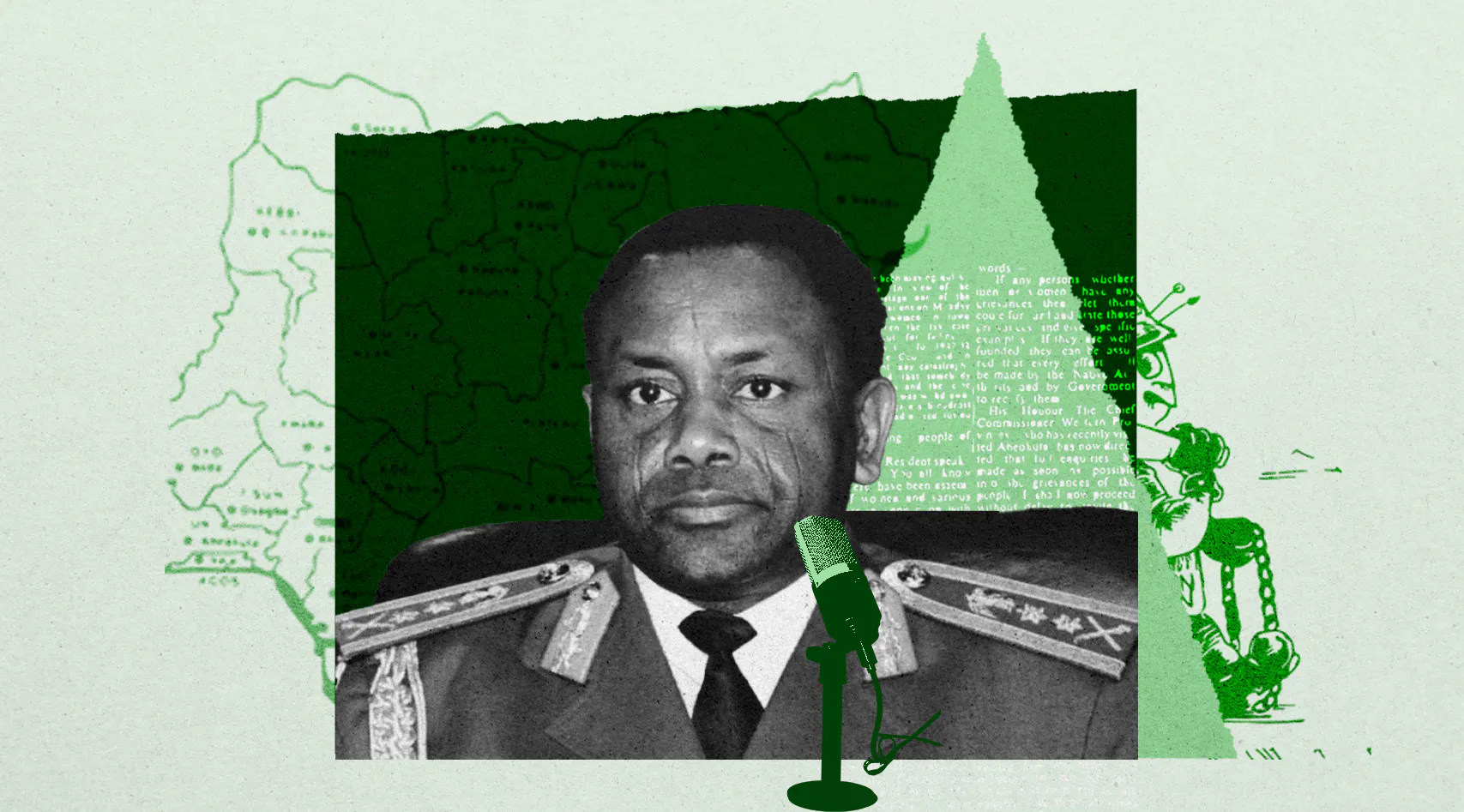
October 1, 1994 Independence Day Speech by Sani Abacha
Fellow Nigerians,
A few days ago, our great nation attained the 34th anniversary of its independence. The milestone was understandably observed with low-key celebrations, for the occasion afforded us an opportunity to reflect not only upon the current state of affairs in our country but also upon the wider political and economic heritage which we have cultivated during this past third of a century of sovereign self-rule.
Fellow Nigerians, we have come a long way from the soaring optimisms that greeted our nation's independence in 1960. Thirty-four years ago, our hearts were filled with the promises of a vibrant young nation enriched by its human resources and sustained by its material endowments. These aspirations were given vent by our founding fathers in the visions they articulated and with which they carried us along. We believed, rightly, that our country and its people had the capacity, the inventiveness and the energy to create the chances and submit to any necessary sacrifices that would take us to higher heights and earn us an enviable place among the nations of the world.
This confidence was anchored on the fact that we already enjoyed a strong foundation in educational institutions, that we were widening our access to modern health facilities and that a budding though limited industrial base was in the offing. Our economic potentials were readily obvious long before oil became the mainstay of our economy. Nigeria was awash with groundnuts, rubber, cocoa, manganese, bauxite, tin, coal and hides and skins, The days when Nigeria was an export nation in these products seem so far away today.
Our great nation is blessed with a fertile soil upon which an agricultural revolution could have taken off. Indeed, it is correct to say that Nigeria is an agglomeration of farming communities. Even today despite the exodus of able bodied young men and women from the towns and villages which form the heartland of our nation, the greater majority of our people continue to live off the land. There was a time when our people bent over time-worn equipment and toiling in back-breaking traditional methods supplied sufficient food to feed us at affordable rates. Today, our country is a major importer of food for which we have to struggle to pay.
It is ironical that even when, seven years after independence, our country was enmeshed in a tragic and wasteful civil war, the financial burden of the war was entirely internally financed. The phenomenal expansion in the oil sector which coincided with that devastating experience increased the benefits to the national coffers at such a pace and to such an extent that our country was willing and able to embark upon a massive programme of rehabilitation and reconstruction.
But regrettably, amid the euphoria of lush earnings derived from the boom in oil revenue, we became encapsulated in the novelty of a national spending spree. Extravagant personal lifestyles became the norm in a new Nigeria where people developed an insatiable appetite for imported goods. Abroad, the Nigerian acquired a larger than life image as a big spender. In truth however, we were exalting in the self-indulgence of borrowed time.
Gradually and perceptibly, Nigeria began to slide into a mono-factor economy. Today, we have become almost exclusively, dependent on revenue from oil. The warning lights of the risks inherent in this over dependence began flashing a long time ago. It began with our failure to plan for the eventuality of a fall in production which, when it came, was accompanied by plummeting world market prices of the crude. We were neither prepared to absorb the shock nor ready to make any sacrifices. On the contrary, we simply carried on as before.
Fellow Nigerians, many of you will recall that the costs of foreign capital goods necessary for our development programmes rose exorbitantly during that same period as a result of prevailing world conditions. Even the essential imported raw materials which were required to feed our nascent industries were purchased at the sudden upward movement in costs. Added to these, we had to contend with foreign debts accumulated from reckless and uncoordinated borrowing by various tiers of government going back into several administrations. Compounding all these also was the failure to service payment schedules at due dates.
Thus, we find ourselves today floundering in the throes of a situation whereby we spend 65 per cent of our total revenue on recurrent government expenditure, while 30 per cent goes to service our debts. This means that at the end of the day we are left with a mere 5 per cent for capital expenditure. It is obvious that under this circumstance, sustainable growth is severely and adversely restricted. So also is the maintenance of existing infrastructure. Hence, the need to re-assess and re-order our priorities. We need a re-orientation in our national psyche. A free and democratic society cannot germinate in a society where hunger, disease and mismanagement replace orderliness. Unless and until we buckle down to tackle the unending cycle of economic malaise in which we are caught, we shall continue to wrestle with the search for democracy.
There is nothing altogether original in saying that our country has made mistakes—mistakes in planning and mistakes of unpreparedness. However, the most fundamental, yet seldom mentioned mistake of them all, is our failure to confront our erring ways and to make the sacrifices without which our best aspirations will remain elusive. We have continued to pile debt upon debt as though blissfully unaware that the days of reckoning have been upon us for longer than we care to remember. Against a background of an inherent culture of tax evasion for instance, we entertain high expectations of our government without adequately measuring the corollary of our individual responsibilities for the common need of society. Long after the days of the honeymoon were over, we sought escape in the illusion that we could avoid having to swallow hard medicines.
When this administration took office less than a year ago, it did so on a tidal wave of goodwill. Yet, we were conscious that lurking in the shadows was a deep seated lack of faith among our people in the institution of government. Over the years, a fundamental distrust that promises made by leaders are soon forgotten became a cynical way of life. That notwithstanding, this administration pledged itself to take difficult and far-reaching decisions. A drift had engulfed our nation and we assumed office with the defined purpose of a rescue operation.
Since then, every policy initiative, every decision executed by this administration has been inspired by that single-minded commitment to our earlier pledge. We remain determined that at the end of the tenure of this administration, we would have set a worthy example by the courage with which we made difficult but vital decisions. Our quest is to fulfil the long-term interest of our country. In particular, we are determined that we shall not play to the gallery.
Fellow Nigerians, a nation prospers if its people understand that a government does not function like a fairy godmother. Over the years, we have sought to survive on the erroneous concept that government has access to a secret and gushing source of unlimited finance from which it can draw on to meet all our demands. In this sense, the average Nigerian has come to believe that the government perpetually possesses the resources with which to absorb our national economic problems without having to call upon us to make sacrifices.
In recent times, the production cost of our crude oil has risen. It is self evident that the previous cost of ₦3.25 per litre was grossly underpriced. So Nigeria has consistently subsidised her domestic consumers. The recent strikes and disturbances which involved large scale destruction of infrastructure, power stations and refineries were characteristic of the periodic disruptions which have been the bane of the Nigerian oil industry. Frequent shutdowns have resulted in high maintenance costs and expensive turnaround. Billions of naira have been lost. At given-times, we have had to import refined petroleum to satisfy the domestic demand because of industrial unrests and sabotage which brought a halt to local production.
During these periods of stress, government paid for importations in hard currency and at prevailing international price. These were then resold to the domestic consumers at the subsidised rate. Thus, in addition to an otherwise needless foreign exchange expenditure, the national coffers were further depleted by the support given to consumers locally. Added to all these is the fact that each time the industrial unrest compelled the refineries to be shut down, government had to pay in foreign currency to restore production. These colossal sums had to be diverted from other commitments such as the provision of health and educational facilities and the acquisition of life-saving drugs.
As if all these were not enough, we have suffered the aggravations of the massive smuggling of petroleum products across our borders into neighbouring countries by greedy and unpatriotic collaborators. Within Nigeria, some shylock dealers have during the past weeks posted the price of petrol per litre in excess of ₦10 making away with huge illegal profits.
At the end of the day, what we spend must come from what we earn. We may delude ourselves that we can continue to live on borrowings and debt rescheduling. We can continue to contrive subsidies and try to postpone yet again that day of reckoning which has already come! But that will be chicken-hearted of an administration that has publicly and firmly declared itself to make the hard decisions for the sake of the ultimate good of our country and our people.
And so, on Sunday 2nd October, 1994, this administration drew the proverbial line in the sand. Consequently, the NNPC introduced new pump prices for petroleum products. The new prices did not necessarily entirely remove government subsidy, but may have been too sudden to the ordinary Nigerian. Government is mindful of the trauma which this sudden change would have on the majority of our citizens. In as much as we are desirous to accelerate the pace of our economic recovery, we must be careful that the steps we take are done in such manner that the overall well-being of our people is not seriously jolted.
It is under this circumstance that I feel constrained to intervene and adjust the new prices as follows:
- PMS (Petrol) - ₦11.00 per litre
2 AGO (Diesel) - ₦9.00 per litre
- FO (Fuel oil) - ₦7:00 per litre
- HHK (Kerosine) - ₦6.00 per litre
With this pricing, it can be rightly said that this exercise, although an increase on the existing price levels, government is still substantially subsiding the cost of petroleum products for the consumers. Nevertheless, whatever savings that may be made from this exercise is needed for other urgent socioeconomic programmes. The fallout from this policy is that there must be some adjustments and discipline among all our citizens. We do not anticipate undue hardship among the generality of our people. I should point out that despite the introduction of the new price, the cost of petrol to the Nigerian motorist remains the cheapest in the world.
Even so, appropriate measures are being taken to ease the transition. Specifically, I have approved a welfare package tailored to alleviate the immediate burdens of those most likely to find it difficult to cope with the changed circumstances in the immediate future. In this regard. I have approved the immediate purchase of 1,000 Mass Transit Buses to improve and strengthen the Urban Mass Transport System. In addition, I have approved an upward review of some allowances currently in operation in the public services. The details of these will be elaborated by the appropriate ministry. These measures are effective from the 1st of October, 1994. In this regard I appeal to all our transporters nationwide not to exploit this situation by any arbitrary escalation of transport fares.
It should be emphasised that if we must generate income to cater for and develop other sectors of our economy and establish a permanently viable infrastructure for sustainable growth, we must accept the need for a realistic pricing of our petroleum products. It is expected that by the adjustments in the pricing of petroleum products some substantial savings will be made to this country.
Fellow Nigerians, I want to assure you that these savings will not be absorbed into the Federation Account nor will they be allowed to disappear into the tortuous bureaucratic melting pots of ministerial systems. I have directed that a Special Account should be established immediately in the Central Bank of Nigeria into which all these funds will be paid and held. Our plan is that this opportunity of earning additional revenues must be utilised to improve the scope and quality of key infrastructural services to the benefit of the generality of our citizens.
The key sectors agreed upon are:
- Roads and road transportation; including mass transit in large cities.
2 National railway transportation and waterways.
- Education
- Health
- Food supply
- Water supply
- Police services, relating to the security of citizens
- Alternative source of domestic energy
- Rural development programmes
Further elaborations on these areas would be provided soon.
Consequently, a Special Trust comprising of Nigerians of proven integrity will be set up to manage this fund. Special funds will be allocated, drawn from the Special Trust Fund to each of these sectors when created for the execution of the specific projects within a given time frame. A task force will be established to manage each of the sectors. I must stress that the innovative and far-reaching measures which will follow the rise in the cost of petroleum products are without prejudice to other equally carefully planned development in other sectors of our national endeavours. There are concerns such as the supply of electricity and efficient communication network which continue to engage government attention and for which much forward planning is being undertaken.
Fellow Nigerians, our present situation calls for a nation tightening of belts as well as personal sacrifices by every one of us. As parents, we strive to give our children a good start in life, hoping that their future will be an improvement other than the life we knew. We must understand that by living beyond our means, we are mortgaging the future wellbeing of our successors. No good parent consciously plans to burden her heirs with crippling debts and obligations. In the same vein, our generation must pause to think that it is precisely when we risk bequeathing to those who will follow us. Will they remember us with pride and gratitude, or in bitter resentment? It lies within our grasp to ensure that their inheritance is not the begging band of a debt-ridden society.
Government acknowledges that there are, at this moment in time, difficulties within our socioeconomic systems. The impediments which stare us in the face are not insurmountable, but they are not to be trifled with either. We should rejoice in the knowledge that the accident of fate has chosen our generation to lay the foundations that could form the bedrock upon which a future great nation will rest. We look to the future with hope and courage, knowing fully well that at this critical juncture in the history of our nation, we are taking vital steps for the upliftment of our fatherland.
Thank you and God bless you.
- In 1994, unlike most presidents, Abacha delivered his Independence Day speech on October 4.
Source: Daily Times