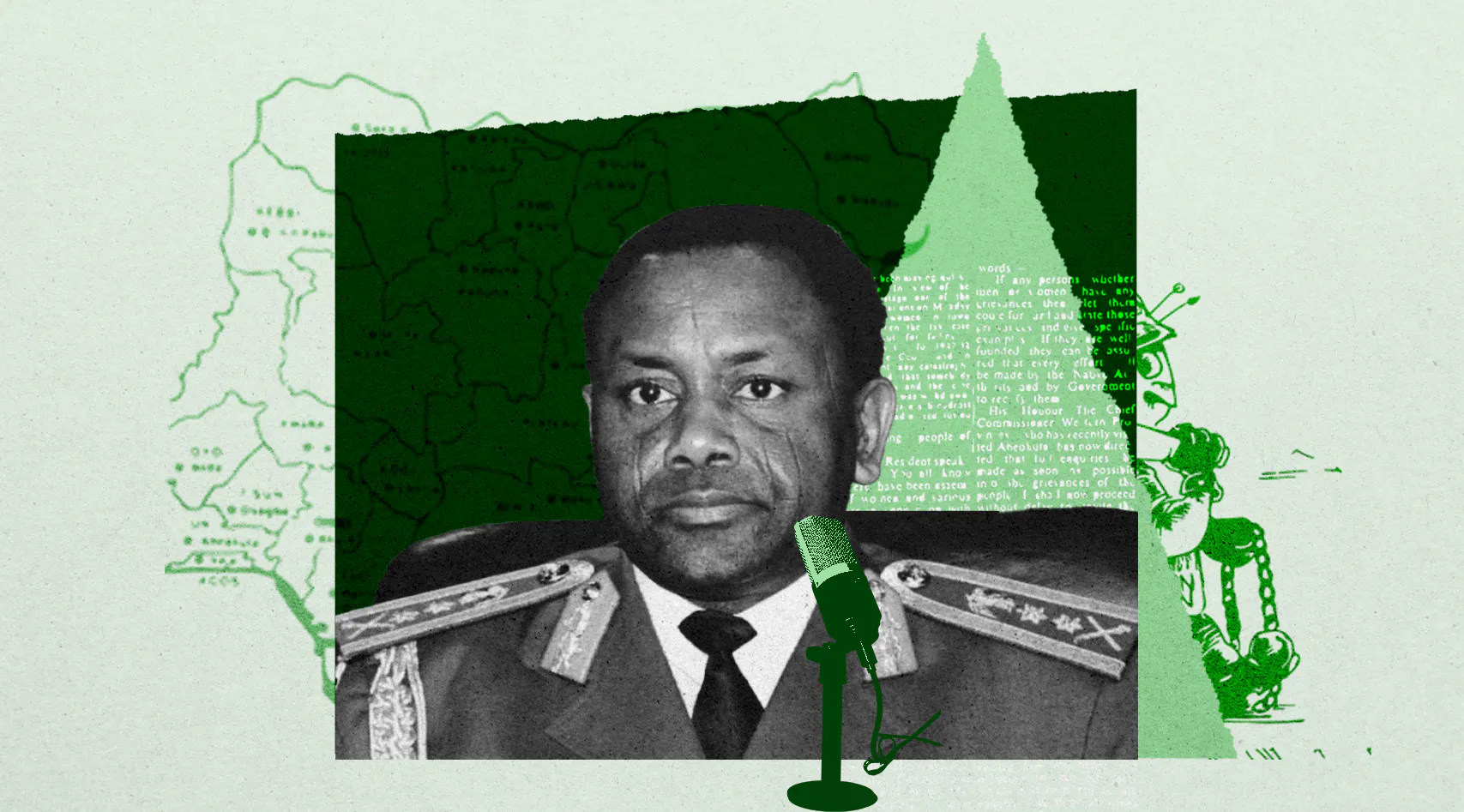
October 1, 1996 Independence Day Speech by Sani Abacha
Fellow Nigerians,
I am happy to address you on this important occasion of the 36th anniversary of our political independence which marks the beginning of a glorious era. I seize this opportunity to salute the memory of our founding fathers who endured all hardships to bequeath to us a prosperous and resilient nation.
This year's independence anniversary is coming at a time of great national transformation. As we continue to move along the path of success and progress in all sectors; we should rededicate ourselves to the cause of our great nation and attain yet greater heights in all fields of our national endeavour.
In my national day broadcast in October last year, I announced the transition programme leading to a democratically elected government on 1st October, 1998. The various transition institutions were accordingly established and commenced work within the terms of reference given to them. I am happy to state that a considerable measure of success has been recorded since my last national day broadcast. At the same time, I announced our commitment towards achieving economic stability and progress which are basic for the political and social stability of our nation.
Following the remarkable success of the operation of the 1995 budget and the economic reforms of the same year, we launched the budget of consolidation in 1996. We considered it necessary to consolidate on our gains of the previous year and move our nation forward. I am happy to state that the mid-year budget report and independent assessment of the performance of the economy in 1996 have shown greater success over that of the previous year. We have now achieved considerable economic stability in various sectors and are in a position to plan ahead for the future.
Having effectively checked all areas of losses and wastages, we have met all our revenue targets in both oil and non-oil sectors. The heavy deficit level which has adversely affected the operation of our budget and the performance of our economy for over a decade now has been reversed. While in 1995 we recorded a surplus of ₦1 billion, our mid-year review shows prospects for a higher level of surplus at the end of 1996. We have achieved macroeconomic stability in our exchange rate and interest rate regime. As a result of all these, inflation is well under control and it is our hope that in the not too distant future, all other negative trends in our economic and social lives will be effectively controlled. In particular, government will put in place the appropriate policy measures meant to bring down cost of foodstuff, goods and services. In the meantime, I appeal to manufacturers to respond positively to the various tax incentives and other policy measures to lower the prices of their goods and products.
With our political transition programme very well on course, the prospects for stability, peace and unity will continue to be greater. The successful conduct of the local government elections earlier in the year, formation of political associations and the process of registration as political parties, administrative reforms undertaken in the civil service are all positive signs of bright prospects for our nation.
Vision 2010
Fellow Nigerians, the concept of Vision 2010 is being adopted at this stage of our development to enable us appreciate the importance of long-term planning in achieving national self-reliance, economic strength and political stability. It arose out of our historical experience of the post independence era where successive national plans and strategies for development were conceived of and executed on short-term and ad-hoc basis.
Our nation has in the last three decades missed the opportunities to harness its resources properly, control areas of wastage and utilise such resources for development-oriented projects and programmes. We have also realised that, in all that we did, the mobilisation of our population in the rural areas towards meaningful development has not been effectively achieved. This state of affairs has led to a continuous rural-urban drift creating serious socioeconomic problems for our people.
It is our hope, therefore, that a solid foundation for our progress and success could be achieved within the framework of Vision 2010. The first step is to identify where we went wrong and then consolidate our gains as a nation. Happily, this is the time to do so, having achieved within the last two years a substantial level of macro-economic stability, unity and peace. This is a period of stock-taking, a period to get the correct bearing for our nation, a period during which all hands should be on deck.
We should prevent a reversal of our major gains while exploring new grounds that should launch our nation successfully into the twenty-first century. The prospects for success are brighter now than ever before and we must not relent in our efforts. The future generation of Nigerians would expect from us this enormous but noble responsibility. It cannot be delayed any further. Accordingly, I urge all our country men and women to be part of this nation-building process.
To ensure the success of the Vision 2010, government has now decided to set up a high-powered committee, headed by Chief Ernest Shonekan, former head of state, an industrialist of international repute, to put into clear focus, and channel the course of Vision 2010. The committee which will be composed of representatives from all sectors of our economy and public life will be charged with the responsibility for defining for our nation its correct bearing and realistic sense of direction. It will specifically examine those aspects of our economy which should be developed and strengthened. It will set goals and appropriate target for our economic growth and social stability. Our vision should focus on such important indices as Gross Domestic Product (GDP), literacy level, employment prospects, inflation control, health service delivery, agriculture, industrialisation and development of science and technology.
Fellow Nigerians, let me restate the fact that no nation can grow and develop without its own vision, its own original ideas, its will and determination to achieve true independence and sovereignty.
We are not unaware of the social crisis that has adversely affected the growth and stability of our nation in the last three decades of the attainment of our political independence. The problems of unemployment, crime and poverty which have affected our society for some time now must be addressed on both short and long term basis. Already, government has taken all the necessary steps to deal with these problems effectively. The various policy measures introduced in the last two years are meant to tackle such problems. The various projects being implemented under the Petroleum Trust Fund, and the National Rolling Plan will have a long-term stabilising effect on the social sector in particular, and on the nation in general.
Fellow Nigerians, in realisation of the problems that have brought about economic recession and instability in our country, this administration introduced some far-reaching measures to sanitise the system and instil some discipline in the operation of the economy and public service management. Already, the Failed Banks Decree which has come into effect has sent positive signal for recovery and sanitisation in that sector. This policy will be maintained and further extended to other sectors with similar problems. The Failed Parastatals Decree will come into effect before the end of the year. As I have always stated, positive growth and development of our economy cannot be achieved without a serious restructuring and sanitisation of the system that supports our socio-economic and political development.
Education
Fellow Nigerians, the perennial problem in our educational sector has been a major cause for concern to this administration. The crisis in the sector covers all segments of our educational system, from the primary to the tertiary levels. We do realise that the crisis arose out of the cumulative effect of several negative forces both from within and outside the sector. Their solution therefore has to be gradual but effective and long-lasting. Accordingly, government has decided to set up a high-powered committee consisting of eminent professionals in the field and other well-meaning Nigerians to examine the problems that have retarded our educational growth and proffer solution for the restoration of normalcy to our national education system.
The committee will be charged with the responsibility of closely examining all past and present policies of education and to identify the areas of major constraints. Their focus will be the improvement of quality of education, the relevance of our various educational programmes and the structures already put in place to manage our educational system.
Let me convey government's appreciation to all well-meaning Nigerians who have shown their concern and interest in our educational sector and who have contributed in many ways to the effort in restoring normalcy to the system. I commend the effort and concern of the Committee of Elders and Traditional Rulers and the issue of education in particular on all other matters of national interest.
Creation of states and local governments
Fellow Nigerians, as part of the ongoing transition programme, this administration has undertaken to examine the issue of state creation, local governments and boundary adjustments. Accordingly, I inaugurated the committee on Wednesday 13th December, 1995 to study all demands for new states, local governments and boundary adjustments in all parts of our country. The committee's terms of reference charged them to consider each case on its own merit and make appropriate recommendation for consideration and approval by the Provisional Ruling Council. In view of the enormity of the assignment, it took the committee a longer time than scheduled to submit the report.
I am happy to state that government has now studied the report of the committee and decisions on their various recommendations have now been taken by the Provisional Ruling Council. In arriving at the decisions, government took a number of factors into consideration. First, the exercise of state creation is not new to our nation. Since independence, 36 years ago, our nation has grown from a three regional structure to a 30-state structure with a Federal Capital Territory and 593 local government councils. This rapid and enormous expansion of our political and administrative structure within less than four decades has continued to exert heavy pressure on our economy and system of governance.
The current exercise was embarked upon in response to the growing demands for additional states and local governments by people from various parts of the country. It was also one of the major items on the agenda of the National Constitutional Conference which was passed over to this administration for resolution. It is our view that where genuine cases exist, they should be treated on their own merit within this period of transition. In this way, it is hoped, government will help minimise any pressures or unresolved issues which may impede the stability of a democratically elected government.
Although various reasons were given to support such demands, we must be conscious of the fact that proliferation of states and local governments is not the ultimate answer to our socioeconomic development. Nor is it the best solution to the problems of marginalisation or inter-ethnic and communal conflicts. This administration has not embarked upon the exercise to encourage separation of peoples and communities who have lived together in peace and harmony for many years. It has been our desire to see that bonds of community relationships that existed from time immemorial among our people are strengthened at all times.
As we move along the path of a new political era for our country, we should cultivate new sense of unity, patriotism and long lasting bonds of relationship. The spirit behind my inaugural address to the committee and their terms of reference have emphasised the reinforcement of our unity and self-determination. The entire exercise should therefore be seen for administrative convenience and necessity rather than the separation of peoples and communities.
I am aware of the large number of requests made for states, local governments and boundary adjustments. While some of the demands were genuine and capable of improving upon the administrative machinery of government, many could not be justified within the present context of our economy and administrative structure. The committee received a total of 72 requests for states, 2,369 for local governments and 286 for boundary adjustments. While it made recommendations for the creation of some states and local governments, it made very limited recommendations for boundary adjustments, due to the complex and technical nature of that exercise. Boundary adjustments will now be undertaken as a separate exercise by a panel to be set up by government for the purpose.
Creation of new states
The principle adopted for the creation of states and local governments was to ensure a fair spread and balancing within the geopolitical zones of the country applying such criteria as population and land mass, among others. Accordingly, six new states are hereby approved, one each from the six geopolitical zones of the federation as follows:
- Bayelsa State with headquarters at Yenagoa is created out of the present Rivers State. Bayelsa shall comprise eight local government areas.
- Ebonyi State with headquarters at Abakaliki is created out of the present Abia and Enugu states. Ebonyi State shall comprise 13 local government areas.
- Ekiti State with headquarters at Ado Ekiti is created out of the present Ondo State. Ekiti State shall comprise 16 local government areas.
- Gombe State with headquarters at Gombe is created out of the present Bauchi State and shall comprise 11 local government areas.
- Nasarawa State with headquarters at Lafia is created out of the present Plateau State and shall comprise a total of 13 local government areas.
- Zamfara State with the headquarters at Gusau is created out of the present Sokoto State and shall comprise a total of 13 local government areas.
Creation of local governments
In considering the creation of new local government areas, the Provisional Ruling Council approved equitable distribution of the number of local governments based on 30 per cent increase over the existing number of local governments in each of the states of the federation. A total of additional 183 local government areas are hereby approved. The details thereon will be released soon.
Fellow Nigerians, as we are very well aware, the exercise of state and local government creation entails considerable amount of administrative work to ensure a smooth takeoff. Government therefore expects that all those charged with the responsibility for ensuring the success of the exercise will do so with great sense of responsibility and commitment. Implementation committees have now been established to monitor and coordinate the various administrative work involved in the exercise.
In carrying out these assignments, it is important that all past mistakes are avoided. Therefore, there should be no festivities and jubilation or ill-feelings among communities over the new states or new local governments created. There should be responsible and orderly behaviour over matters of asset-sharing or movement of personnel. New states and local governments should settle down to business without any delay.
The task of development which was uppermost in the presentation of the various memoranda from those who demanded new states and local governments is a challenging one. It is important that the issues of development plan and production are addressed realistically by all proponents of new states and local governments in order to justify their pledge to the people and the nation. The Federal Government will not provide special takeoff grant beyond what is budgeted for in the federation account for states and local governments. The impression should not be created that more resources will be channelled to new states or local governments. This is the time when everyone should work hard and contribute to the development of our nation. In keeping with the philosophy of this administration, all areas of wastage and loss of resources should be avoided in the establishment and management of states and local governments.
Registration of political parties
Fellow Nigerians, as you are aware, the process of the formation of political associations and their registration as political parties commenced in accordance with our political programme of transition. To facilitate the success of this process, the National Electoral Commission of Nigeria (NECON) issued the necessary guidelines to ensure that associations applying to register as political parties achieve the required national spread and the necessary structures that would make them viable organs of unity and cohesion.
It is important to state that in a democratic process the political party is the main vehicle for promoting unity and mobilisation of the people. Political parties should be strong enough to mobilise support and sustain themselves against the intense competition for elective offices at the various levels of our political system. Political parties must have properly articulated statements of their mission and objectives within the framework of our wider national goals and objectives.
It is for all these reasons that the National Electoral Commission of Nigeria (NECON) issued such guidelines.
Government's concern in all these processes is the evolution of strong and viable parties that will form the structures necessary for achieving the democratisation of our polity. It is also the desire of this administration to see that the political parties that emerge are national in character and can work in unison and partnership in our nation-building process.
On the whole, government is pleased with the level of enthusiasm and interest demonstrated by the various associations in response to the lifting of the ban on political activities. At this point, I will like to reiterate my appeal to our politicians that, if we are to succeed there has to be a disciplined and orderly conduct of partisan politics. They should avoid the pitfalls of the past, learn from the bitter experiences we have passed through and build a strong and virile democratic culture. They should work in close cooperation with NECON in the task that lies ahead.
I am happy to state now that the National Electoral Commission (NECON) has, in accordance with its guidelines, made a comprehensive assessment of the status of all the political associations in their verification exercise. The report of the commission has been carefully studied by the Provisional Ruling Council in order to ensure that the rules governing the formation of political parties have been strictly adhered to.
From the deliberations on the commission's report, government is satisfied that the commission has treated each political association fairly and equally. The commission has now released the results of their findings and the list of the political associations' which have met the minimum requirements for registration as political parties.
As I have stated earlier, political parties have enormous responsibility in our national development. Members and their leaders should adhere strictly to the rules of the game. They should avoid all past mistakes that have impeded our progress as a nation. They should be conversant with the provisions of our constitution and all the electoral laws governing orderly conduct of politics.
Fellow Nigerians, let me reaffirm this administration's commitment towards the success of our democratisation effort. I appeal to you all to give the maximum support towards government's effort to establish the foundation of an enduring democracy for the good governance of our nation.
Foreign policy
Our primary foreign policy preoccupation remains the defence of our national interest. We are aware that in international relations, only national interest remains permanent. Accordingly, our foreign policy priority must be the cultivation and development of relationships with those countries with the capability and goodwill to help us protect and promote our national interest.
Since independence, Nigeria has pursued a consistent policy of friendly relations with all countries in the world, especially fellow African countries to which we have demonstrated solidarity through material assistance and manpower development programmes. We have made these enormous sacrifices not only in Africa but globally in the true spirit of African brotherhood and the collective security of the world.
My appointment as the current Chairman of the Economic Community of West African States (ECOWAS) is an affirmation of the confidence which member states have in our country. I am happy to say that during my short tenure, I have enjoyed the support and cooperation of my brother Heads of State and Governments of the sub-region. Under my leadership, I hope to take ECOWAS beyond preoccupation with security to socioeconomic development.
Fellow Nigerians, as the United Nations begins the march towards a new era, we must seize the tide now so that together, rich and poor, strong and weak, we would all ride to a new plain that will considerably reduce, if not banish poverty and discrimination and bring us to the dream land where peace, justice, equality and respect for mankind would reign supreme.
Let me use this opportunity to reassure Nigerians and the international community that this administration is determined to ensure that Nigeria is not left out of the global trend towards democratisation in spite of the orchestrated campaign against our commitment. We are not oblivious of the linkages between lasting democracy and economic development.
As I have stated on several occasions, Nigeria has a long history as a peace-loving nation with contributions to the United Nations peace-keeping missions dating back to pre-independence days. Our philosophy of peaceful co-existence has greatly influenced our contributions to worldwide peace-keeping operations.
Peace, we are very much aware, has a huge price on its head which must be paid for the sake of humanity and Nigeria has been paying its dues in this respect in cash, human resources and political commitment. A stable condition of peace is a necessary precondition for all forms of development.
It is on record that Nigeria cancelled the honorarium due to her from the Organisation of African Unity (OAU) amounting to millions of dollars which the country expended in sending and maintaining peace-keeping forces in neighbouring Chad in the late ‘70s and early ‘80s. This sacrifice was to save money for other pressing areas of need in the continent.
A decade later, Nigeria again embarked on a more politically ambitious and financially involving venture in beleaguered Liberia, contributing some 90 per cent of human and material resources.
We have remained committed because we regard it as unique being the first time that a regional organisation would dispatch a peace-keeping force to help restore peace and stability in a member country devastated by a civil war and to restore peace and security of the region as a whole.
To us, ECOMOG represents the pioneer example of peace enforcement by any regional organisation. In this respect, ECOMOG rightly symbolises Africa's flagship in international peace-keeping and peace enforcement as well as the finest demonstration thus far of African responsibility and African capacity in resolving African problems.
Nigeria is indeed honoured and proud to be a major part of this achievement which has saved Africa and the world from the nightmare and trauma represented by the kind of genocide which occurred in Rwanda.
Fellow Nigerians, today we are happy that after about six years of blood-letting and eleven unsuccessful peace proposals and agreements, relative peace and stability have been restored in Liberia following the signing of a comprehensive peace accord in Abuja.
We shall continue to actively support all international arrangements for conflict resolution, including in particular, the OAU central mechanisms for conflict prevention, resolution and management. We will continue to play an active role in the promotion of international peace and security through participation in peace-keeping operations, in line with our international obligations.
Nigeria has always cherished the principle of good neighbourliness and peaceful coexistence. In recent times, interactions between us and our neighbours have been wide-ranging; productive and mutually rewarding. We shall continue to encourage this relationship in the best interest of our countries and peoples.
Unfortunately, the issue of Bakassi has created unnecessary tension between two brotherly countries that have traditionally enjoyed warm and cordial relations. We continue to believe that ultimate solutions will be found in dialogue and peaceful negotiations rather than a recourse to the use of force. In this regard, we welcome the various initiatives taken by President Gnassingbé Eyadéma of Togo and the United Nations Secretary-General, Dr Boutros Boutros-Ghali, particularly his recent goodwill mission to promote confidence and ease tension. We urge the government of Cameroon to recognise the merits of these efforts and to accept the logic of peace.
Conclusion
Fellow citizens, there continues to be greater expectations from our nation as more challenges unfold themselves in our nation and the rest of the world. We must continue to inculcate a sense of discipline in ourselves and chart the course of unity, peace and socioeconomic stability. Experience has shown us that nothing is insurmountable on the course of our national development. We should be the architects of our policies in accordance with our national interest. We must pursue those policies that will help us build our nation rapidly without let or hindrance. Let everyone be a party to this nation-building process and let us move our nation to greater heights in the years ahead.
Thank you and God bless Nigeria.
Source: Daily Times