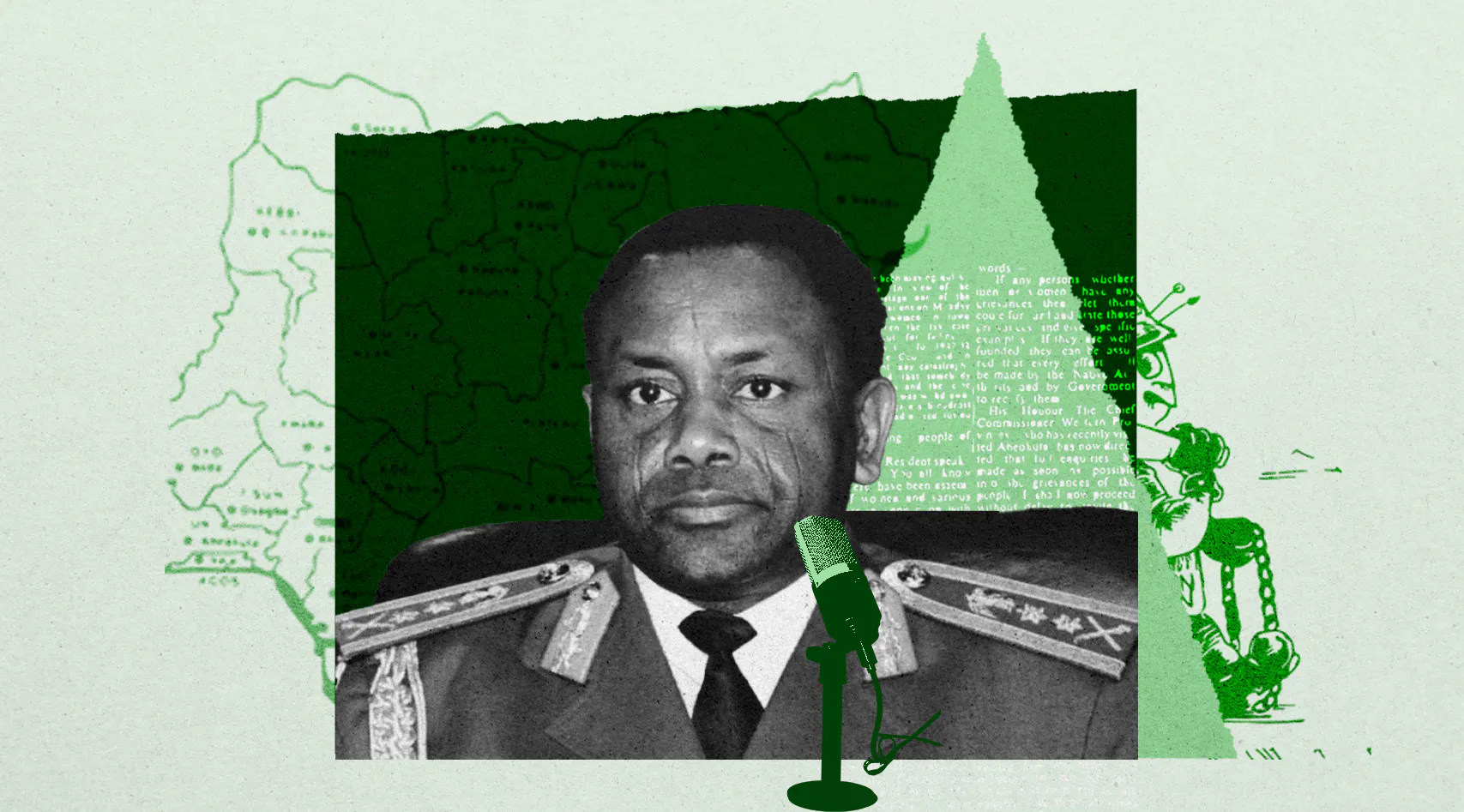
October 1, 1997 Independence Day Speech by Sani Abacha
Fellow Nigerians,
It is with a genuine sense of accomplishment and with gratitude to God that I join you, my fellow countrymen and women, in marking the safe passage of another eventful year in the history of the independence of our great nation.
On the occasion of the 37th anniversary of that first day of October in 1960, when our beloved country shook off the bonds of colonial rule and we Nigerians took on the immense tasks of nation-building, our thoughts must inevitably turn to the past. Today, however, fellow Nigerians, although I enjoin you to let us draw strength and wisdom from the past, I call upon you to focus more purposefully upon the great and exciting challenges that lie before us.
All over the world, the peoples of the various nations are acutely aware of the prevailing psychological import as the 20th century rapidly draws towards a close and the imminent advent of a bright new 21st century opens a vista of unquantifiable opportunities for a new world order.
It is with this deep sense of history, duty and the heavy burdens of destiny that this administration has pursued a programme of innovative stewardship, transparent leadership and a realisable transition schedule which will culminate in an elected civil government on October 1, next year.
We are all well aware of the antecedents which created the special circumstances that ushered in this administration four years ago. Such were the political and economic conditions, as well as the widespread threats to the security of law-abiding citizens. It was true that the very survival of our nation hovered on the precipice of collapse.
Today, thanks to your resilience, your perseverance and our united resolve not to lose our sense of purpose, we have put the worst behind us, so that now we can truly look forward to the future with justifiable optimism. I salute you, my dear countrymen and women, without whose support and encouragement we could not have achieved these gains.
With the support of the overwhelming majority of the people of this great country, we have successfully dispelled those clouds of gloom and despair that hung over our national life at the inception of this administration. Working together with our patriotic and law-abiding citizens, the well-meaning leaders of our society, indeed, with professionals from all fields of national endeavour, we have overcome the political crisis which engulfed our nation and brought our beloved fatherland to the brink of anarchy and disintegration.
Permit me to state, with modesty, that the events of the past four years and the role which this administration has played in them will be remembered in the annals of this great nation among the most momentous and constructive.
In my maiden address to the nation on November 17, 1993, I was emphatic that the survival of this nation as a united and indivisible entity takes precedence over all parochial consideration. We pledged our commitment to restoring peace and stability to our beleaguered country, convene a constitutional conference to discuss and resolve all issues of concern to our country and to reform our inefficient social and economic institutions. You will agree with me that we have kept these promises.
Fellow Nigerians, the citizens of our country have, over the years, demonstrated their ability as a people to resolve their differences themselves and to live together in peace and harmony. It was in recognition of this and in keeping with our abiding faith in dialogue, conciliation and consensus building at the inception of this administration we convened the National Constitutional Conference.
Despite the unfortunate distractions occasioned by the regrettable actions of some individuals who chose to place their personal ambitions above overriding national interests, and notwithstanding the misplacement of our sovereign rights by certain sections of the international community, we have continued to pursue our objective of bequeathing to the nation, a strong, vibrant effective political and socioeconomic framework. We have always considered these objective fundamental prerequisite for our future national development.
I would like to express profound appreciation to all our citizens for the great support which enabled us to proceed successfully with these objectives. The National Constitutional Conference has met and done its work. The members worked very hard indeed in prosecuting their very important national assignment. An important outcome of their deliberations is the political transition programme which is being steadfastly implemented and which will by the grace of God terminate on the 1st October, 1998, the entry into office of an elected civilian administration.
The submission in 1995 of the Draft Constitution marked an important phase of our political programme. It was our hope that the Constitutional Conference would help greatly in finding a lasting solution to the incessant problems of political instability that had plagued our nation over the years We are glad that indeed the conference produced useful and innovative features that should, with faithful application, allay, for instance, existing fears of the domination of one section of the country by the other. It is important that we establish a sense of belonging among all the sections of our country so that all the citizens of Nigeria may once again be proud to be members of this nation.
We must bear in mind however, that the institutional safeguards we provide are not in themselves conclusive guarantees of peace and stability. Much will depend on the major actors and operators who elect to guide and guard our nation under the new constitution.
Fellow Nigerians, the success of any experiment in political engineering ultimately depends on the watchfulness and commitment of the people. For our new political structures to work, we all must imbibe the spirit of give and take, fair play, justice and respect for the rule of law.
It is noteworthy and happily satisfying that the overwhelming majority of our people and their leaders are participating enthusiastically in the implementation of the political transition programme. Thus, the spirit and letter of the first stages of the transition programme have been successfully fulfilled. The National Electoral Commission of Nigeria (NECON) which has since been established has indeed now settled down to its tasks. All restrictions on political activities have been lifted and the five registered parties are now firmly established and ready to participate in the remaining elections of the transition period.
Already, NECON has successfully completed four of its major assignments under the transition programme. These include the registration of voters and production of an authentic voters’ register which took place in February this year; the delimitation and delineation of local government electoral wards, federal and state constituencies as well as senatorial districts; the conduct of local government elections on political party basis and the revision and updating of the voters’ register which has just been concluded.
Fellow Nigerians, in response to the yearnings of our people and in keeping with our commitment to make the benefits of government more accessible to the greatest number of our citizenry, I announced on October 1, last year, the creation of six new states and 183 new local government authorities. This was after a careful review of the report of the panel constituted to study and make recommendations on states and local governments creation as well as boundary adjustments. In keeping with the administration's policy to redress grievances and to finetune policy implementations, steps are now being taken to review specific issues that have raised genuine concerns.
It is important to reiterate that our policies in the social and political realms in the past four years have revolved around the process of establishing peace and stability in our country and the felt need to put our economy on a firm footing, We are convinced that in order to ensure a stable and lasting civil rule for our people, a solid economic base is a major prerequisite.
Consequently, we have evolved and introduced measures to curb inflation, strengthen the value of the naira, encourage savings and productivity, stimulate investment and create employment. We have also taken steps to address the problems of deficit financing and excessive money supply in the economy. In addition to these measures, we have tackled the necessary task of checking corruption and other traits which have impacted negatively on our national life.
We devoted special attention and immense resources to checking the menace of drug trafficking, drug abuse, money laundering and business scams and their attendant evils on our society. The National Drug Law Enforcement Agency (NDLEA) was reorganised, strengthened and properly equipped to operate more efficiently. As a result of its efforts and other measures taken by this administration, drug dealers and other collaborators no longer find it easy to carry on their nefarious trade through our country. To completely stop the drug menace requires international cooperation. We therefore call the international community to cooperate with us through exchange of relevant information and other necessary assistance in the fight against drug trafficking. To further this objective, we have already entered into bilateral agreements with several countries to deal with this issue of global concern.
With regard to money laundering and business scams, a special unit established within the Central Bank of Nigeria to work in conjunction with NDLEA has continued to function effectively in tracking suspicious financial transactions. Its work has achieved remarkable results as borne out by the drastic reduction of this unwholesome practice in our society.
Fellow Nigerians, it is evident that we have striven to entrench probity, accountability and transparency in our public sector and national economy, especially the financial sector. The civil service, the key agency for the formulation and implementation of our national policies and action plans, has also been reformed and placed on a better footing to carry out its very crucial duties.
We introduced a policy of guided deregulation of the economy and government is moving towards disengaging from economic activities that can be effectively undertaken by the private sector. This administration's economic agenda has also involved determined action to move our economy away from its overdependence on the export of a single product — crude oil.
The thrust of government policy in the oil industry has been the diversification of our revenue base from crude oil exports by the implementation of several gas-based projects. In the past four years, significant progress has been made in the execution of the Liquefied Natural Gas project, the Escravos Gas project, the West African Gas Pipeline project and the petrochemical projects.
The restoration of order and security to the country together with government's commitment to ensuring future political stability through its political transition programme, has created a climate of confidence for the international investment community in the oil sector. Consequently, our joint venture partners and Indigenous oil companies have kept the tempo of investment in the petroleum sector at a high level, while government has provided necessary incentives to raise the profile of crude oil production and build up existing reserves. As a result of these efforts, our crude oil reserves have risen from 20.8 billion barrels in 1994 to about 25 billion barrels today.
My dear countrymen, the Petroleum Trust Fund, which was established to manage the proceeds of the correct pricing of our petroleum products which we effected in 1994, is now fully operational and its beneficial impact is already being felt by our people. This will increase remarkably in the coming months. In keeping with our pledge to deploy funds accruing to the Fund for rebuilding our country's socioeconomic infrastructure, the Petroleum Trust Fund has already committed funds in excess of ₦30 billion to road rehabilitation nationwide.
There is no doubt that with the continued present deployment of funds, the activities of the PTF will help significantly in reflating our economy and achieving rapid improvements in important sectors of our national life such as education, healthcare delivery, water supply, transportation and other social services, as well as security, law and order.
In spite of the adjustment in pricings, petroleum products in Nigeria remains the cheapest in the world. Consequently, the criminal act of smuggling petroleum products intended for domestic consumption across neighbouring international borders remains an attractive stock in trade among unpatriotic elements whose greed have contributed immensely to the periodic plagues of long queues at filling stations. This situation is compounded by widespread hoarding diversion and adulteration. However, the products importation programme embarked upon by the Federal Government saved the situation. It is the desire of government to continue to provide our people petroleum products at affordable prices. Those who engage in acts which threaten to frustrate this liberal policy are enemies of the people who thoroughly deserve our condemnation.
Government has therefore reviewed appropriate actions which will guarantee uninterrupted supplies to our people while the merchants of the nefarious illegal exports must henceforth expect to face severe penalties.
Government has also noted with concern the incessant sabotage of oil production facilities, pipelines and flow lines carrying crude oil to export terminals. Apart from the inherent risk to life and property, these activities of some unpatriotic Nigerians can lead to grave economic consequences. Government is therefore developing fresh strategies to cope with these acts of sabotage and decisive action will be taken against those responsible. To promote peace in oil-producing areas, however, a new strategy is being worked out to coordinate community relations programmes to enhance grassroots benefits. The pooling of community relations programmes and a well-articulated and balanced implementation programme will soon be given effect to further meet the needs and aspirations of oil-producing communities.
In the agricultural sector, this administration has been facing up to the challenges of making the millions of Nigeria’s small-scale farmers the primary beneficiaries of funds invested in the sector. For far too long, the subsidy on fertiliser meant to assist farmers became a source of easy money for those who diverted fertiliser shipments, smuggled the commodity out of the country or sold at prices below the cost of production to textile factories and the makers of ammunitions and explosives used for various social ceremonies.
In 1997 alone, this administration prevented the handing-over of more than ₦19 billion to persons engaged in such unwholesome and unpatriotic activities. Government is, however, working out a comprehensive package of relief measures that will have a direct impact on the farmers and substantially increase their output levels and boost their earnings. These measures are in the final stage of formulation and will be announced before the end of the year.
It is uplifting that as we come into the final year in office of this administration, the nation is experiencing relative macroeconomic stability as a result of the policy measures and actions we have taken. Earnings from our non-oil sector have increased over the past four years, our foreign reserves have risen and we now have a favourable balance of payments, stricter fiscal discipline and a reduced rate of inflation which has fallen to 17.5% in June this year from 72.8% in December 1996.
Furthermore, the exchange rate of the naira has stabilised over the past four years and our external debt stock fell to US$28.060 billion in December 1996, from over US$32 billion a year earlier. Interest rates have stabilised, creating a better investment climate.
Despite the success of our efforts to combat inflation, government is not unmindful of the adverse effect it has had on the purchasing powers of the vast majority of salary and wage earners in the country, especially those in the public sector. Ways and means of effectively addressing the critical socioeconomic problem of our people's dwindling purchasing power remain under active consideration by government.
In my 1997 budget address, I announced that each state of the federation could establish its salary structure. It was hoped that this measure would encourage states, that could afford to do so, to undertake an upward review of public sector remunerations. On its part, the Federal Government has almost concluded a review of the salaries and allowances payable to workers in its employment, including the Armed Forces and Police. It is expected that the outcome of this exercise will be implemented soon.
Our educational sector continues to be troubled by the severe strain and stress occasioned by many years of bad planning and shortsightedness. The problems of the sector took a turn for the worse with the downturn in our economy which we have relentlessly and vigorously fought to overcome. We have continued to do our utmost to ameliorate the inherited problems contained in our education system. With recent improvements in our national finances we shall soon be in a position to deploy more resources to the rehabilitation of this crucial sector of our national growth and development.
Relative stability and sanity have been restored in our schools in the past one year through various decisive policy initiatives. For the first time in many years, schools began and concluded an academic session without disruptions occasioned by strikes, closures or students unrest. However, the seeming proliferation of the menace of secret cults in our institutions of learning has been a setback amid an otherwise overall improvement in standard behaviour. Measures to stamp out the phenomenon of cult mayhem in the campuses have already come into the force, but it is obvious that total eradication must include the active cooperation and vigilance of parents.
In our traditional society, a child's behaviour is judged to reflect his home environment and family pride. Responsibility for a child's behaviour outside the home has always therefore been as much that of the school authorities as that of the parent. We must retum to these values.
The 25-man positive measures have been taken to improve the quality of learning in our schools. The 25-man Committee on the Review of Education established by this administration to understand a fresh study of the problems of the educational sector is expected to submit its final report soon. We expect that its findings and recommendatons will greatly assist government in evolving further measures to renew this vital sector of our national life.
Another source of hope for the educational sector is the education tax fund established through Decree No. 7 of 1993. About ₦7 billion has been realised thus far by the fund and its disbursement will begin as soon as the board of trustees which will manage it has been put in place. As prescribed in the decree, all federal, state and local government educational institutions will benefit from the proceeds of the education tax which will be distributed as follows: universities (25 per cent), polytechnics (12.5 per cent), colleges of education (12.5 per cent), secondary education (10 per cent), and primary education (40 per cent).
Fellow Nigerians, peace and stability are necessary preconditions for any form of development. This administration therefore remains firmly committed to do the maintenance of law and order and the protection of lives and property of all citizens and foreign residents in our country. There is an absolute need for vigilance, especially at this stage of our sociopolitical transition programme. We cannot deviate nor should we permit ourselves to be diverted from the course we have chosen for ourselves.
We have to bear in mind at all times that the responsibility of maintaining law and order is not that of security agencies alone, but of all Nigerians. Those who plant bombs to kill and maim innocent citizens have declared war on their country. A people who have experienced the bitterness of civil war know that there is nothing to be gained in violence but mutual misery. Let me on your behalf warn those trying to introduce the alien culture of urban terrorism that the Nigerian people are not prepared to be dragged into dastardly acts that will destroy their friends and relatives in the name of politics.
I invite all loyal Nigerians to continue to engage in the political process, and I wish to use this occasion of our National Day to appeal to those who may consider themselves aggrieved and alienated to endeavour to find relevance within that process. Confrontation and violence which place the self-righteous dissidents outside the political process are self-defeating and merely exclude the perpetrator from serious consideration as a builder.
Being fully conscious of its responsibilities, government has moved swiftly to tackle the rising crime levels in some of our urban centres. Incidents of armed robbery, car snatching, urban terrorism and assassinations pose a great challenge to our national security and law enforcement agencies. Government has met this menace by providing the agencies with the support and facilities they require to perform their duties more efficiently.
I am glad that as I speak today, the massive anti-crime operation launched in Lagos, our largest city and the acknowledged economic centre of our country, as well as the crime waves in other towns across the land have started to yield positive results. Criminal elements are now finding it much more difficult to operate and law-abiding citizens can now go about their affairs with a greater sense of security.
As we move with determination towards the democratisation of our polity, it is disappointing that Nigeria continues to be wrongly characterised by some irredeemable detractors as a country where there is an institutionalised and rampant denial of fundamental human rights.
This unfortunate state of affairs is due in great part to the campaign of misinformation and misrepresentation waged against us as a people by itinerant dissidents and their sensationalist and ill-informed collaborators in sections of the international community and foreign media.
The truth is that having achieved the urgent and primary aim of our administration with the restoration of order, peace and stability to our country, we have progressively liberalised our nation's sociopolitical environment and inaugurated a National Human Rights Commission last year. The commission has been given the task to investigate all alleged cases of human rights violations in our country and to make appropriate recommendations to government for the prosecution of violators and the provision of remedial measures to victims.
The right of habeas corpus has been restored to persons detained under Decree 2 of 1984 as subsequently amended, and a panel has since been constituted to carry out a periodic review of the case of all persons detained under this decree. Government has since ordered the immediate release of many detainees against whom no formal charges could be brought and will continue to do so as the need arises.
Since its inception, this administration has pursued a pragmatic and dynamic foreign policy. We have continued to play a responsible role in the international system and have generally operated in a manner to safeguard our national interests.
Despite attempts by some misguided persons, and assisted by a hostile section of the international community to wage an ill-motivated campaign against our country, we are satisfied that Nigeria's international stature has remained undiminished. We have continued to play our traditionally constructive roles within our sub-region, within Africa and indeed on the large international arena.
In the past few years, we have responded to the dictates of the emerging world as it became necessary for Nigeria to look to other parts of the world to make new friends. This seems to be normal practice by all nations and our country should not be an exception. In this regard, we are satisfied with the remarkable level of response we have received. We have been able to expand our circle of friends. This has enhanced in no small measure our international image. We will continue to build upon these achievements to facilitate the attainment of our foreign policy objectives. However, our arms and doors remain open to all those who wish to be friends and cooperate with us. We are conscious of the fact that true friendship can only be nurtured on the matrix of mutual understanding, trust and respect.
Nigeria is a peace-loving country and we have always sought to maintain peaceful and cordial relations with all nations of the world. It is our policy to maintain a brotherly and harmonious relationship with all our neighbours and it has been our historic commitment to play a special role in our sub-region and in our continent Africa.
Our sub-regional organisation, ECOWAS, has served as a strong rallying point for us, and our neighbours have shown once again confidence in our commitment by honouring us with the leadership of that body now for two consecutive years. We have led the way in the establishment and successful operation of an African mechanism for conflict resolution in our continent. This is borne out of our recognition of the fact that peace and stability for our peoples are fundamental prerequisites for economic and social development of our nations.
When I addressed the nation on this occasion last year, the conflict in Liberia was far from resolved. Today, however, it is gratifying for me to say that with determination and our strong collective resolve, we have finally achieved peace in that sister country on the basis of the Abuja Peace Agreement. I avail myself of this opportunity to congratulate my brother Heads of State of ECOWAS for their steadfastness which made the realisation of our objective possible. I wish also to pay tribute to the gallantry of the men and women of ECOMOG some of whom paid the supreme sacrifice to ensure that peace reigned once again in Liberia. In the same breath, we wish to express our appreciation to members of the international community and organisations for their support in the achievement of the ECOWAS Peace Plan for Liberia.
Regrettably, however, events in neighbouring Sierra Leone took a turn for the worse following the violent overthrow of the legitimate government on May 25, 1997. The sad events in Sierra Leone, no doubt, pose new challenges to the ability of the sub-region at conflict resolution. We already have experience which we will bring to bear in our search for a peaceful resolution of the crisis.
In this regard, we call on the illegal regime in Freetown to resume serious negotiations and dialogue on the ECOWAS objectives of:
i. the early reinstatement of the legitimate government of President Tejan Kabbah;
ii. the return of peace and security; and
iii. the resolution of the issue of refugees and displaced persons.
We also call on the international community to give full support to ECOWAS effort to resolve the crisis and, in particular, to work with ECOWAS’ credible modalities for extending needed humanitarian relief to distressed Sierra Leoneans who are suffering as a result of the excesses of the illegal regime.
We must not forget that ECOWAS is essentially an economic grouping. It is therefore imperative that we fully integrate the economies of the sub-region to ensure our collective economic development. We cannot effectively begin to build a viable African economic community until the sub-regional economic groupings, which constitute its building blocks, are fully operational. There is need, therefore, for member states of ECOWAS to work in concert to achieve its objectives.
Nigeria is strongly committed to multilateralism as an instrument for promoting international peace and cooperation. We will continue to ensure our full support to and active participation in the Organisation of African Unity (OAU), Non-Aligned Movement (NAM) and the United Nations (UN). In order to remain relevant to the needs of all its members, it is important for these organisations to adapt to a changing international environment. It is in this context that we welcome the reforms of the UN proposed by its Secretary General, Mr Kofi Annan. We will actively take part in the consideration of these reforms which we hope will establish a revamped United Nations of shared values and interests and promote a more enduring concept of the quality of member states.
The reforms will be incomplete without the reform of the Security Council, which has responsibility for the maintenance of world peace and security. The reform of the council will entail its restructuring and expansion to reflect the increased membership of the United Nations and the need for the organisation to reflect the interests of all its constituent regions. We support the decision taken at the 33rd Summit of the OAU in Harare last June which called for Africa to have two permanent seats with full veto powers in an enlarged and expanded Security Council.
With regard to the Commonwealth, Nigeria harbours no regrets for the enormous contribution we have made to that organisation over the years. We will continue to seek the understanding of all the members of the organisation of the situation in Nigeria, It is our hope that the Commonwealth leadership will embrace fair play, genuine dialogue and negotiations in order to resolve the unfortunate impasse between the association and Nigeria. On our part, Nigeria will always adopt a constructive posture in all these matters in spite of the unfair targeting of our country by a few influential members of the Commonwealth family.
Fellow Nigerians, on this happy occasion of our national anniversary, let me take the opportunity once again to pay deserving compliments to the women of this country for the magnificent role they have continued to play to ensure the furtherance of peace, understanding, security and development in our nation.
The various positive programmes initiated by our women across the country for the upliftment of the social conditions of and presenting new opportunities to our people will continue to earn government’s sympathy and acknowledgment. It was indeed refreshing for us this year to host the first ever summit meeting of Africa's First Ladies here in Abuja. The highly successful meeting presented real opportunities to further the Nigerian initiative of the African First Ladies peace mission. It was a necessary prelude to the historic presentation to the heads of state and government at the 33rd Summit of the OAU in Harare, Zimbabwe by Nigeria's First Lady.
Similarly, it is praiseworthy that our youths, who constitute our most valuable national asset, have through their exploits in various fields of sports, especially football, continued to bring great glory to our beloved country. In recognition of these spectacular achievements, the Federation of International Football Associations (FIFA) has approved our hosting of the 1999 U-20 World Football Championship. We should leave no stone unturned to ensure that the championship is successfully conducted.
Meanwhile, Nigeria's qualification for the FIFA world cup in France next year is another feather in our sporting cap. It is an opportunity for us to confirm to the world that our outstanding appearance in USA ‘94 and gold-wining performance in the Atlanta Olympic football competition were no mere flukes. We will fully support our endeavour in France ‘98.
Fellow Nigerians, it became obvious that we need to confront future challenges to us as a people, in a well structured manner. We have confronted this challenge — that of moving beyond immediate and inherently temporary solutions, to the need for a carefully phased medium and long term approach to national development. This was established in Vision 2010 Committee headed by former head of state, Chief Ernest Shonekan. Its assignment was to formulate an intellectual basis on which we should build a stable prosperous nation. The committee's report, which I had the honour of receiving formally yesterday, has mapped out a viable set of principles and pragmatic action plans pointing the way forward for our nation. Building on the foundations of our current achievements, the Vision 2010 Committee's report provides the context for accelerated economic growth and long term development in all spheres of our national life. As its inspiration, I assure you that this administration will keep faith with its recommendations. Accordingly, we shall, before the end of our tenure, introduce the measures immediately required to begin the programme's implementation in the firm belief that succeeding administrations will carry it through to a successful conclusion with the support of our people and friends of the nation.
My fellow citizens, I remain a firm believer in the great future envisioned for our fatherland by its founding fathers. As I have often stated, we must set aside all our differences and work together as one people and one family for the attainment of our dream of a strong, stable and prosperous society. We must dream great dreams for our country and transform our thoughts into positive action. We must develop greater pride and belief in our capabilities and potentials and assume our destined role as the largest black nation on earth. It should be for us a commitment to transform these past difficult years into the golden years of Nigeria's final takeoff. Nigeria should be launched into a safe orbit of a strong, stable and happy country; a nation of sustained growth and development; a people of contented leaders and citizens working harmoniously together; with a fresh young generation actively being prepared to inherit the fatherland.
Finally, I wish, once again, to thank all our people for their support and understanding over these past four years. Your dedication and willingness to make sacrifices for the cause of a better future for cur children has helped to bring us this far.
As we enter the last year of this administration, we shall continue to count on your support and cooperation.
Long live the Federal Republic of Nigeria. May God bless you all. Thank you.
- The inflation figures cited here (72.8% in December 1996 and 17.5% in June 1997) differ from publicly available data. Figures are retained as stated in the original speech, as documented by two national newspapers.
Source: Daily Champion and Nigerian Tribune