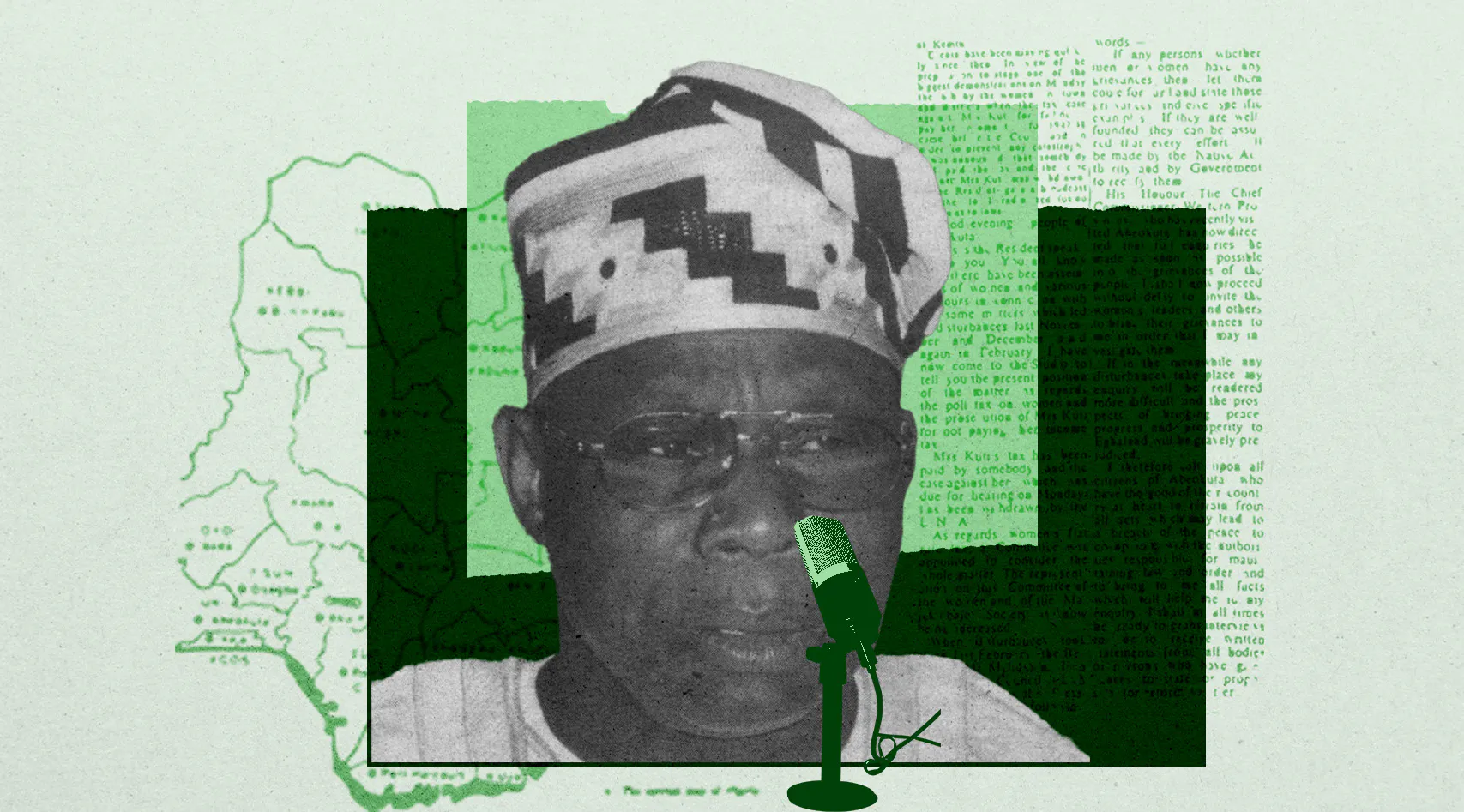
October 1, 2000 Independence Day Speech by Olusegun Obasanjo
Fellow Nigerians, it is a privilege and a great honour to address you, on the 40th anniversary of our national independence from Britain.
We owe gratitude to the Almighty for protecting and preserving us individually and our society as a whole to witness this moment in our history, which coincides with the millennium milestone in the history of humankind. Let us thank God for the fulfillment and achievement of many of our wishes, and let us pray to him to give us strength to persevere in our efforts to overcome our weaknesses especially as pertaining to those areas where we have suffered setbacks and success has so far eluded us.
As tempting as it might be, I will not use this occasion to dwell on our administration's plans or extol our achievements as a government or as a party. There is a risk of doing some of that. But, I thought we should all threat this as an occasion for sober reflection, as the hallowed saying goes. The 40th anniversary, at the turn of the century and the beginning of a new millennium, is a unique and symbolically compelling moment to reflect on our journey so far and to articulate and affirm an animating, elevating and enduring vision and ideals for Nigeria and unwavering commitment to the actualisation of a great Nigeria.
In most cultures and societies, the 40th birthday is a significant landmark in any person's life. Any man or woman who reaches 40 years of age is judged to be truly mature, and worthy of being entrusted with sacred responsibilities.
At Forty:
- it is time to part with youthful pursuits and settle to a lie of reasonableness, decency, good family values, good citizenship and leadership;
- it is also a time to henceforth enjoin the good and eschew the evil; and
- it is the age to be realistic, candid and to abandon deceiving oneself and others.
We all remember the old cliché: a fool at forty is a fool forever! But, we have even more reason to feel and act mature, because Nigeria is, as a matter of fact, much older than 40. Nigeria — the name — may have been stamped on our land by colonial design. But Nigeria the people and the society did not commence existence with political independence from Britain. Nigeria did not even begin in 1914, or even with the arrival of the white man on the shores of West Africa.
Our people, the Nigerians of today, have been living together as neighbours and mixing our lives accordingly. We have been visiting each other, we have traded among ourselves, we have blended our cultures. And, yes, we have quarreled, fought and reconciled with each other. We shared the joys of harvest and growth as well as the natural disasters of flood, drought or pestilence. The long distance trade in cattle and kolanuts has, for example, been going on for centuries. What about the great empires that once existed in Benin, Oyo, Songhai, Sokoto and Borno?
The name and the political boundary may be relatively recent. But, our people have been together from time immemorial. We have been around for a very long time and, by the Grace of God, we will be here in perpetual succession!
I know there will be some of us who will on this anniversary be wondering whether or not we have any reason to celebrate. The many difficulties, shortcomings and setbacks on the road to national development provide good grounds for this cynicism. I would personally count myself among those who have been most disappointed or saddened by our many problems, especially as most of them have been thoroughly avoidable and often self-inflicted.
As at the first of October 1979, when we handed over a robust nation and a new constitution to an elected civilian government to launch the Second Republic, some of you may recall from my farewell broadcast my vision of Nigeria being among the top ten greatest nations in the world by the end of the 20th century. We were then ranked 48th in the league of prosperity. Now, Nigeria has sunk into the league of poverty, where we are ranked as the 13th poorest nation on earth.
Earlier than that, I also unfolded my vision of a Nigeria aiming to succeed at building a just, disciplined and humane African society. Instead, Nigeria is now perceived as the most corrupt nation in the world, and so listed by an organisation that I cofounded because of my belief in fundamental moral values.
How can anyone deny the blight on our society when we all know how much our society has degenerated into a kleptomaniac culture, where everyone entrusted with any funds, public or corporate, everyone but a few, steals at every state of the way, from paper clips, through ghost worker proceeds and contract stealing, to outright plundering of the nation's resources? How can anyone deny the unfathomable shame when the whole world regards us as "born scammers" because of the worldwide white-collar fraudulent activities of some of us;. and when there are many among us who look at every new law, not as a tool for improving society but as a means to be rich through corruptly circumventing it, in one way or another?
How can anyone deny the pervading depravity, when so many of us do not like to do any form of productive work, but prefer to get something for nothing, regardless of the morality of our activities? With due modesty, I can claim that there are not many who would be more disappointed than myself.
I foresaw Nigeria as a great industrial giant, and great in agriculture, petroleum, other minerals, with an economy that exported finished or value-added goods, making the most of what we needed, selling it to the world and importing much less than we would be exporting. Instead, Nigeria, apart from the crude oil, exports little, and the land has been turned into a paradise for smugglers, commission agents and a dream market for manufacturers of junk and fake goods from overseas.
Fellow Nigerians, Nigeria had the land and the ecosystem, as we all know, to be a country of flourishing forests and grasslands, with rich wildlife to savour and a healthy air to breathe and clean water to drink, and a land of variety and beauty of nature. Instead, Nigeria has become an environmental disaster and ecology discriminated of its animals and trees, and with the Sahara and erosion aggressively eating up the usable land. And no one is doing much about it.
Ours is now a land of rural deprivation and urban subhuman congestion and suffering. It is clear that unless we do something, we shall soon have nothing to show but decadence and what was and what could have been. Many of us had good reasons to dream of Nigeria as a Mecca for investors, scholars, artists and tourists from all parts of the world, where efficiency and enterprise would create wealth in the service area. Instead, Nigeria has become a country most difficult to do business with, to visit or to return to, all because of indolence, discourtesy, indiscipline, insecurity, and of course, corruption. Nigeria became the country where things, anything, just did not work.
Fellow Nigerians, this country was set to be a proud homeland where young people had their career expectations of rising into the middle class fulfilled, and all our people enjoying full opportunities of employment particularly in the burgeoning private sector, in a country with free enterprise, a country of economic growth and development.
Instead, Nigeria became a country of stagnation, retarding economic growth and unemployment. The middle class was all but destroyed. Professionals and academics found ready successors in brain drain, resulting in a large pool of Nigerian talent in the diaspora and solving other people's problems. Those left behind at home became idle and frustrated, steeped in poverty with disruption of social relations. A young graduate could not look forward to a job, a house, a car, not to talk of the self-respect and joy of marrying and raising a family. We had all the opportunity, after successfully winning a civil war of unity and achieving reconciliation, of becoming a truly united and powerful country where everyone of its citizens was proud, nationalistic and patriotic, feeling free and welcome in any part of this country.
Nigeria was allowed to become a country where politicians wantonly practice the politics of ethnic and religious divisiveness, and where the responsible elite leadership thoughtlessly talk of disintegration and dismemberment of the country wherever it suited their personal political whim and caprices.
Not so long, many of us indulged in the intellectual luxury of seeing Nigeria as a free and democratic nation with full freedom and human rights guaranteed to every citizen. Instead, Nigeria was steadily pushed into a most brutal dictatorship which corrupted everything and almost everybody, not excluding our cherished traditional and religious institutions. Nigerians became so impotent to the extent that a brutal dictatorship could ride roughshod over the collective will, freedom and voice of the people, openly plundering every public treasury or account, arresting, detaining, torturing and even killing its perceived enemies, and to still have among our men and our women disgusting but rich sycophants loudly cheering it. No one would have thought that Nigeria would suffer such prolonged and brutal tyranny of a few people over the rest, and to be saved only by divine providence.
Fellow Nigerians, I could go on with the list. Each one of us has been disappointed to a greater or lesser degree by the developments that shaped our nation in the last two decades. Some of the disappointments we can share, others we cannot, but all of them have been by our own acts of omission or commission over the period. Maybe these are some of the reasons which make some of us feel that we have no cause for celebration. I disagree.
Even if things were much worse, Nigeria is worth celebrating. Because all these wrongs are within our power and ability to correct. All we need to do is resolve to put things right! We will of course need God's guidance and support, but, as is known and believed in all faiths, the Almighty will only help us to change if we ourselves demonstrate the will to do so.
We can right the wrongs because we still have the country and the freedom to take our decisions. Many other peoples in this world have to start by, first of all, finding a country, and then fighting for freedom to self-determination. We can right the wrongs because we have lived together all this while and know ourselves. We know our strengths and weaknesses. We have shared experiences. We shared the sweat of the struggle for freedom from colonial rule; together we savoured the sweetness of attaining self-government, followed by independence, and then full nationhood of republicanism.
We endured the crisis leading to the civil war, and suffered together the pain of fighting our brothers, friends, colleagues, teachers or classmates. And we rejoiced as one at the end of that war, and we celebrated the establishment of kingship ties in the context of a country that we all believed was heading for greatness. We went through all these experiences together, and more. Those who were present taught those who were absent or unborn. In between, we witnessed together real life cycles of flood and drought, boom and burst, ease and anxiety, pleasure and pain, happiness and grief, excitement and frustration. But we never shared despondency. And we never had reason to lose hope. All those who, in the dark days of their lives, lost hope for Nigeria only lived to eat their words and rue it!
We can right the wrongs because we have been blessed in so many ways that, compared to our assets, our problems become mere opportunity to show what we can really do. Our physical endowments; the land, the flora and fauna, and the mineral wealth, can support much larger populations, living happily and enjoying a much better standard of living than we have been able to attain. We are also blessed that these sources of wealth are utilisable by us in our time. The oil has, for example, been there for a million years and could remain for as long if only we were to leave it there.
Fellow Nigerians, I believe that we can right the wrongs of Nigeria because we have our people. The men, the women and the children, these are our greatest treasure. The people are not only an unsurpassed asset, it is also our people who give us our intangible blessings—our history, as well as our rich cultures and traditions, and our value systems.
It is worth dwelling for a while on what our people represent for us, what they have done for us and what we can together make of the future. It does not seem as if many of us reflect deeply enough on what a great blessing our people are. They are not just deadweight statistical burdens. All those who struggled for our independence remain our greatest heroes, in whatever way they may have contributed to the common goal. They recovered our dignity from the clutches of foreign imperialism. They inspired us with a sense of common dignity. They claimed for us a nation with much promise.
Tragically, less than six years after independence, the most prominent fell victim to badly conceived political judgements and actions, when they were overthrown, some killed and others rendered redundant. If only the dead could return, they would surely wonder with much agony at what we have made of the vision and system they had bequeathed to us. In many ways they would feel badly let down. It was quite appropriate for the founders of the ruling Peoples Democratic Party, on the occasion of the party's inauguration, to have expressed words of apology to those leaders of years gone for our collective failures of the country.
Fellow Nigerians, we have had leaders. People like Dr Nnamdi Azikiwe, Sir Abubakar Tafawa Balewa, Sir Ahmadu Bello, Chief Obafemi Awolowo and Malam Aminu Kano, would all rank very high as quality leaders in any period and at any time and anywhere in the world. We should not forget the sad and tragic circumstances of the demise of Chief Samuel Akintola and Chief Festus Okotie-Ebor.
There were also younger heroic leaders like General Murtala Muhammed and Chief M.K.O. Abiola and General Shehu Yar'Adua. All of them have gone to the great beyond. But, their memories remain fresh in our minds and their heroism evergreen in our hearts. Their memories remain an abiding source of inspiration and pride. They, and their contemporaries, freed and built Nigeria. Their work, their vision and their sacrifice serve to illuminate our road map into the future as one country.
We are not only blessed with early political leadership in every other field of human endeavour. Nigeria has heroes and heroines that are not only to be proud of and to be admired, but to be regarded as everlasting treasures in the history of a great nation. Our military can boast of officers of sheer courage like the first Nigerian GOC of our Army, General Johnson Aguiyi-Ironsi; Colonel Unegbe, who sacrificed his life in opposition to military takeover; Colonel Adekunle Fajuiyi, who chose death rather abandon honour. We also have Ademulegun, Maimalari, Sodeinde, Mohammed, Largema, James Pam and W.U. Bassey, who were men of great courage in a wide variety of situations.
We also had—and still do have—outstanding professionals and academics and policy managers in all fields of human endeavour. They rose to lofty eminence in their respective specialties where they achieved both national and world recognition and honours especially and including literary men like Abubakar Imam, Chinua Achebe and Nobel Laureate, Wole Soyinka. This nation still has people whose very names are synonymous with the struggle for freedom, liberty, human rights and good governance.
Let us pay homage to those entrepreneurs who started from nothing, yet honestly built empires of wealth and opportunity, providing jobs and succour for many. Great men of enterprise like Alhassan Dantata, Sir Odumegwu Ojukwu and Ogbeni Oja, Adeola Odutola. And we have our great athletes and other sportsmen and women, fetching trophies and gold medals in world games and sports. Not to mention our fine artists and performing artistes admired, collected of, listened to, or watched the world over. You know that is true.
These heroes did not just turn up from nowhere. They arose from amongst us. We, the collective rest, past and present. They selectively inherited the high qualities of the society and excelled. In other words, the real hero is the ordinary Nigerian, alive or dead.
Fellow Nigerians, I sincerely believe in the intrinsically good nature of the Nigerian character. Of course, like all societies, we have our share of deviants and criminals. And ordinarily our exuberance and boisterousness may often give the impression of aggression and abrasiveness. But behind all that there is a great Nigeria, a kind and warm Nigeria. Our people are diverse, beautiful, warm, friendly and hospitable. They are respectful without possessing a complex. They are highly assertive at whatever level of authority, but generous and helpful if correctly approached.
Our people love beautiful things and we must rank among the most well dressed people in the world. Not only do our people like beautiful things, they admire success. They celebrate it heartily in themselves and rejoice for others in boisterous participation. Our people are in love with education. That is why our great investment in education succeeded in creating such a vibrant society where social gaps have been greatly closed. Their love for education goes hand in hand with the love for upward mobility even though some of the desperate means are not laudable.
The Nigerian is indeed of generous spirit. We care for our people, and we share what we have with friends and relatives. A lot of the time, foreigners, particularly from the so-called developed countries, admire the classical African way we care for our kinsfolk; parents, children and all relatives, to whatever extent we can.
By tradition, we care to share. It is this generosity of spirit that enabled us, over the ages to build a very fluid society whereby anyone can rise to the top in wealth or power regardless of pedigree or even early status in life. The truth of this statement is borne out of numerous examples that surround us in the society. Not least of all, Nigerians are great believers in freedom. That is why dictators may come, oppress, maim and kill, but never totally subdue the spirit of the people.
We may have our defects as individuals and as a society, but I have not here said any good things that we are not. We may be too involved with ourselves to appreciate our laudable qualities. But, others do. None of us can fail to be impressed by how worried the rest of the world became during the throes of our recent plight and how welcome to many nations, far and near, was the restoration of democracy and freedom in Nigeria. The rest of the world was justified to welcome and appreciate Nigeria, and we should be thankful for that.
This nation has carried, and continues honourably, to carry the burden of other nations, especially Africa. When we recount what we have done for others, it is not the wish to belittle them. No, in moments like this, we need to remind ourselves of the good we do as part of our celebration.
Whether in the United Nations, G77 and Non-Aligned Movement, Black Diaspora, the Commonwealth, anywhere, Nigeria has discharged its responsibilities many times over. We have done so regardless of our own difficulties internally, and our imposed burden of foreign debt. But, nowhere have we had more satisfaction than with what we have been able to do in Africa on bilateral basis, in the Economic Community of West African States (ECOWAS), or in the Organisation of African Unity (OAU).
This country has, for the past forty years, and even more, worked and owned for Africa. We imported and distributed for Africa. We sacrificed, fought and died for Africa. We have done so and we will not stop doing any of these. When the great nations of the world are avowing not to send their nationals to fight for any cause abroad, we have fresh in our mind our over one thousand troops who, in the last decade, have died trying to restore peace in our West Africa sub-region alone. And this is not counting material costs. All over Africa, there are tombs of Nigerian soldiers who went to sacrifice their lives for peace. Our troops are still out there.
History will surely record forever Nigeria's inimitable African nationalism, of being located in West Africa and yet declaring itself a frontline state in the struggle to rid our African Brothers and ourselves, and the world, of the heinous evils of colonialism and apartheid in Southern Africa, and successfully contributing to the eventual victory. And there is no stopping for us. Wherever there is a real need for us, we will be there.
We have every cause to celebrate and to give thanks to God Almighty for Nigeria. Some of us can be very hard or cynical and say that all these foregoing blessings and achievements might be very well, but that we have squandered all the good will, opportunities, and mutual fellow feeling and that there is little left to save. They cannot be more wrong, especially when they consider the alternative, or when they consider that there is really no alternative to a united, strong and confident Nigeria forging ahead. Besides, and fortunately, such people do not represent many, let alone the majority of our people.
The experience of evil governance in the years preceding transition has raised serious questions about the strength of foundation of corporate Nigeria. Who wants Nigeria? How do the parts see themselves fitting into Nigeria? These questions were further highlighted by many of the incidents and disturbances in many communities since we came into office.
In order to deal with the question, particularly with the 40th anniversary approaching, I invited a wide cross section of the political, traditional and religious leadership of each of the six zones of the federation to a separate dialogue in the State House in Abuja. We talked with each group at length. They were very candid with us. Their demands and complaints were varied, but of the usual vintage of equity, justice, development, power sharing, marginalisation, security, empowerment, resource control and the like.
For example:
- One of the zones expressed firm belief in ONE Nigeria, but with true federalism based on equality, power-sharing and justice, where each tier of government — i.e., federal, state, and local governments — has its functions and performs its function adequately and efficiently.
- Another zone does not want only the unity and oneness of Nigeria, but wants it with equity, and is ready to fight for it.
- A zone recognises its peoples as essentially itinerant all over Nigeria, they need the unity and progress of Nigeria as much as any other group, but it must be unity and progress with security.
- Yet another zone talked of indivisibility of unity and oneness but with greater involvement in the resources of their region.
- One of the zones simply abhors marginalisation.
- Another simply cries for development.
We were rather pleased with the outcome, because the issues speak of an underlying oneness in the pursuit of a fair and progressive society. But, it was significant that it did not believe in a strong and united Nigeria. Let me say that I most strongly share the sentiment of the zone whose people were prepared to fight for the unity of Nigeria.
I have once fought for the unity of Nigeria. And I am prepared to do so again, if need be. Let us all be prepared to fight for Nigeria, that unity with progress is worth any sacrifice! The outcome from the interactive consultation with leaders from six zones point us to the formulation of a binding national ideology which could read thus: To build a truly great African democratic country, politically united and stable, economically prosperous, socially organised, with equal opportunity for all and making adequate all-embracing contributions sub-regionally, regionally and globally. This should substitute for political religion, tribalism and sectionalism.
This national binding ideology has a place for each Nigerian, no matter his place of residence, his birthplace, state or region, religion, political affiliation, occupation, social status, gender or present place of residence. It is both fulfilling and challenging. It elevates rather than diminishes. If we all embrace this national ethos and live by it and for it, the name of Nigeria will cease to conjure up in the minds of some outsiders the image of chaos and confusion, military coups and instability, corruption, non-working utilities, repression and brutality, violation of human rights, drug trafficking and business fraud.
I have always believed in democracy. And I will always do. I have a track record for that. I shall therefore never knowingly subvert the spirit, let alone the letter of the constitution that I have, not for the first time, sworn to defend. People will naturally always try to find ways by which they can do their jobs more easily. But, I shall never forget that we all came through democratic elections and have a constitution to operate and defend in our respective assignments.
I have always believed in fundamental human rights and freedom, because I know that these values represent the best expression of democracy. I also know what it is to be deprived of human rights because I was once deprived of my own. I have always believed in working as part of a team. Military training and my military experience demand no less. Even where I have been given the average to determine the composition of a team, I have endeavoured to maintain the team spirit. Similarly, belonging to a political party means being part of a team. And I concede full loyalty to our party.
Our victorious party, the Peoples Democratic Party, is a phenomenon in Nigeria, being the first to win a very large absolute majority at all levels of government in a country where coalition governments had been the traditional means of making the centre hold. We have to purge and strengthen the party by manifesting a democratic instinct at every turn, by successfully managing our impressive majority and, above all, by making a difference for the better, for all Nigerians, everyone, everywhere, and irrespective of party affiliation or other group identity.
I have always believed in the great potential of our people. Every man, woman or child has, or will have, much to offer, given a fighting chance. In particular, I entertain great hope in, and have much respect for our youth. I do not disdain the youth or youthfulness. Like everyone else, I also grew up and do have my own children. Furthermore, I know that the young must have a voice and that the young shall grow, which is what keeps the world going. We are currently in the process of formulating a youth policy which I believe will provide a suitable formula for looking after our youth.
I have always believed that the education we receive and the positions we hold are mere tools and opportunities for greater service to our fellow beings, especially our fellow country men and women. We are not colonialists, and have not been put there to replace the British colonialists. We are supposed to be better than they were. That is the whole point of independence. We certainly have no right to act even worse than the colonialists did. The nation owes us citizenship, liberty, justice and opportunity. It does not owe us a living, let alone callous aristocracy over our own people.
Furthermore, the fact that others misbehave, even if they get away with it, is no reason or excuse for any of us to also knowingly do so. For the immediate future, the task in hand must include: fight against corruption, enthronement of equity and justice, need for moral rearmament and spiritual regeneration, move away from recourse to ethnicity and religious sentiments to sustain evil, greed, corruption, and oppression of others. It is a sin against humanity and God to condone, actively or passively, man's evil against other people because the perpetrator is related to you in any way or you hope to benefit from the misdeed.
We are determined to move away from the past practices where corruption, crime, injustice, indolence and perversion were seen by many as legitimate avenues for wealth and advancement. Initiatives, industry decency and good performance will be commended and rewarded, while corruption, crime and poor performance will be punished. We must enhance moral tone and bring about spiritual regeneration in our national life.
We are fully committed to make every Nigerian feel secure, where security implies freedom from fear, not just in terms of defending territory but more in protecting people and providing for their basic and essential needs. First, this must involve preventing deadly conflicts by promoting political and social arrangements in which all groups are fairly represented, combined with human rights, minority rights and broad-based economic development. The socioeconomic programme must be predicated on equity, accountability, and alleviation of poverty.
Despite all the difficulty that we have had to confront, and are still confronting, it is always important that we all continue to have as our motivation, and as the justification of all our actions, the duty to work, with vigour and purposefulness, towards achieving our manifest destiny. And that destiny is this: that by virtue of our size, our population, the ingenuity of our citizens, their ability to endure, and the natural resources with which God in His mercy has endowed us, it is our fate to be great.
But in order to achieve this, two things are essential; we must convince ourselves that this destiny is a realistic one; and we must ourselves work at it persistently and deliberately. We must all rededicate ourselves, at the beginning of the new millennium, to the search for unity of purpose and faithfulness to the vision of the founders of our great country.
I particularly wish to appeal to our leaders in Ohanaeze, Afenifere and Arewa Forum to genuinely dialogue with each other, rather than talk at — and against — one another from entrenched positions and postures. There is absolutely no virtue in confrontation. Each of these groups, in spite of its apparent large following in the context of Nigeria, will be diminished as an independent nation by itself.
We all have a stake in Enterprise Nigeria!
National survival in the coming years cannot be achieved through weakness, or through lack of self-esteem. We owe it as a duty to ourselves, to our children, and to our children's children, to do everything possible to guarantee for Nigeria the nest that our human and material resources entitle us to. We have only just begun the struggle.
The coming years are fraught with challenges. But on behalf of this administration, I solemnly commit myself to do everything necessary, even at the risk of offending a few interest groups, to make Nigeria a country, which in the future we can all be proud of. I know how painful and difficult change always is, but I also know that with patience, with determination and by the grace of God, we shall all overcome. And we will all be beneficiaries of the fruit of the positive change.
We all have our respective tasks clearly defined in front of us. This government and this president will faithfully pursue our party manifesto and our other programmes in the spirit of patriotism and discipline, justice and fair play, due diligence and efficiency, transparency and accountability. In particular, we are inseparably engaged in poverty alleviation, in the basic education scheme, revitalising healthcare services and economic reconstruction.
Above all, we shall ensure with all the sweat and blood we can muster, that our present democracy survives and grows and that Nigeria remains a strong and united nation that every Nigerian shall feel proud to belong to.
As part of our efforts to cast our net wide in seeking advice from relevant quarters, I have decided to establish honorary Presidential Advisory Councils — of not more than seven members per council — on a number of subjects, such as foreign relations, investment, youth development, and so on. Such advice can only enhance the quality of decisions, policy formulation and execution on these issues.
We shall also demonstrate compassion and appreciation in all we do. This is an appropriate point to thank all who have been working for this country. I thank the leaders in both public and the private sector, our teachers and students, our doctors and nurses, all of our workers, all of our good people, men and women. The going may be hard, but we are determined and, by the Grace of God, success lies ahead.
Those who achieve shall be recognised and honoured just as miscreants are fished out and punished. Those who need compassion will find it. It is in accordance with this and in celebrating our 40th anniversary of independence that I have granted amnesty to some of our convicts whose release will pose no danger to society. Those who can be defensively pardoned will receive sympathetic consideration.
Even as I thank you very much for your attention and wish us all a very happy 40th anniversary of independence, let me earnestly commend to you the words of our national anthem. Those works say it all.
God bless the good people of Nigeria. God bless our country, Nigeria. Long live the Federal Republic of Nigeria.
Source: Dawodu