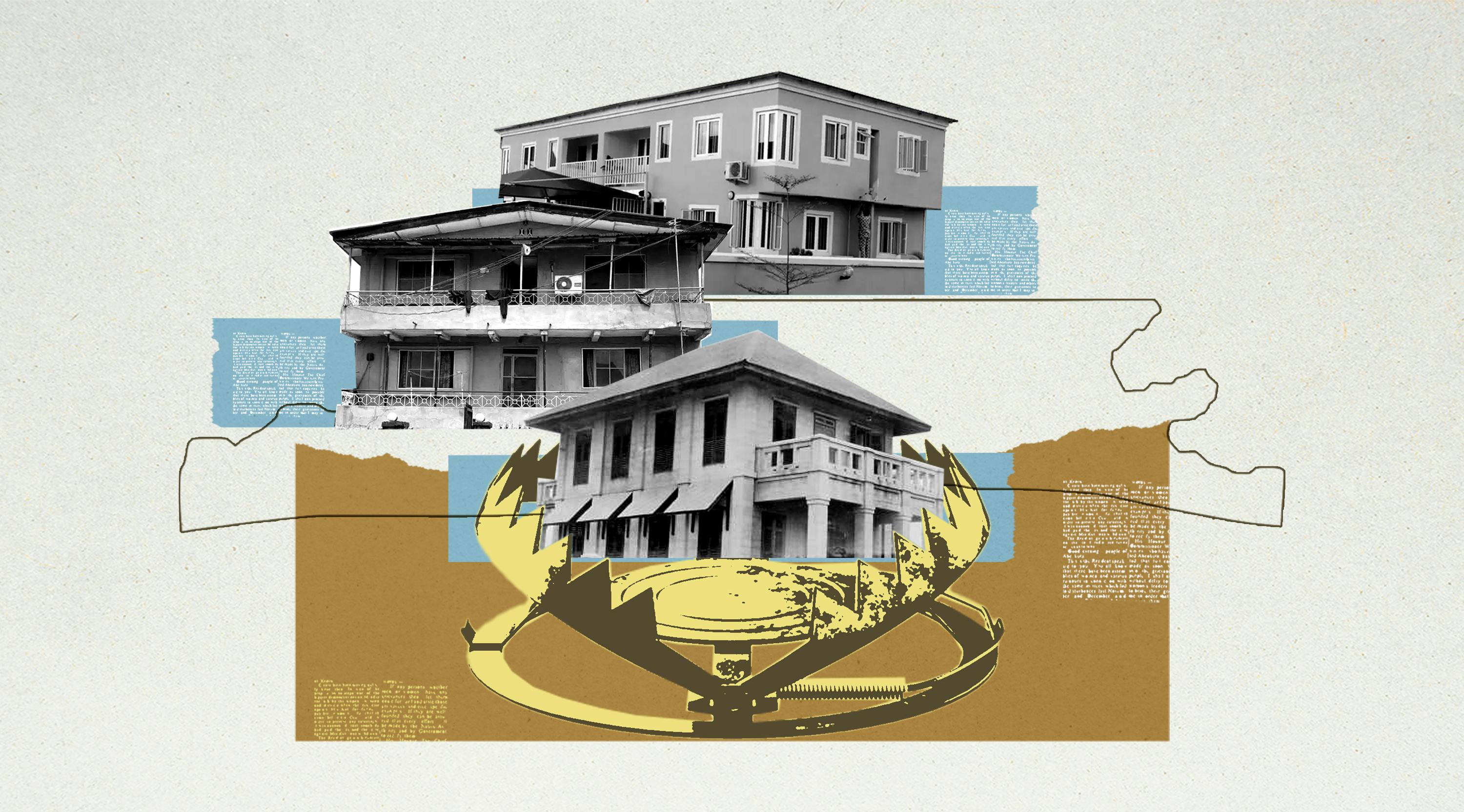
The Generational Trap of Housing in Lagos
“A roof over one’s head is the most important necessity in life apart from food and clothing.”
DRUM magazine, 1970.
In Lagos, finding affordable and dignified housing has remained a persistent struggle across generations.
The story begins here: the late 1950s to the mid-1960s in Nigeria was a period of growth and optimism. In 1966, DRUM reported that the main agents of various housing corporations in the country were living up to expectations. At the time, Nigeria, particularly cities like Lagos, was experiencing a positive turnaround in both the housing and commercial sectors.
As social and economic developments blossomed—fueled by post-independence optimism, rising civil service jobs, and urban migration—living conditions improved, and people’s aspirations for a better life began to take flight.
Modernisation was in the air, and with a higher standard of living came the desire for homes that reflected people’s new realities. Corporations like the Lagos Executive Development Board (LEDB) and the Nigerian Building Society (NBS) stepped in, building large-scale estates and offering loans to individuals to support their personal housing goals.
It seemed, at the time, that Lagos genuinely cared for its people and made deliberate efforts to provide housing across income levels.
Become an ARCHIVI.NG member and get updates straight to your inbox
So, when did things start falling apart?
The housing problem in Lagos began to take a serious turn during the oil boom era. By the late 1960s and through the 1970s, oil had become Nigeria’s dominant source of income. However, the Lagos government, governing a rapidly growing coastal city, failed to adequately address the side effects of this boom: overpopulation, increasing migration, and an escalating shortage of affordable housing.
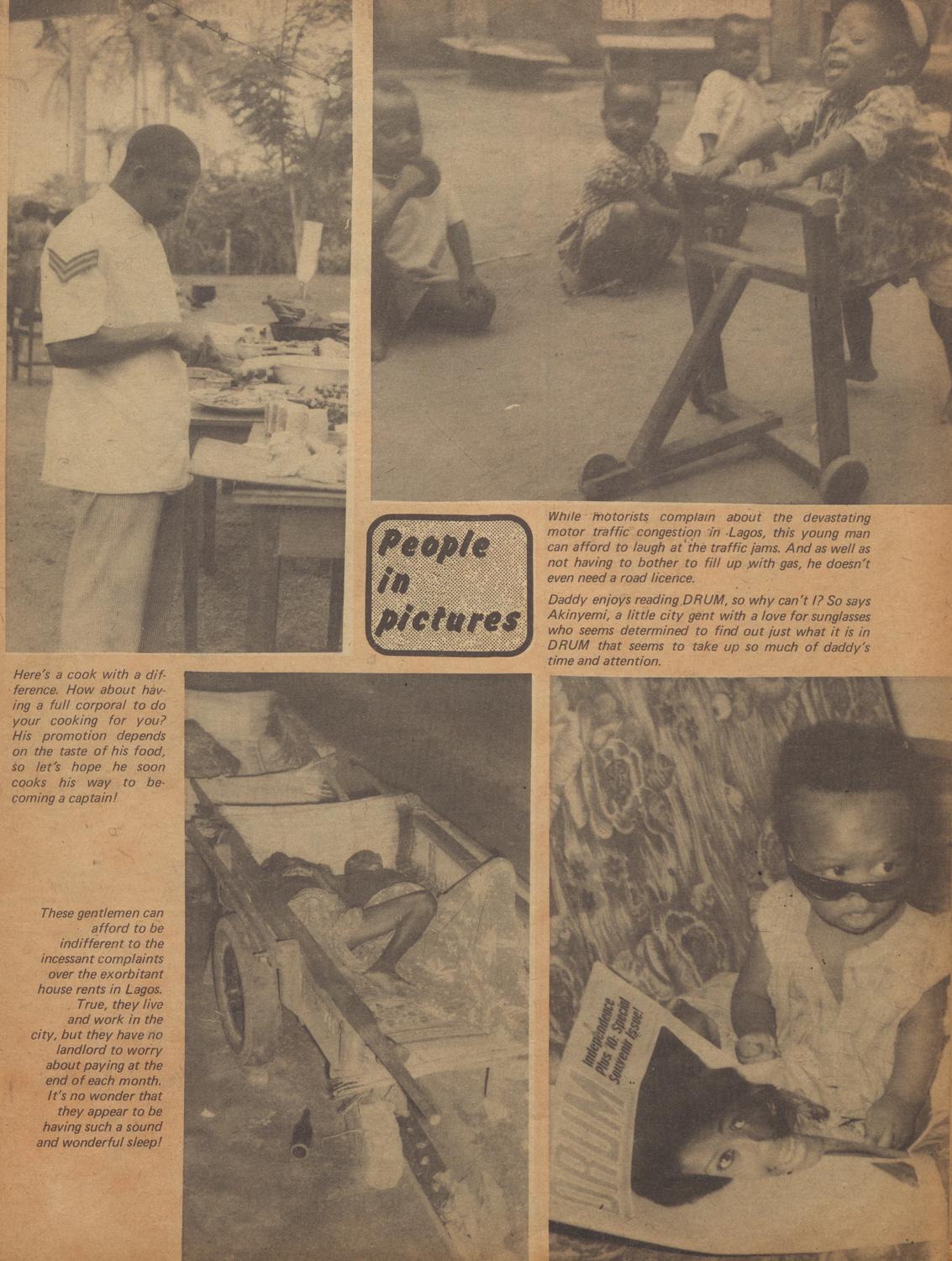
A research article by Dr P.O. Sada, published in Nigeria Magazine in 1970, observed that while demand for low-cost housing was high, development was not happening fast enough to match it. The study concluded that the local government was not keeping up with the pace of urban population growth.
That same year, a Lagos resident, Ifeolu Dosunmu, lamented how the government seemed deaf to the public’s outcry. He pointed to the urgent need for rent control and praised the measures taken in Benue-Plateau State as a model for other governments to follow.
Another Lagosian, who identified as Paddy Mark Guy, described how landlords were charging outrageous fees for poorly maintained, tiny rooms, while the government remained indifferent. He also called for rent control in Lagos, especially since it had already been introduced in some other parts of the country. The editor of the magazine supported his plea and added that the government should also control the cost of building materials, which was also contributing to the problem.
The housing situation in Lagos, just as dire then as it is now, saw rents climbing rapidly within months. Many residents struggled to secure affordable accommodation, leading to an increase in families resorting to living under bridges.
Just like today, estate agents in the early 1990s were known to exploit desperate tenants, charging exorbitant registration fees and high commissions.
/The Nigerian Economist June 7_1993_Pg 36.jpeg)
Was the government silent during these troubling times?
Not entirely.
For instance, in the late 1970s, the government issued a directive that no one should spend more than 20% of their income on rent. But in reality, enforcement was impossible without doing injustice to landlords. Naturally, the law of supply and demand prevailed.
Eventually, both federal and state governments came to admit that the only sustainable solution to the urban housing crisis was to build more homes. Indeed, the federal government invested in this approach, but mismanagement and dishonesty hindered any meaningful results.
One of the most notable government solutions was the Jakande Housing Scheme, introduced in the early 1980s by Lagos State’s first civilian governor, Lateef Jakande. His administration built 16 low-cost housing estates scattered across the state.
The scheme was innovative for its time, providing affordable flats to low and middle-income earners through a transparent lottery system and reasonable mortgage terms. Jakande’s approach involved direct procurement of building materials to reduce costs and ensure quality, and the estates were equipped with basic infrastructure.
However, the scheme faced significant challenges that limited its long-term effectiveness. The military coup that ended the Second Republic in 1983 abruptly halted further construction and disrupted maintenance efforts.
20 years later, the housing estates were deteriorating and posed a threat to the lives of residents. By the late 2000s, some of the estates had experienced collapse. Apart from the fact that they were built to last no more than 25 years, terrible maintenance also contributed to their rapid deterioration.
Beyond Jakande’s efforts, other schemes that were developed to provide mass housing similarly fell short of meeting the needs of Lagos’s growing population. FESTAC Town, built in 1977 to host visitors to the cultural festival, later became a residential area but suffered from overcrowding, infrastructure pressure, commercialisation of residential areas, and poor maintenance.
The Shagari and Jubilee schemes, launched in the 1980s and early 1990s respectively, struggled with slow delivery, limited coverage, continuity, and maintenance. By the 1990s, it wasn't unheard of for landlords to demand multiple-year rents upfront from prospective tenants. Some even quoted rents in foreign currencies. Beyond the usual causes—such as the high cost of land and building materials—the government at some point also increased property rates by 50%, and this further skyrocketed rent.
Companies relocated staff to more affordable areas, while tenants moved from elite neighbourhoods like Ikoyi and Victoria Island to the mainland. Naturally, this caused a rise in rents in mainland areas like Surulere and Ikeja.
What drove rent prices up
When Newswatch asked landlords in 1991 why there was such a high surge in house rent, the majority said it was because of the high cost of building materials and depreciation of the naira.
/African Concord March 1_1993_Pg 20.jpeg)
In a separate 1991 interview with Citizen, Fola Ojumu, a quantity surveyor and housing agent in Lagos, captured the severity of the problem by noting that it was once easier to build a house than to buy a car.
Traders interviewed for the story compared building material prices between 1989 and 1991, noting that in just three years, costs had doubled on items like white sand, which rose from ₦250 to ₦500. The steepest jump was a staggering 2,300% increase in the price of a bathtub, shooting from ₦500 to ₦12,000. The situation was worsened by other factors like high taxes on quarry and limestone, high electricity fees, and the weak state of the naira against foreign currencies.
By 1997, according to a P.M. News article, other factors included the massive importation of building materials in place of locally-manufactured ones, overpriced contract costs by middlemen, the use of quacks instead of experienced building professionals, and inadequate pre-planning by developers, which led to excessive variations during construction. Galloping inflation and the government’s massive involvement in direct housing construction were also contributing factors.
All of this eventually led to an increase in abandoned and uncompleted building projects and slowed down the pace of housing development. To address the situation, the article recommended turning to local options—lime could substitute cement, burnt clay bricks could replace cement blocks, and timbre or fibre roofing could stand in for asbestos and corrugated iron sheets.
Enter NBRRI
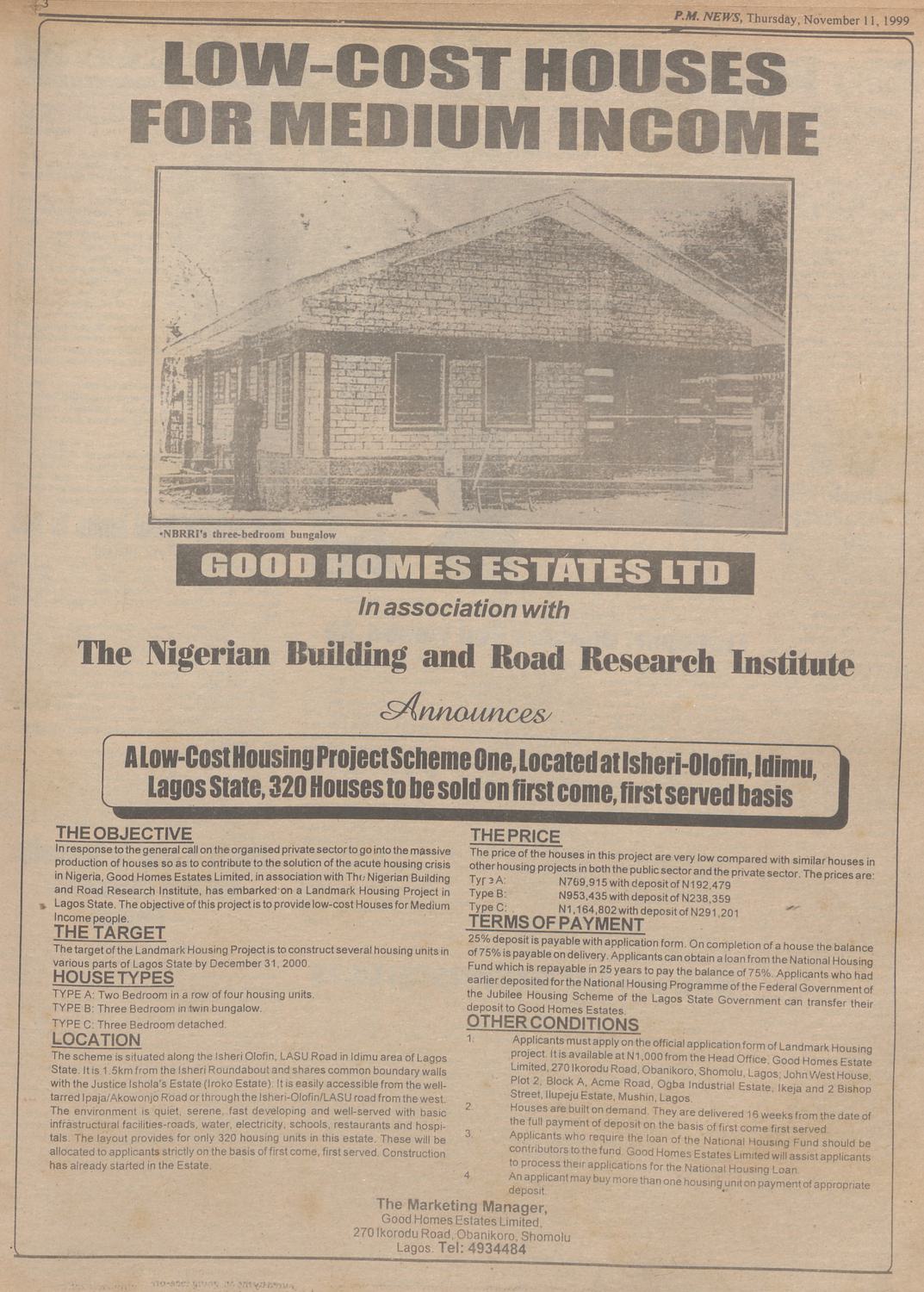
In 1978, the government created the Nigerian Building and Road Research Institute (NBRRI) to develop local solutions for the construction industry. In the 1990s, the agency collaborated with the Federal Housing Authority (FHA) on multiple projects across Nigeria, testing innovations such as lightweight sandcrete blocks, fibre-concrete roofing tiles, and recycled ceiling boards, cutting building costs by up to 50%. In fact, at their 20th anniversary event in 1998, Sam Momah, then Minister of Science and Technology, shared how using the NBRRI-developed materials had cut the cost of building a three-bedroom ensuite house with extra features from ₦1.5 million to ₦500,000—a 75% reduction.
/Newswatch June 29_1998_Pg 55.jpeg)
From the 1990s through the early 2000s, NBRRI’s independent efforts, along with collaborations with the FHA and other housing bodies, showed how local research could reduce dependency on imports while delivering affordable housing for middle-income earners in Lagos and other parts of Nigeria. Despite these achievements, NBRRI's impact remained small due to factors like low public awareness, inadequate government support, poor adoption, and limited research infrastructure.
Various reports have called for stronger institutional backing. For instance, the Centre for African Settlement Studies and Development (CASSAD), an organisation focused on settlement studies, recommended increased support for research institutes like NBRRI to help them develop local alternatives to imported materials.
Similarly, the Housing Policy Council’s review of housing implementation from 1992 to 1993 urged NBRRI to collaborate with other bodies to collect data on local materials and ensure sustainable management. It was also advised that imported raw materials should only be used to supplement local options.
By the mid-1990s, NBRRI had begun training individuals on how to produce bricks and roofing tiles. Some of these trainees had already started small-scale production and sales across the country. However, the agency could not guarantee the quality of these materials. This prompted E. Olabiran, the institute’s chief research officer, to call on the Standards Organisation of Nigeria (SON) to establish clear quality standards, so that Nigerians seeking affordable materials could trust what they were buying.
Manufacturers of low-cost materials developed by NBRRI have also raised the vital role of architects in promoting these products. Without their support, local producers struggle to make a significant impact in the affordable housing space. Architects can help shift public perception by demonstrating how alternative materials can be used in modern, appealing ways.
In 1996, Chuks Eya, a representative from Has Brickworks Co. Ltd., even challenged the government to lead by example by using locally-made materials such as stabilised earth bricks and roofing tiles in its projects.
A way out of the maze
Despite various efforts by the government and private individuals, very little has changed between the 1970s and now. Why? Most initiatives have either failed to scale, been crippled by corruption, or collapsed due to poor maintenance and lack of long-term vision.
I could reference Engineer A. Edeoghon, a senior NBRRI manager, who in 2001 advised the federal government to develop a practical, data-driven, and non-politicised housing policy. Or cite Engineer A. Adedeji, who in 2004 recommended that the government grant mortgage loans only for homes built with local materials.
I could argue for the subsidisation of building materials or an increase in minimum wage to reflect the actual cost of living. I could also recommend stronger public-private partnerships (PPPs), as well as better land allocation policies across the commercial, industrial, and residential sectors.
There’s also a strong case for increased government investment in infrastructure, particularly to support research institutions and local innovators. With the right backing, their ideas could scale, become exportable, and contribute to strengthening the naira. Tax incentives for affordable housing developers would certainly help. So would be enforceable laws to check the excesses of landlords.
And I would be right to say all of these. But the truth is these things have been said before. Some have even been attempted. Yet, as we look around today, very little has improved. Despite all the policies and action plans, the reality on the ground points to a deeper, more systemic problem—one that policies alone cannot fix.
Despite initiatives across generations, housing in Lagos remains strained by weak continuity, poor maintenance, and limited accountability. Many well-meaning projects faltered not because the ideas were unworkable, but because they lacked long-term support beyond the individuals who introduced them.
But don’t mistake this as an attempt to point fingers. The hard truth is that a large portion of the population struggles with the same root problems: compromised values, limited access to quality education, and very little awareness of individual rights, all of which weaken accountability and undermine long-term planning.
Lasting change requires systems. It begins with leadership development, with character at its core, across all levels of society. It also demands institutional reforms, where systems are strong enough to outlive individual leadership.
Policy continuity must be backed by law, not politics, so that every administration builds on what was started. There must also be investment in civic education and history, so citizens know their rights, understand their responsibilities, and can hold systems accountable. Community-driven innovation should be supported by research bodies like the NBRRI and scaled through public-private partnerships and sustained government support.
Finally, robust monitoring and feedback mechanisms are needed, so programmes aren’t just launched and forgotten, but continuously improved based on results. If history has taught us anything, it’s that rent crises are mere symptoms, and lasting change will only come when we fix the foundational housing problems.
Credits
Editor: Samson Toromade
Cover Design: Adeoluwa Henshaw