
The Nigerian Ponzi King of 1991
For six hours on July 17, 1991, a million eyes descended on the two-storey building at 13, Aba Road in Port Harcourt, Rivers State.
Neighbours gathered on the street, balconies and rooftops of surrounding buildings to witness the commotion that started around 3:30 pm.
Colonel Godwin Abbe, the state governor, was at the centre of everything.
He had planned to visit Nembe in Brass after the day’s state executive council meeting. Three helicopters were waiting at a military base to airlift him and other government officials there. Along the route to the base was 13, Aba Road.
Earlier at the council meeting, the state commissioner of police, Owens Onoge, told Abbe that he sent a team of police officers to the building to investigate a tip-off he’d received regarding an ongoing case. The governor was already personally invested in the case, so he decided to check in on what the officers had discovered.
Immediately Abbe arrived at the top floor of the two-storey building, he cancelled the Nembe trip. He sent for the state’s chief judge, the SSS director, the brigade commander, and the air force commander to report to the scene.
Within an hour, more than two hundred soldiers and police officers locked down the street. They blocked the roads in and out of Aba Road, strategically positioned within and outside number thirteen.
Abbe ordered the closure of all companies near the building, including Owena Bank and a petrol station. Then he turned his attention to number thirteen, home to businesses like Chanrai Stores, Light House Insurance Brokers, and a law firm, Wilbas and Company.
The workers were to suspend operations and leave the building immediately. Those who didn’t leave fast enough met swift punishment.
"Lock them in. Bloody civilians," Abbe barked.
His final order to all the security operatives: any unauthorised person who made any wrong move should be shot on sight.
A trip back upstairs would explain Abbe’s theatrics. On the top floor were two rooms so dark that he needed a policeman’s torch to see inside.
In both rooms, floor to ceiling, wall to wall, were bundles of cash in ₦5, ₦10 and ₦20 notes, amounting to millions of naira. Neither the governor nor the men with him had ever seen so much cash in the same place. And everyone knew who the money belonged to.
The magic banker.

The man
Umanah E. Umanah always wanted to be a billionaire, the man who walked into a room and became the centre of everyone’s attention. He also figured out very early that wealth would not fall on his lap.
He was a statistics student at Calabar Polytechnic in 1982 when he came up with an idea built on a carefully designed scheme. He would sell “investment forms” and promise a mouthwatering return of 60% interest every month. If a customer “invested” ₦5, they would get ₦8 at the end of the month.
Umanah hit a goldmine here. Word-of-mouth about his get-rich-quick scheme spread in the student community, and he was soon serving hundreds of customers.
He founded Resources Managers Nigeria Limited (RMNL) in 1989, offering money brokering, investment and management services. It was a scaled-up version of the scheme from his polytechnic days. But something had changed that gave his business a lift.
In 1986, the General Ibrahim Babangida regime implemented the Structural Adjustment Programme (SAP) on the advice of the International Monetary Fund (IMF) and the World Bank. The policy was deemed an “economic surgery” designed to end Nigeria’s dependency on oil. SAP was executed through harsh currency devaluation, rapid rollback of social subsidies, and massive cuts in government spending.
Liberal financial policies ushered in new commercial operators and high-yielding investments in the financial sector, leaving commercial and merchant banks with huge profits.
But for ordinary Nigerians, SAP triggered hyperinflation and mass unemployment, effectively wiping out the middle class and leaving millions of Nigerians desperate for financial relief.
It was under this climate of extreme economic hardship and plummeting living standards that Umanah’s scheme found fertile ground, offering a promise of wealth to a population struggling to survive.
Umanah was a polished man. He liked to appear in well-tailored suits, usually white. His beard was a perfect loop of hair framing his mouth, mirroring the precision of his tailoring. He looked rich, and his unspoken pitch to every customer was that they could be rich and posh like him, even when the economy was falling apart. He was the perfect salesman for such a time.
Everyone from Port Harcourt to Calabar and Aba fell under his spell. Students, market women, office clerks, housemaids, civil servants, soldiers, policemen, businessmen, and top government officials.
"Every Tom, Dick and Harry is a customer," he boasted.
By 1991, Umanah had over 400,000 customers, trading hundreds of millions of naira stashed in multiple vaults like the one at 13, Aba Road. For eighteen months, he kept his word. He made everyone rich. Except the traditional bankers.
RMNL did not escape the attention of commercial banks in the areas where Umanah operated, especially Port Harcourt. Most banks offered an annual interest rate of less than 25%, a far cry from Umanah’s 720% annual return. Customers were withdrawing huge deposits from banks and flocking to him to invest.
On May 8, 1991, the CBN's director of banking supervision, J.I. Osinowo, sent a letter to Umanah. He stated that RMNL's activities of “advertising for and collection of deposits are duties reserved for licensed banks.” He told Umanah to stop collecting deposits as it was a violation of the Banking Decree of 1969.
"All funds previously collected should be refunded immediately," the official warned.
Umanah disagreed with the CBN’s framing of his collections as deposits. He insisted they were investments from the public. Nigeria was a free market economy, he noted. There was no law on profit. To clear things up, he considered travelling to the CBN office in Lagos to make his case. He also had a high-ranking police officer who could help him out.
Umanah was prepared to fight for his life’s work.
Become an ARCHIVI.NG member and get updates straight to your inbox
The long knife
Godwin Abbe knew how to command a room.
He joined the army in 1967, in time to fight in the Nigerian Civil War. He became a colonel in 1986, the same year he was appointed the military governor of Akwa Ibom State. Two years later, he was the military governor of Rivers State.
Around noon on May 20, 1991, Colonel Abbe convened an extraordinary security council meeting inside the conference hall of the Rivers State Government House. Inside the room were members of the council and a few bankers.
When the CBN director sent Umanah a letter, he wrote a separate one to the Federal Investigation and Intelligence Bureau (FIIB) in Port Harcourt to enforce the directive to dissolve RMNL. That was the council meeting’s sole agenda.
Umanah had first attracted Abbe’s attention in February when he received an intelligence report about his business and the "exceedingly fat interest rates" he paid customers. He was at first indifferent, until he spoke to the chief executives of all commercial banks operating in the state and members of the Port Harcourt Chambers of Commerce and Industry. What they told him informed his decision to report Umanah to the Federal Military Government, which authorised the move against RMNL through the CBN.
At the May 20 meeting, Abbe wanted to know if RMNL was operating legally. If yes, had it contravened any banking laws regardless? What the governor was trying to get at was whether the company’s operation had directly or indirectly adversely affected Port Harcourt’s economy.
The manager of Savannah Bank in Port Harcourt, O.C. Isiakpona, and the manager of Pan African Bank, D.P. Iyabi, agreed that the company’s operation was legal, but the 60% monthly interest rate was mathematically impossible to sustain. An inevitable crash would be devastating for the economy.
The controller of the CBN branch in Rivers, J.S. Imhoede, insisted RMNL violated banking laws by receiving deposits when it was not licensed for such an operation. The state’s attorney-general, O.C.J. Okocha, agreed with him.
Abbe ejected the bankers from the meeting and asked the security council members to discuss the next line of action. Many proposed that RMNL’s operation should be suspended, and Umanah arrested and investigated. The only person who objected was the most familiar with the situation: the commissioner of police, Onoge.
He agreed with the bankers’ assessment that RMNL was registered to do business in financial investments and had not broken any law so far. He also pointed out the obvious: nobody involved in the scheme had complained of being cheated. He wanted more time to investigate the business before any further action.
The governor didn’t care. He shut down Onoge’s request and ordered him to arrest Umanah and his staff before 4 pm that day.
Abbe was used to getting his way.

Three sides of a story
Umanah and Onoge have vastly different versions of events about their relationship, but some details align.
A month after Onoge was posted to the Rivers State Police Command as commissioner, a team of detectives arrived from Lagos to investigate RMNL. Their report to Onoge concluded that the company was operating within legal limits. He disagreed. He could not understand how the scheme was possible, unless it was a front for something else.
Before his arrival, the state command had also investigated the business and found nothing.
In the course of his business, Umanah had made many friends in the police force, many of whom were his customers. Around Onoge’s arrival, senior officers advised him to meet with him and find common ground and sort out the grudge the commissioner held against him.
This is where their stories start to travel in opposite directions.
Umanah's version is more colourful.
/Newswatch September 23_1991_Pg 1.jpeg)
He met Onoge for the first time in April 1991. A police inspector had visited him at his office and arranged a meeting at the commissioner’s residence.
He drank from a bottle of beer as Onoge told him he’d been itching to shut down his business because he was selling empty forms. The commissioner said he’d written a petition to the Inspector-General of Police (IGP), Aliyu Attah, and Governor Abbe to flag the activities of his company.
The two stayed in touch over the next few weeks. A few days after their first meeting, the commissioner sent Umanah ₦10,000 with a note to invest in RMNL on his behalf, but without using his name on record. He made further deposits through close friends, and everything eventually pooled up to ₦500,000. Umanah felt at ease with Onoge so much that he even requested to link him up with Governor Abbe.
On May 17, two police officers told Umanah about the letter CBN sent to the government. He visited Onoge’s home later that night to discuss how to navigate the situation. His host told him to write a response to the CBN and put him in copy. They even drafted the tone of the letter together, he said.
The commissioner then mentioned that the governor may also be interested in the developing situation. He advised Umanah to raise some money to settle the governor and other top police officers who knew about the letter.
The price to make everything go away was ₦1 million.
Two days later, Umanah returned to Onoge’s house with ₦920,000. He'd had to remove ₦80,000 to pay a customer in an emergency, but promised the commissioner he’d send the missing balance the next day.
When he visited the state police command on May 20, the commissioner was in a meeting with the governor. Umanah wanted to hand him the balance before heading to Lagos to meet CBN officials that day. Hours later, two police officers arrived at his office to tell him the commissioner was now ready to see him.
In Onoge’s version of events, May 20 was the first time he met Umanah.
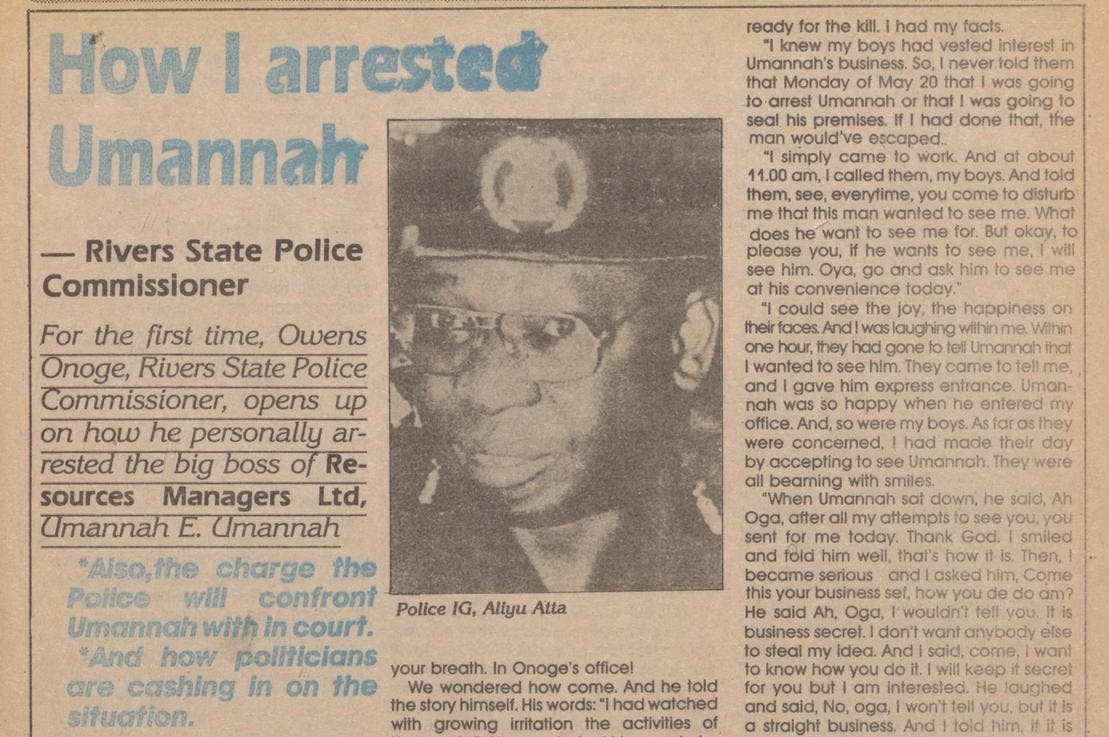
He had watched Umanah from a distance with growing irritation. The commissioner faced challenges investigating him because many of his officers were investors in RMNL. They gave the business a vote of confidence every time he asked them to investigate. They even tried multiple times to get the two men in the same room.
Onoge always excused himself from meeting Umanah, he said. But he also wanted to know how he performed the magic of 60% monthly interest. On May 19, The Sunday Magazine (TSM) published a feature story about Umanah’s business. The commissioner found it the perfect opportunity to strike, so he asked his officers to summon the banker.
“Come, this your business sef, how you dey do am?” Onoge asked Umanah the most burning question once he settled in his office.
“It is a business secret,” Umanah replied, laughing.
He hated to explain the workings of his scheme and only gave people the part to believe in. But to pay the first customer who invested ₦5, at least two new customers must also invest ₦5. Their investment covered the first customer’s interest payout.
Once those early customers got paid, they spread the word, and more people rushed into the scheme to get paid. But no real investment or business was making the money. At the end of the month, Umanah paid old customers using money from new ones. As long as new customers kept investing, the scheme appeared to work. But once that traffic of new customers slowed down, the inevitable crash occurred.
Umanah often bragged that he came up with the scheme on his own, but an Italian man ran a similar scheme in North America in the 1920s, operating for over a year before it collapsed, costing investors millions of dollars. He also wasn’t the first person to run it, but he became the poster boy for it. His name was Charles Ponzi.
“I don't want anyone to steal my idea. But it’s a straight business,” Umanah finished his response to Onoge, still laughing.
The commissioner needed to be back at the Government House to brief Governor Abbe about carrying out his directive, so he didn’t have the time to keep playing a game of hide and seek.
“Look, my friend,“ his friendly tone changed, “you're under arrest.“
Umanah thought he was joking.

The man in the dock
Two weeks after the raid of 13, Aba Road, Umanah appeared in the dock before the special military tribunal in Lagos on July 31.
Five of his operatives stood next to him. Friday Umanah, manager of general duty; Dumotiem Pedro, customer relations manager; Elizabeth Ibok, cash controller; and supervisors, Bassey Ekpo and Godwin Okolo.
The suspects were charged with “large-scale fraud and deceit against the general public.” Investigations revealed that Umanah diverted millions of his customers’ investments into his private bank accounts. If the tribunal found him guilty, he could go to prison for two years or pay a fine.
The 34-year-old hired Ledum Mitee as his personal counsel, while Chief Mike Ozekhome defended his employees. The lawyers raised a preliminary objection to the two-count charge because the tribunal had no jurisdiction to charge them. The Recovery of Public Property Decree, they said, only applied to public officers. Umanah was a businessman. The prosecution, led by Jide Ayenibiowo, disagreed. The decree gave the tribunal jurisdiction to try anyone who could sabotage the economy. It was a testy first session.
But the bigger drama was outside of the courtroom.
The police, under Onoge, disregarded an initial court order to release Umanah on a ₦2 million bail before he was eventually moved to Lagos for trial. He refused to cooperate with the police investigation to find his vaults and record of customers, pointing out their own failure to cooperate with the court order. So the police only found his vaults based on intel from other sources.
After accounting for the money stashed in three vaults, the government announced a total of ₦77.1 million was found. Counting the money was a public spectacle on its own. It took three days to complete, and the Nigerian Television Authority (NTA) and Rivers State Television (RSTV) gave it dramatic media attention.
Umanah raised a stink from inside his prison cell, where he spoke to the press. He said the vault at 13, Aba Road alone held ₦260.7 million, billions of naira today.
The disagreement further heightened tensions, especially with almost half a million RMNL customers who were now worried about how to get their money back. A lot of the anger was directed at the government. Protesters, especially in Port Harcourt, demanded Umanah’s release so he could continue with his business.
To tamp down tensions, Abbe made a special radio and television broadcast begging citizens not to take the law into their hands, and promising their money would be refunded once investigations were completed. Onoge also met regularly with various interest groups—students, businessmen, women—to brief them on the progress of the case. Umanah’s scheme was a scam that was discovered early, he would highlight. This was a public service.
All of it fell on deaf ears for Grace Uchenna, a nurse who started investing with RMNL in 1990. She was disappointed with the government's persecution of Umanah, who had not defrauded anyone. In fact, the government was the one cheating ordinary Nigerians by stopping him from helping the poor with his scheme.
“The man wants to help us come out of poverty by the year 2000. To avoid any problems, I suggest that the government should allow Umanah to talk to us on television. He is the right person we know,” she told The Nigerian Economist.
On August 16, based on a directive from the federal attorney-general, Bola Ajibola, the prosecution team withdrew the case in Lagos. The defence lawyers were right. The suspects should never have been charged under the Recovery of Public Property Decree. The tribunal struck out the case and discharged them. After more than three months in detention, Umanah was a free man—if only for a few minutes.
The police rearrested all six suspects outside the courtroom. They still had a case to answer. They were to be transferred back to Port Harcourt for trial by a federal high court.
The first judge to try the case, Solomon Ojutalayo, withdrew five months later. The defence lawyers accused him of writing his judgment before the case had ended, exposing his apparent bias. Mamman Kolo would later replace him and, in May 1992, discharged the defendants from three of the seven counts against them.
While the case played out, Clement Akpamgbo had succeeded Ajibola as attorney-general. In May 1992, he inaugurated a six-member Committee for Disbursement of Funds (CDF) to handle the refunds to Umanah's frustrated customers. They had a two-month deadline to settle everyone, but numerous cases and infighting delayed the process. By February 1993, more than half of RMNL customers had been paid back by the committee.
At this point, Umanah was also out on bail, preparing to defend himself against the remaining four counts.
The more things change
Public fascination with Umanah’s case would eventually die off in the media as its main characters faded from the stage.
Abbe left office to make way for a civilian governor in January 1992. Five months later, Onoge was forcefully retired in a purge of fifty senior officers. The stink of his rumoured relationship with Umanah was reported as the reason for his early send-off. Nigeria suffered another military coup towards the end of 1993.
We don’t know what happened to Umanah’s 1991 case past that point.
However, as he faded into obscurity, the spirit of his scheme remained alive. Weeks after his arrest in 1991, police shut down similar Ponzi operations in Warri, Effurun, Port Harcourt, and Aba. In Benin, Monitree Foundation, described as "God's bank," paid similarly outrageous returns.
Ponzi schemes have resurfaced in Nigeria every few years since then.
MMM was one of the most notorious. It originated from Russia, launched by Sergei Mavrodi a few years after Umanah’s empire already collapsed. The MMM Global scheme made its way to developing countries around the world in the mid-2010s, resurrected by Mavrodi after he completed a prison sentence for fraud.
MMM Global’s promise of a 30% monthly interest became a hit in Nigeria, especially among low and middle-income earners and the unemployed. It had the same structure as Umanah’s scheme. Funds from new customers sustained old customers. It was a game of musical chairs. When the music stopped, not everyone found a seat.
Repeated warnings from the CBN and the Securities and Exchange Commission (SEC) about not investing in MMM did not find listening ears. Mavrodi even gained a cult following in the country. Man of the people.
MMM predictably collapsed in December 2016. An estimated three million Nigerian customers lost over ₦18 billion. But the lesson still didn’t stick.
Ponzi schemes—Ultimate Cycler, Loom, Cashless, Lion’s Share, Racksterli, CBEX—have always found willing customers in Nigeria, no matter the era or brutal lessons of the past. The economic conditions that allowed Umanah to thrive have never really disappeared.
For many Nigerians, the road to wealth is long and torturous, and they labour all their lives trying to survive, barely hanging on. Wages are swallowed by inflation, savings dissolve quietly, and clear pathways to financial freedom can appear non-existent. Each generation watches the distance between effort and reward stretch further apart, while the idea of a stable middle class becomes less and less real.
In that climate, the promise of get-rich-quick schemes that sound too good to be true doesn’t immediately register as danger, but as an opportunity. To get ahead, to climb out from under the rock, to finally breathe.
Some people go into it blindly. Others know exactly how the system works. For both, there’s economic pressure to get involved and hedge your bets. To not play the game is to be foolish.
It’s this crack in the socioeconomic fabric that operators like Umanah exploit for their own gains, and millions of desperate people become victims of more financial ruin.
History repeats not because people forget, but because the conditions never really change.
Everyone is trapped.
The thing about spots
In May 2022, Justice Agatha Okeke of the Federal High Court in Uyo, Akwa Ibom State, passed judgment on a notorious Ponzi scheme operator.
His company, No Burn Global Limited, operated in several states, promising customers 50% return on investment in just seven days. One of his customers was Joseph E. Uko, who waited several months for a credit alert that never came.
When Uko asked for the invested capital back, the 64-year-old operator issued him a ₦500,000 cheque. Uko found out he couldn’t cash the cheque because the bank account wasn’t funded, so he petitioned the Economic and Financial Crimes Commission (EFCC) to investigate.
Before his arrest at a hotel in July 2020, the operator had been dodging his customers who were asking to get paid as promised. They submitted over 70 petitions against him at the EFCC’s zonal office in Uyo.
At the end of the trial, Justice Okeke found the operator guilty and sentenced him to ten years’ imprisonment.
His name was Umanah E. Umanah.
The magic banker.
*In October 2025, President Bola Tinubu reduced Umanah’s prison sentence to seven years “based on remorsefulness and old age.”
*Umanah E. Umanah’s story was reconstructed from feature stories and interviews published in Citizen, Newswatch, The Nigerian Economist, and The Sunday Magazine.
Credits
Editor: Ruth Zakari
Art Illustrator/Director: Owolawi Kehinde