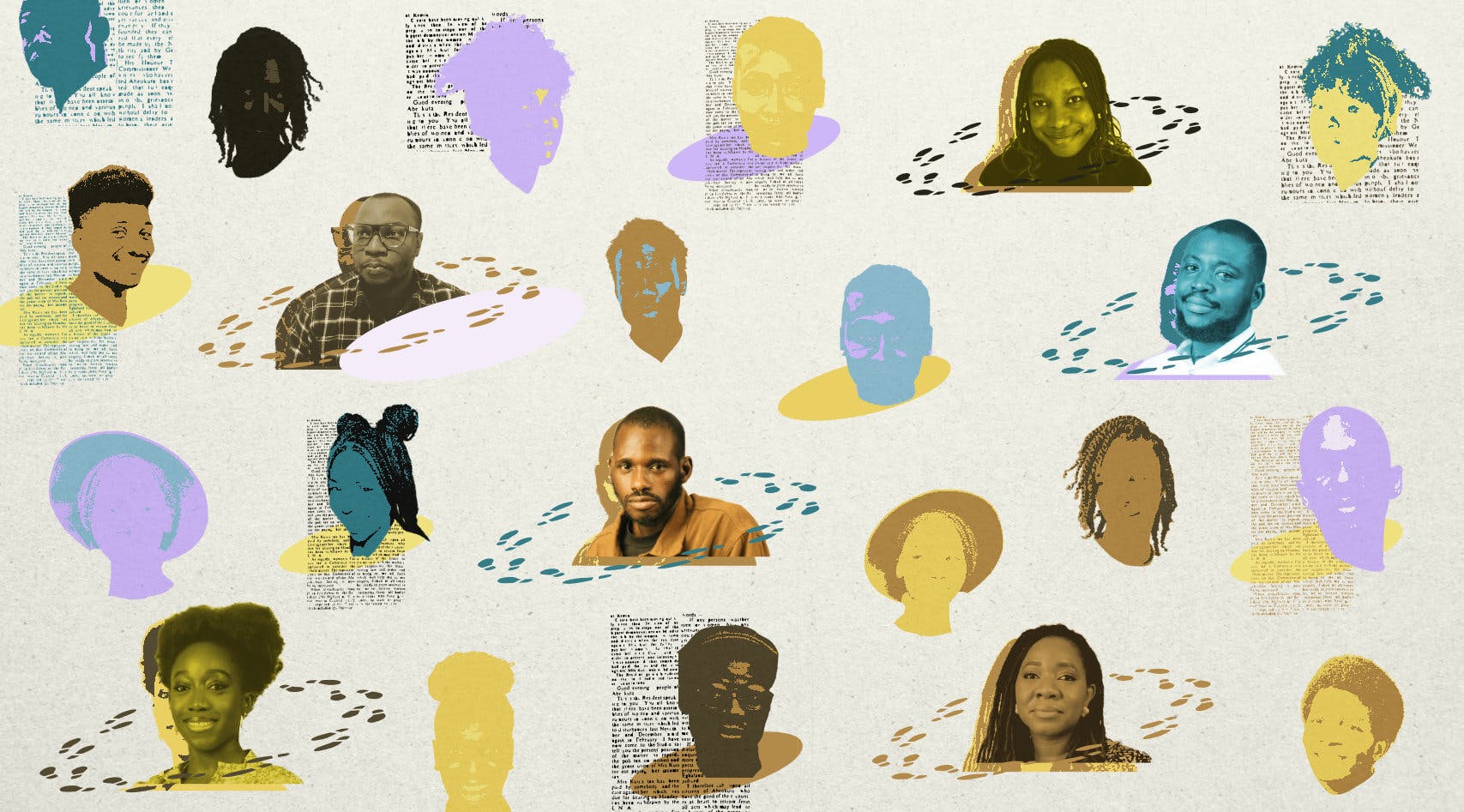
How We Selected 6 Fellows from 1,290 Applications
For the second cohort of The Archivi.ng Fellowship, we asked for projects that fit the theme of The More Things Change, our two-year inquiry exploring patterns across Nigerian history.
1,290 people answered, with ideas full of curiosity and a desire to make sense of Nigeria’s past. We assembled a small team to read through every application, weigh ideas carefully, and make the final selections amongst hundreds of thoughtful submissions.
That small team—Fu’ad, Ruka and Samson (that’s me)—talked through how we approached the process, what caught our attention, and how we selected the final six fellows.
Samson: A good place to start: what are the most important lessons we learnt from the first cohort?
Fu’ad: The first thing was that Nigerians have all kinds of curiosities and not enough outlets to explore them. We also had some gut instinct concerns at the selection stage—largely because it was our first cohort—and most of the concerns came to life. For example, we learnt that projects that hadn't already started—whether in the maturity of the thinking or closeness to execution—were harder to finish.
Samson: And that kind of insight is useful for how you run the next thing.
Fu’ad: Yes. Another thing, most of our selections for the first cohort were storytelling-led. But we realised that people want to build tools and do research. So, for the second cohort, we organised our final selections into three tracks: research, storytelling, and technology. Each track has two fellows.
Samson: Another thing that’s different this year is that Nigerians in the diaspora could also apply. And we got applications from interesting places. Canada, China, Germany, Ghana, Hungary, the Netherlands, Rwanda, Scotland, South Africa, South Korea, the United Kingdom, and the United States.
Ruka: Best in Geography.
...
Fu’ad: Diaspora applicants were not allowed for the first cohort because we still needed to do some learning. But at the end of the day, a big part of the people who make Archivi.ng the institution it is are also Nigerians outside Nigeria—in enthusiasm and curiosity. Even though we are tethered to Nigeria, Archivi.ng is about the Nigerian experience, home and abroad, so people in the diaspora could apply this time.
Samson: There’s also the monthly stipend going from ₦500k to ₦1 million.
Fu’ad: And that’s especially because we want the projects to be a little more ambitious. We also realised that the fellowship requires very focused support, so we brought in Ruka as a programme manager to make the execution of the projects and everything else more effective.
Ruka: Let me just say the first thing that struck me about the second cohort applications was the variety of ideas that people had. There was a richness to just what was possible with the applications we received. And then the rigour of the research track applications. Something else was how some applications used ChatGPT. We received a number of similar structured ideas that lacked depth or originality. I remember the word “echoes” showed up a lot.
Samson: And, of course, there were the extreme cases where the prompts were submitted with the output. I actually want Fu’ad to speak more clearly about the use of LLMs because it was a bit of an issue for the first cohort, too. But for clarity here, we’re not GPT-phobic, per se.
Fu’ad: What makes ideas unique is our own connection to them and how grounded they are in lived experiences. The thing that LLMs cannot do is give authentic lived experiences. They can manufacture one, yes. But if you try to manufacture a lived experience, it will come out over the course of the application, whether or not it’s authentic. So, I think that people need to use LLMs for research to find answers and strengthen their argument, but LLMs cannot provide the argument itself.
Ruka: I agree, and that’s instrumental to what makes a compelling application. We have a list of metrics that we run each application through. For example, how aligned is the application to the theme, how original, how rigorous is the thinking in the work? There’s also the question of how well it would resonate with an audience. It’s important to us that the projects we pick are practical in the sense that they would lead to real-life usage or have a connecting factor for either a dedicated audience or a general audience. We also considered whether a project can be accomplished in six months, or if we even believe we have the resources to fund it.
Samson: And that’s how we cut down 1,290 applications to an initial longlist of 48, and then a shortlist of 20 people that we interviewed. For those interviews, Fu’ad, what would you say was the single most important factor for the people we selected?
Become an ARCHIVI.NG member and get updates straight to your inbox
Fu’ad: I think all the 20 people we spoke to were pretty strong. Ruka has already outlined the metrics. But one other thing was that we were more drawn to people who came prepared, like people who presented stuff. We didn’t ask, and it wasn’t necessarily the most critical factor, but it showed they were not winging their ideas.
Samson: Why I’m particular about clarifying this part is that, for this cohort, there were some very strong reactions to our rejections. We got emails asking for reassessments and Twitter callouts about why applications were rejected. I imagine many more people, especially applicants for the next cohort, are curious about what makes an application stand out.
Fu’ad: Fundamentally, it’s alignment. How aligned is their work with The More Things Change? But also, do we have the resources to support the project?
Samson: Ruka, what are your expectations for the second cohort?
Ruka: We have six fellows who are quite good at what they do and are about to open a box of curiosities. Engaging with their projects will be pretty fun, and I'm looking forward to providing support where necessary till we converge at the August Event.
Samson: Either one of you can answer this. Why should anyone care about these projects coming out of The Archivi.ng Fellowship?
Fu’ad: They are very timely and just relevant to the zeitgeist. When you look at Festus’ project, it somehow tackles some of the biggest questions Nigerians are asking right now: “Why are so many people dying? Why are non-state actors killing people? And where did all of this come from?” With Mez’s project, election anxiety is going to get more and more intense over the next few months. When her project is done, we can see post-election court drama a little more clearly. The projects feel grounded in a way that contributes meaningfully to how people understand the present.
Samson: So, when people want to apply for the next cohort of the fellowship, what feels like the most useful tip?
Ruka: Pitch something you’re deeply curious about, in a way that it’s clear why it needs to exist.
Fu’ad: Start thinking about what you want to do right now, because thinking matures over time. Your curiosity will compound, so by the time you have to pitch, the thinking is very clear, and you understand it. As you gain more clarity, you have more conviction about your work.
Samson: Over the two cohorts, some of the applications had really good ideas, but very obvious gaps in the historical knowledge to ground them. So it means that historical research has not even happened at all, or not enough. And I think maybe one last thing you guys left out in the metrics bit is that for The Archivi.ng Fellowship, you have to be super specific about the question you want to tackle. Those are also very important boxes to check before you click submit.
The Archivi.ng Fellowship is proudly supported by Luminate.
Credits
Art Illustrator/Director: Owolawi Kehinde