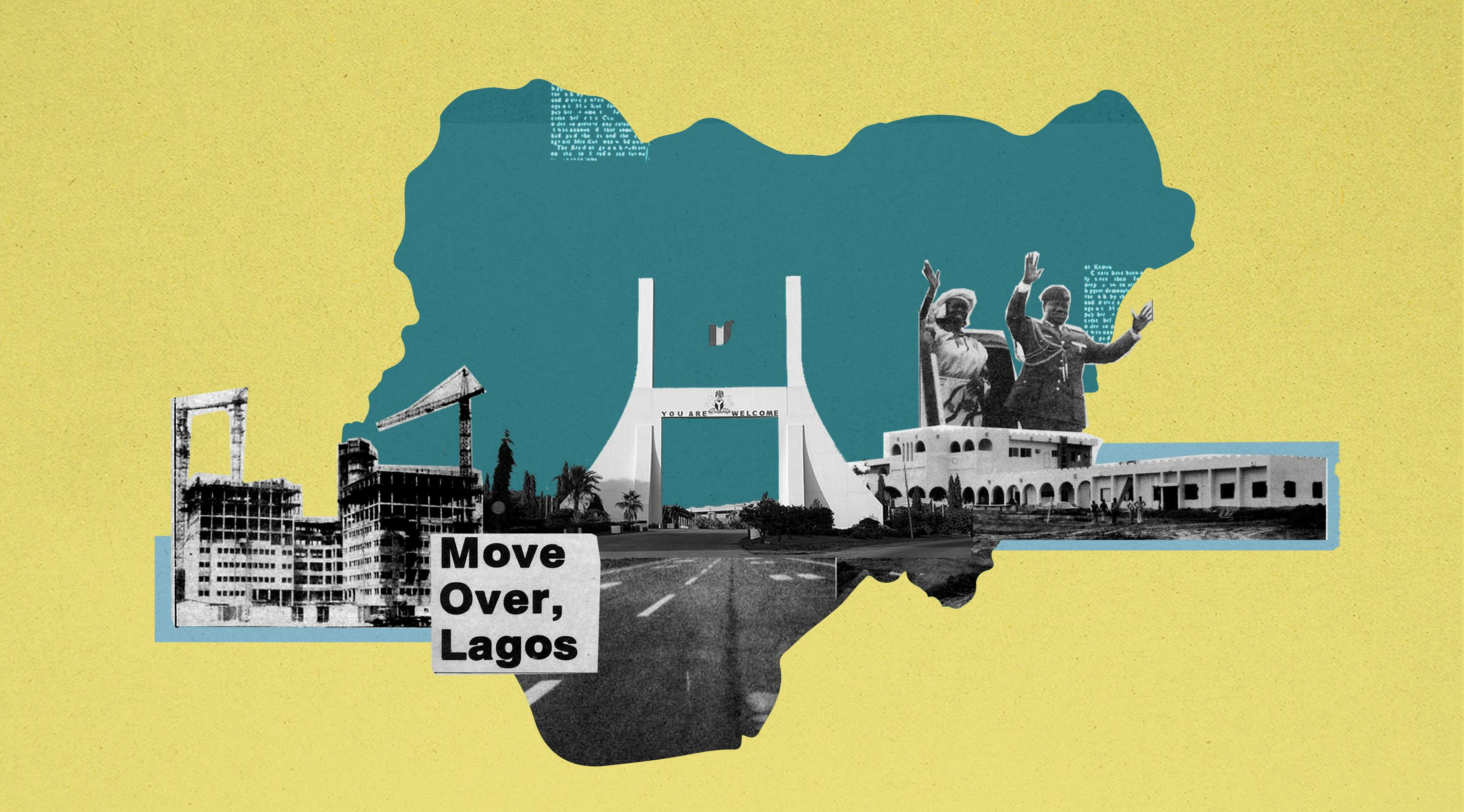
When Nigeria Moved From Lagos to Abuja
By the mid-1970s, Lagos—Nigeria's commercial and political nucleus—was a chaotic, crowded city struggling with congestion, insufficient infrastructure, and limited space for expansion.
In 1975, under General Murtala Muhammed, the Federal Military Government initiated plans to establish a new capital that would better serve the administrative needs of the growing federation. The move was intended not just as a geographic shift but as a structural reform aimed at national integration and more balanced regional development.
Abuja, selected for its central location and neutrality among Nigeria's major ethnic groups, was carved out of Niger, Kwara and Plateau to form the Federal Capital Territory (FCT), spanning approximately 7,315 sq. km, more than double the size of Lagos State.
The territory was largely undeveloped, offering a blank canvas for the creation of a planned city. The official relocation began in 1982, with Abuja envisioned as a modern, purpose-built capital capable of accommodating long-term population and administrative growth.
Become an ARCHIVI.NG member and get updates straight to your inbox
Why Abuja?
In a historic broadcast on February 4, 1976, General Muhammed formally announced the government’s decision to relocate Nigeria's capital to a new site. This moment followed the recommendations of a committee, chaired by Justice Akinola Aguda, which was tasked with evaluating Lagos' capacity to continue as the nation's capital. The committee concluded that while Lagos was commercially vital, it faced structural limitations, including traffic congestion, overpopulation, unsanitary conditions, flooding, security concerns stemming from its coastal location, and vulnerability to environmental risks.
The choice of Abuja, however, was not merely a reaction to Lagos' problems. Strategically located in central Nigeria, the area offered geographic neutrality in a country still healing from the civil war. Its position avoided privileging any major ethnic group, a key consideration in fostering national unity.
Symbolically and geographically, Abuja represented a fresh start, a neutral ground capable of housing a government that aimed to be closer to all regions. Economically, the decision coincided with Nigeria's oil boom of the 1970s, which provided the resources to create a planned city from scratch. Inspired by other capital relocations, such as Brasília in Brazil and Washington D.C. in the United States, Nigeria envisioned Abuja as a planned city with modern infrastructure and room for long-term growth.
To realise this vision, the government enlisted the services of International Planning Associates (IPA), a United States-based consortium, to develop the city's master plan. With designs in place and initial funding secured, Abuja's development began, but this did not happen without challenges, from relocating indigenous communities to managing the economic transition between the two major cities.
How Abuja came to life
The relocation of Nigeria's capital from Lagos to Abuja brought transformative economic changes to the new city.
One of the most visible economic effects was the unprecedented infrastructure boom. Abuja, originally a sparsely populated area, was essentially built from the ground up. The city’s master plan, developed by the IPA, provided a blueprint for phased urban growth and guided construction activities in public utilities, road networks, housing, and administrative buildings.
Major highways like the Kubwa and Airport Roads were constructed to improve mobility, while the Central Business District (CBD) took shape with government ministries and agencies being gradually relocated there.
This construction boom led to job creation and attracted a skilled labour force, from architects to artisans. Residential housing developments emerged in satellite towns like Gwarinpa, Kubwa, and Lugbe to accommodate the growing population. The demand for housing also spurred private real estate investments, further boosting the economy.
/Newswatch December 23_1991_Pg 1.jpeg)
The mad rush to the centre…
The shift of Federal Government institutions to Abuja created an immediate demand for supporting services: security, hospitality, banking, and logistics. This led to the migration of many private sector firms seeking proximity to government decision-makers. Banks, insurance companies, legal firms, and consultancies established regional headquarters in Abuja to maintain relevance in the new administrative landscape.
International organisations and diplomatic missions followed suit. The diplomatic quarter in Abuja soon housed embassies and foreign missions, reinforcing Abuja's status not just as a national capital but as an international diplomatic hub.
As Abuja grew into its role, it generated a variety of economic opportunities. New businesses emerged to meet the needs of a diverse, upwardly mobile population, ranging from retail outlets and markets to private schools and hospitals.
The hospitality industry, in particular, experienced significant growth, with the emergence of hotels, event centres, and restaurants catering to business travellers and officials.
However, this rapid development came with a rising cost of living. Abuja has consistently ranked among Nigeria's most expensive cities in terms of real estate, transportation, and consumer goods.
/Newswatch January 27_1992_Pg 21.jpeg)
What Lagos suffered…
The relocation of Nigeria's capital to Abuja had profound implications for the Lagos economy. While many feared that the city would decline in economic significance following the loss of its status as the political nerve centre, Lagos demonstrated remarkable resilience and retained its commercial dominance. In fact, the capital shift helped catalyse certain economic transformations within Lagos, though not without challenges.
Immediately after General Ibrahim Babangida moved the Presidency to Abuja on December 12, 1991, Lagos experienced a reduction in public sector activity. Thousands of civil servants, government agencies, and ministries gradually relocated to the new capital, and this created a temporary economic vacuum in sectors tied to administrative operations such as hospitality, real estate, and transportation. The outflow of government spending and bureaucratic presence also meant that less federal allocation was directly tied to the city, affecting municipal budgets and infrastructure planning.
One notable economic pressure Lagos faced in the post-capital relocation era was urban over-congestion. With less federal attention and investment following the move, Lagos' infrastructure development struggled to keep pace with population growth.
Real estate prices soared as the city grew organically with little central planning. The vacuum left by departing government personnel was quickly filled by migrants seeking economic opportunities, leading to increasing strain on housing, transportation, and public services. In many cases, the city expanded informally, resulting in a high cost of living and traffic congestion that became more notorious.
/Newswatch December 23_1991_Pg 28.jpeg)
What Lagos gained…
Despite these initial disruptions, Lagos' position as Nigeria's economic capital remained largely unshaken. Its well-established ports, industrial base, and status as the hub for banking, media, and international commerce ensured that private sector activity continued to flourish.
The city remained the preferred location for multinational headquarters, large-scale manufacturing, entertainment, and finance. In fact, by the 2000s, Lagos had emerged as the economic powerhouse of West Africa, contributing over 30% to Nigeria's GDP and handling more than 70% of the country's imports.
The relocation may have indirectly prompted Lagos to develop more robust mechanisms for economic self-reliance. Without the advantage of being the capital, Lagos began to pursue internal revenue generation more aggressively, leading to reforms in tax collection and service delivery.
The challenge of Abuja
/The Nigerian Economist February 18_1991_Pg 09.jpeg)
Like many grand undertakings, Abuja's creation was not without serious challenges and enduring controversies. Central among them was the question of land and identity. Though envisioned as a neutral "no man's land," Abuja was already home to nine recognised indigenous ethnic groups when it was designated the new capital in 1976.
The government's promise to relocate affected communities was only partially fulfilled. Today, persistent protests and agitations for recognition and privileges based on indigeneity undermine the vision of ethnic neutrality and unity that Abuja was meant to symbolise.
Economically, the relocation introduced a costly dual-capital dynamic. While Abuja became the political capital, Lagos remained the country's commercial hub. The result was a fragmented administrative landscape in which ministries, agencies, and corporations often had to operate across two cities, inflating costs and complicating logistics.
Despite over $100 billion invested in the Federal Capital Territory, the move did little to address deep-seated inequalities between Nigeria's north and south, inherited in part from colonial policies like "divide and rule," which unevenly distributed education and infrastructure.
Allegations of corruption further marred the project. From its earliest stages, Abuja became a lucrative site for inflated contracts, kickbacks, and opaque dealings. As former Chief of Army Staff, General T.Y. Danjuma, observed, "There was a rich unbroken line of opportunities for corruption that stretched from wartime army contracts… to the Abuja contracts." These practices became embedded in the capital's governance and real estate culture, fuelling an economy often driven more by speculation than planning.
This has left a lasting mark. Abuja's infrastructure remains uneven. While the city centre boasts gleaming boulevards and imposing government buildings, many surrounding districts tell a different story. Projects like the Abuja Light Rail, the INEX Bridge, and major road expansions remain incomplete or abandoned. Satellite towns such as Gosa and parts of Abuja North West suffer from inconsistent power supply, poor road networks, and underdeveloped services.
Despite its lofty beginnings, Abuja continues to grapple with the contradictions of its founding—caught between vision and reality, ambition and execution.
Nigeria's moon landing
Over the past half-century, many nations have talked up a big game about building ultramodern new cities, but only a few have successfully pulled it off. Despite its shortcomings, Abuja remains one of Nigeria's greatest success stories.
From the ground up, the project became a bustling metropolis of over four million people, attracting businesses, diplomats and tourists. Its central location has made it a hub for international conferences and cultural events, and it is currently one of the best cities to live in Nigeria.
On the other hand, the rapid and unplanned growth has challenged its potential to become a "smart city." With population growth exceeding initial projections, a strain on housing and infrastructure has led to many informal settlements on the city's outskirts. Areas like Nyanya, Sauka and Kauru still struggle to meet the basic needs of urban life, as growth often bypasses the intended planning, leading to environmental challenges and a lack of cohesive development, but the potential is clear as day.
In the words of the former FCT Minister, Nasir el-Rufai, "Abuja has not developed as expected, but it has been far more successful than expected."
Credits
Editor: Samson Toromade
Cover Design: Adeoluwa Henshaw